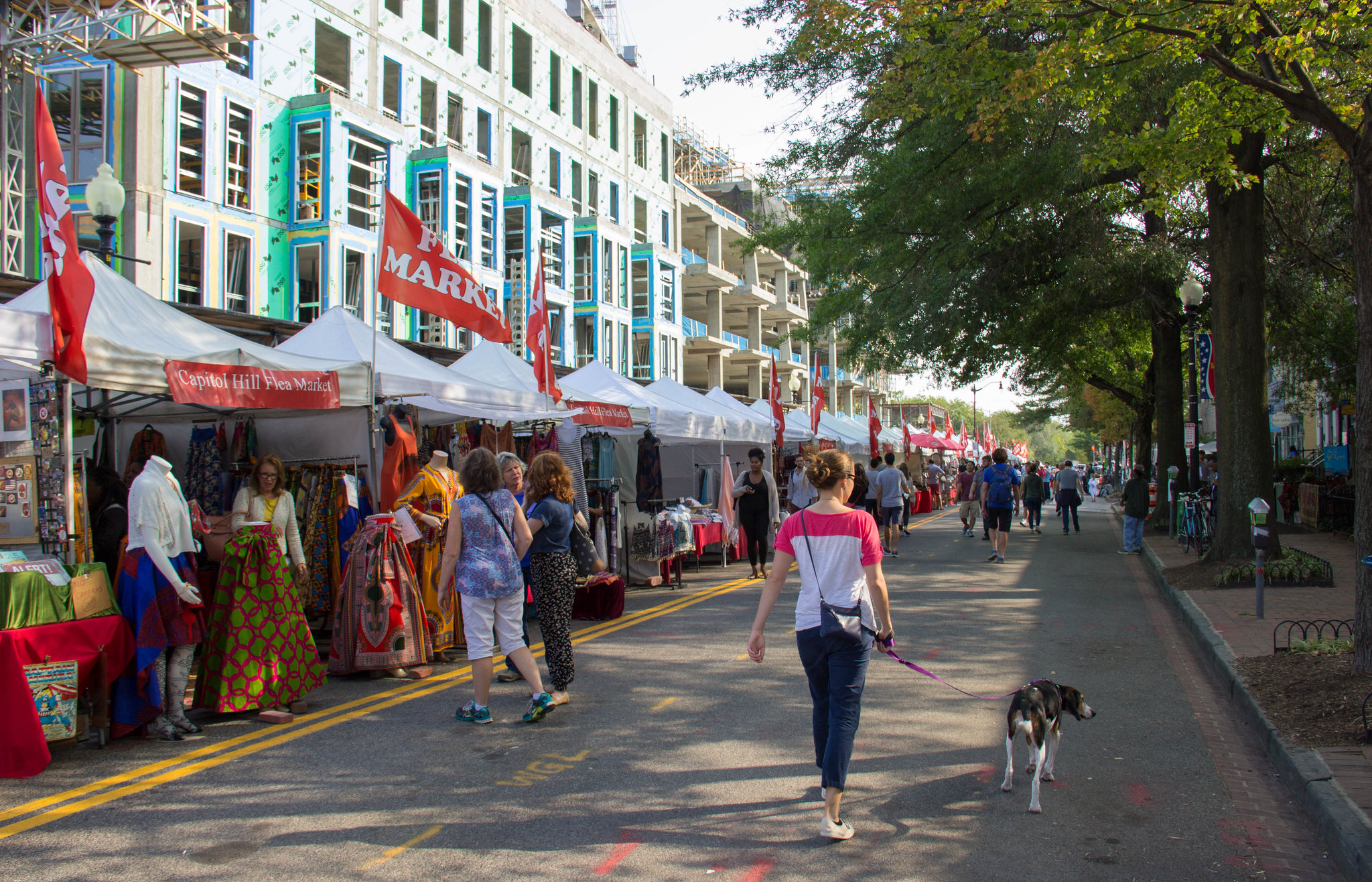
Until recently, weekend visitors to Eastern Market would have encountered Leda Black among the lively assembly of vendors. Black’s setup, the Female Power Project, offered prints, scarves, and other products designed to spark conversation about influential women—and her interactions with shoppers are what Black says elevates it to a type of performative installation.
“A friend has described my ‘role’ as a cross between high priestess and therapist,” Black says. “Many people have a highly emotional encounter with my work when they enter my installations.”
Then the pandemic hit. D.C. Mayor Muriel Bowser’s decision on March 24 to ban gatherings of more than 10 people transformed public spaces like Eastern Market overnight. Now, Black is one of the many artists, makers, and entrepreneurs who must adapt in real time.
While independent artists and makers may not rent permanent retail spaces, they still face overhead costs and financial strain. Like other self-employed workers, many makers lack affordable healthcare or paid time off. And all now face the steep challenge of cultivating an online audience—not to mention staying healthy themselves. (Black is currently recovering from COVID-19, the disease caused by the novel coronavirus.)
Collectively, artistic and cultural work forms 8.4 percent of D.C.’s total economy, according to a 2018 report from the D.C. Commission on the Arts and Humanities. Without a clear timeline for when in-person retail might return in the region—including the festivals, art fairs, and other events that local independent makers rely on to sell their goods—it’s equally unclear when this sector of the economy might begin to recover.
On April 3, D.C.’s annual Art Book Fair became one of the first local festivals to cancel an event scheduled for the summer. (Plans are in the works to hold the Art Book Fair in March 2021.) Art Book Fair co-founder Malaka Gharib says she briefly considered creating a virtual event, but ultimately decided it would fall short of the fair’s signature serendipity: the opportunity to simultaneously encounter interesting people and beautiful artwork.
“You kind of just need to be face-to-face with the artists,” she says. “Part of the fun of going to the Art Book Fair is discovery—walking around, picking up pieces, feeling it in your hand. It’s a scene.”
Other summer event organizers are surely considering their plans, but few have made formal decisions. The Columbia Pike Blues Festival is scheduled for June, but its website doesn’t mention COVID-19, nor does the website for the 17th Street Festival, which has a ticker counting down to the scheduled date in August.
Even fall events aren’t in the clear: They may coincide with a predicted resurgence of the novel coronavirus. Adams Morgan Day is scheduled for September, but organizers are planning for “multiple possible contingencies” and “are extremely concerned about both the short- and long-term impacts of the coronavirus on our community,” per its website. The Takoma Park Street Festival, which takes place each October, is accepting applications but “will not be making any decisions until summer on [the festival’s] status,” its website says.
For artists and makers, each cancellation represents substantial financial losses. “This was my lifeline,” Black says, describing the impact on her projected revenue for the year. She relies on seasonal pop-ups and festivals, as well as spaces like Eastern Market, for an estimated 95 percent of her income.
Pop-up retail spaces that help artists and makers connect with customers are also suffering. Since its founding in 2016, Femme Fatale DC has hosted than 250 women and nonbinary entrepreneurs in five pop-up retail spaces, including its current location in Mount Vernon Triangle. Products have included jewelry, candles, artwork, and more.
Femme Fatale DC operates as a collective, allowing artists and makers to rent a portion of a retail space, display inventory, and retain 100 percent of the sales revenue.
“An artist who sells directly can charge less,” says Black, who is also a Femme Fatale DC vendor. Not only do festivals and pop-ups such as Femme Fatale DC allow makers to achieve a higher profit margin, but lower prices can drive a higher volume of sales. Black says she’d need to mark products up by 40 to 50 percent to earn the same profit through a traditional retailer.
For now, though, Femme Fatale DC’s doors are closed. Prior to the pandemic, Femme Fatale DC had extended its lease from March through the end of May. Adriana Mendoza, the collective’s chief operations officer and creative director, says she intends to invite current vendors to continue selling with Femme Fatale DC for two months, whenever they’re able to reopen to the public.
In the meantime, Femme Fatale DC’s team is arranging appointments for individual vendors who need to pick up inventory on a case-by-case basis. They’re only allowing one person in the space at a time, and providing gloves and hand sanitizer.
With in-person retail at a standstill, many small business owners are forced to rely on e-commerce websites and social media to drive sales. But even as Zoom happy hours and classes proliferate, going virtual isn’t as easy as it might seem. Mendoza points out that makers’ in-person charisma doesn’t always translate for a virtual audience. “Not everybody’s meant to be on something that’s live,” she says.
When quarantined customers shop online, most begin by searching on Amazon or Google—platforms that are already saturated with brands clamoring for their attention. A festival might introduce makers to hundreds of new customers in a single day, but cracking social media and search algorithms requires patience and expertise. Smith worries that this will hurt independent, local makers the most. “In an already uneven playing field, how are we ensuring that things are equal, and equally accessible?” she asks.
Gharib shares the same concerns. Under normal circumstances, the Art Book Fair’s luxurious venue—the National Museum of Women in the Arts—attracts visitors all on its own. A social media-based event would rely on participants’ existing followings. “There’s nothing the Art Book Fair would be coordinating, other than a hashtag and a moment,” Gharib says. “Otherwise, people would have to put in their own work to hustle their own product.”
This leaves makers to rely on past customers who are already fond of their products—many of whom may be limiting their spending due to record-breaking unemployment. For those who didn’t have an active online presence prior to the pandemic, like Christyna Falden, the transition can be challenging.
Falden and her aunt began making their own bath bombs two years ago. Their collaboration grew into Soak and Relax, a self care-focused business offering bath products and paint-and-sip events. Falden says she was focused on keeping up with an active circuit of pop-up events around the region when the pandemic struck.
“[E-commerce] wasn’t really a focus, because we were doing so well without a website,” Falden says. Now, furloughed from her full-time job in hospitality, she’s wondering how to keep pushing her business forward from home.
As Falden works on her website, she’s realizing that her product strategy will need to shift, too. Currently, Soak and Relax specializes in handmade, small-batch bath products. “Our products change all the time,” Falden explains. But if the same products aren’t always available, it might be tougher to build brand loyalty. “I can’t really do that if I want a good website people are going to come back to,” she says.
Along with a website, Falden says she’s exploring virtual events. Prior to the pandemic, Soak and Relax had a slate of paint-and-sip parties planned. Falden had already purchased the necessary materials, so she might offer kits for virtual painting events to recover some of the up-front investment. “You don’t want to let this time of despair distract you,” Falden says. “You could be so frustrated with what’s going on with your regular life—your bills are still happening, you’re out of work, unemployment’s taking forever. It’s one thing after another. Can we just get some positivity back?”
Some makers believe collaboration is the most promising path forward for makers who must now sell their work online.
Long before the pandemic struck, Joel Traylor was thinking about ways to overcome outdoor retail spaces’ inherent unpredictability. Throughout two decades of selling artwork at Eastern Market, Traylor says he has regularly faced challenging weather conditions. “Our stores and merchandise can literally blow away,” he says. “When the weather is bad, we have a difficult decision to make: Go and risk making no money, risk losing merchandise and nine hours of our time—or stay home and wonder what if.”
In 2017, Traylor bought the domain EasternMarketArtists.com. “My intention was to help fellow Eastern Market vendors balance the bad weather days by having an online presence,” Traylor says, noting that some merchants don’t have a website of their own. The project lapsed several times until the pandemic prompted Traylor to focus on making it a reality. He’s creating profile pages for each Eastern Market vendor, then inviting vendors to upload their products to a virtual shop—without charging them any fees.
“I was a bit worried that people might be annoyed that I made a profile page without their consent,” Traylor says. But so far, the response has been “overwhelmingly enthusiastic,” with 11 makers uploading their products. Traylor estimates that the site brought in between $100 and $200 in sales for artists total during the first two weeks, while the site was still under construction. Even vendors who already have an Etsy profile or e-commerce website welcome the opportunity for a boost in traffic and SEO. “Some vendors have been very generous, sending donations to help with hosting and site maintenance expenses,” Traylor says, though he had planned to cover those costs himself. “All unprompted, unasked for.”
Makers who have an established web presence can still face pandemic-related challenges, as Taelor Salmon has learned. Salmon runs Cadence Candle Co, a candle company inspired by her favorite music. Her e-commerce website is sleek and polished, with links to original playlists and the ability to order custom gift sets.
But Salmon’s e-commerce presence was still no match for COVID-related manufacturing delays. She was preparing to launch a new line of candles in April as part of a larger rebrand, but the Boston-based manufacturer she hired has been unable to fulfill her order. “The manufacturing is not done, the vessels can’t be printed, the candles can’t be poured,” Salmon says.
While Salmon says she’s glad she can continue to fulfill online orders, she’s encountering delays when restocking shipping materials, labels, and other necessary supplies. Until manufacturing can resume, she will continue to carry on the labor-intensive production cycle she hoped to move past. It feels like a frustrating step in the wrong direction, “kind of like going back to the beginning, when I first started,” Salmon says.
Some makers, like Ebony Brown, are adapting by offering products tailored to the moment. Brown runs Mz Eclectic, a pop-up boutique that showcases her passion for upcycled textiles, traditional cultural clothing, thrifting, and design. Until recently, in-person retail provided an opportunity for sharing the history behind her apparel.
“I had the opportunity to tell them: ‘Oh, that’s a vintage sari from India that I sewed on the back of a jacket.’ Or, ‘The beads come from a local thrift store,’” Brown says. “If it’s a cultural piece, I got to explain the history of why a group of people use that specific fabric, or what the pattern on the fabric means.”
Initially, Brown hoped to continue focusing on her original clothing designs during quarantine. But as friends, family, and customers struggled to find masks, they began to ask if she could help. “I’ve had to move away from producing my own product to just making these masks and selling them,” Brown says. “There’s a demand for them, and that’s what’s selling right now.”
True to her brand, Brown has continued upcycling scraps from past products, stitching masks with brilliant colors and bold patterns, though she has encountered delays in acquiring elastic for ear loops. But the new reality of life under quarantine leaves little room for the creativity she would normally pour into her work. In addition to fulfilling mask orders, Brown is also focused on caring for her daughter and providing for her family. Her husband’s work in event lighting and sound design is currently suspended, and without in-person retail events, she estimates that her income has dropped by around 70 percent. “There’s definitely a big difference,” she says.
In a March 13 statement, the DC Commission on the Arts and Humanities said its staff is “actively exploring the options that may be available in order to provide additional support and stability to the sector, if needed.”
But makers say funding has been elusive. In late March, Black learned of the DC Small Business Recovery Microgrants program, but she was too sick with COVID-19 to apply by the April 1 deadline. Though the mayor’s office recently announced an additional injection of $8 million, those funds are only available to the original pool of 7,000 applicants.
Falden’s bank received more requests than it could fulfill, she says and she is waiting for a possible second wave of funding to be announced. And Brown says her time is stretched so thin that even navigating the funding bureaucracy feels out of reach. “Just trying to make sure that there’s always something coming in does take my attention away from sitting down to apply for those things,” Brown says.
As the absence of in-person retail causes sales to plummet, many artists and makers say they will need more than their own creativity and resiliency to survive. “This is make or break for a lot of people,” Brown says.