Margaret Barthel
This story was updated at 3:56 p.m.
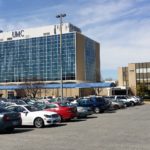
Daryl Blackeney has lived in the skilled nursing facility at United Medical Center for three years and seven months. That’s all about to change in the next week, as D.C.’s public hospital — and the only one east of the Anacostia River — prepares itself for a surge of coronavirus patients.
Part of that preparation involves transferring Blackeney and fellow residents living in the hospital’s 120-bed nursing facility to other nursing homes in the region.
Blackeney is 49 and has multiple sclerosis. He told DCist that he doesn’t know when he’ll be transferred, or where he’s going.
“I don’t think it’s fair,” Blackeney said.
United Medical Center spokeswoman Toya Carmichael explained in an email that “Residents and families are notified of their transfer location once it is identified. As the resident you spoke to is still here, he would not know where he is going because the location has not been selected yet.”
Seventy-five residents were living in the UMC skilled nursing facility at the beginning of this week. They’re expected to be transferred to facilities in the District and Maryland by May 15, according to the Legal Counsel for the Elderly’s Office of the D.C. Long-Term Care Ombudsman, which advocates for residents in long-term care settings in the District. The office was created in 1975 and is an affiliate of AARP.
Albert Reed, an ombudsman specialist at the office who has been monitoring the transfer process, said his initial reaction to the decision was shock and concern.
“They’re not numbers. They’re not beds,” Reed told DCist. “These [residents] are family to us, and that’s why we take it very seriously when we get a call and say that they’re going to be moved.”
Reed said he understands Blackeney’s frustration over not knowing where he’ll be moved, or when. But he’s been in touch with facility administrators at United Medical Center daily, and he said there’s no way around the waiting.
“UMC put out referrals to other nursing home facilities asking if they can take some of the UMC residents, and they are waiting for responses from those facilities. They cannot make final transfer plans until they hear back,” he explained.
That means a great deal of anxiety and uncertainty for residents still living at United Medical, Reed said.
“We’re talking about closing somebody’s house, packing them up and taking them to a new house,” he said. “That’s what this is.”
Blackeney worries he’ll end up in a facility in Maryland, where he knows the nursing homes have been hard-hit by the coronavirus; UMC’s skilled nursing facility currently has eight cases.
He said he’s afraid residents will “go out there and we [get] it, and we pass away.”
Carmichael acknowledged that the coronavirus is a concern in nursing homes generally.
“The UMC [skilled nursing facility] team is working hard to ensure that residents are transferred to a facility with a decreased risk of infection,” she wrote in an email.
Carmichael said UMC’s skilled nursing residents would be tested for COVID-19 before they’re moved.
It’s not clear when — or if — residents will be able to eventually move back to UMC. In part, that’s because the length and intensity of the coronavirus outbreak in the region also isn’t clear.
The District is also planning on closing down United Medical Center in the next several years. Last month, D.C. Mayor Muriel Bowser announced plans to replace UMC with a new hospital at the St. Elizabeths campus, two new urgent care centers in Wards 7 and 8, and an expanded Howard University hospital.
Mark Miller, the director at the Office of the Long-Term Care Ombudsman, worries about what might happen to UMC nursing home residents in the long term, in light of the eventual plans to close the facility.
“Here’s my concern: because the city wants to close that building, they are using the coronavirus crisis to move all the nursing residents out, potentially to Maryland facilities, and that they will not be offered any opportunity to return after the pandemic is over,” Miller said. “This allows [the District] to avoid the problem of relocating people when they build the new hospital.”
DCist has asked DC Health to comment on whether or not residents will be able to return after the pandemic.
Blackeney is considering not taking the transfer he’s ultimately offered — and leaving the nursing home altogether.
“I’m thinking about just leaving in my chair,” said Blackeney, who uses a wheelchair. “I spoke to my aunt, and I told her I’m thinking about telling her to come and get my clothes the day that I get shipped out.”
This story was updated to clarify AARP’s connection to the Legal Counsel for the Elderly’s Office of the D.C. Long-Term Care Ombudsman.
For information on how seniors in D.C. can get assistance, call: the Legal Counsel for the Elderly Hotline at 202-434-2120, or the Office of the D.C. Long-Term Care Ombudsman Hotline at 202-434-2190.