Elliot C. Williams
 Rachel Sadon
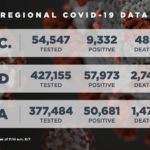
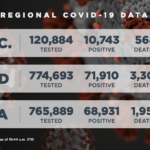
Even as Maryland and Virginia start moving toward a limited reopening this month, the two states and the District added 2,106 new COVID-19 cases on Saturday—among the biggest daily increases in the number of infections so far.
That brings the total number of confirmed cases to 60,832. The new caseload represents a 3.6% increase from Friday and a 31.5% increase from a week ago.
While state and city officials have pointed to federal guidelines recommending a 14-day decline in new cases before initiating reopening plans, the numbers in all three D.C.-area jurisdictions continue to bounce around—showing declines for no more than a handful of days at a time before ticking upward once again.
Most of the states that have begun reopening or are planning to in the coming days, have similarly failed to meet criteria set by the Trump administration, the New York Times reported this week.
Maryland Governor Larry Hogan said on Wednesday that declining hospitalizations and ICU patients could clear the way for a limited reopening within the next two weeks. Though no date has been set to begin implementing the state’s three-part plan to reopen, he did lift some restrictions on elective surgeries and some outdoor activities (Ocean City prominently reopened its boardwalk today, though few people showed up on a cold afternoon.)
But while the number of new cases dropped as low as 709 earlier in the week, Maryland reported 1,049 new COVID-19 cases on Saturday—the fourth day in a row where new cases exceeded 1,000. That brings the state’s total to 31,534 cases in all.
Maryland hasn’t seen new cases decline for more than three consecutive days before climbing once again, according to data tracked by journalist Alejandro Alvarez.
Across the state, Prince George’s County has the highest number of cases, followed by Montgomery and Baltimore counties. Prince George’s County Executive Angela Alsobrooks has said the county is not ready to reopen and would not follow suit next week if Hogan begins enacting phase one of the reopening plan.
Explaining his thinking in a Washington Post op-ed Friday, Hogan writes that the state doesn’t need to “choose between restarting the economy and protecting public health.”
“If we don’t get the virus under control, Americans will voluntarily disengage from the economy and we’ll destroy the recovery before it even gets off the ground,” Hogan writes. “At the same time, a permanent lockdown is not sustainable. Reopening must be safe, gradual and evidence-based, but it must happen as soon as possible.”
Still, some researchers say the region is not where it needs to be to reopen.
“We do not have enough testing,” Luisa Franzini, chair of the department of health policy and management at the University of Maryland School of Public Health, tells DCist. “And we can see that because a measure of if we have enough testing or not is the percent of tests which are positive. And in the last week or couple of weeks, it has stayed more or less constant … If we have more cases, it’s not because of more testing, it’s because we really have more cases.”
In Virginia, Governor Ralph Northam has said he plans to begin phase one of the state’s reopening plan on May 15.
“We are not opening the floodgates or flipping a light switch from closed to open,” Northam said at a press briefing on Friday. “We’re taking a dimmer switch and turning up the intensity, as we can and as the numbers allow.”
Like Maryland, the number of new cases in Virginia has not seen a decline for more than four days in a row before climbing back up again, according to Alvarez’s data collection.
The governor said that he is basing the decision on a decline in the percentage of tests that have come back positive since April 21. Even without a decrease in the total number of cases, the White House has said that a state could begin reopening if the share of positive tests was lower than two weeks prior—though the efficacy of that measure depends on maintaining robust levels of testing.
A Harvard Global Health Institute and NPR study shows that a minimum of 16,664 tests per day are needed to effectively monitor Virginia’s outbreak. As of May 6, the state averaged just 3,967 a day.
On Saturday, the commonwealth reported 854 new cases, marking 23,196 total confirmed and probable cases. That’s a 36.6% increase from a week ago.
When Northam made the announcement, the commonwealth had seen a steady climb in hospitalized patients with either confirmed or pending test results, reaching an all-time-high of 1,625 on Friday. As of Saturday, that number dropped to 1,593, according to the Virginia Hospital & Healthcare Association.
Fairfax County, the state’s most populous county, has been hit hardest, followed by Prince William. Those two counties, along with Loudoun, account for 40 percent of the state’s cases, local leaders pointed out in a letter this week to Northam seeking to be consulted on Virginia’s reopening plans.
Arlington officials have gone farther, saying that the county has not met the criteria to begin reopening on May 15 and they are working with the Northern Virginia Regional Commission “to determine the safest path forward, with an extended timeframe for entering Phase One.”
On Friday, Northam indicated he would give flexibility to jurisdictions in Northern Virginia.
“We realize that the Greater Washington area is an area that we need to pay particular attention to. We’ve also been talking to local leaders in places like Alexandria, Arlington and Fairfax County,” he said. “As we get closer if they have concerns and want to raise that floor for another week or whatever they think is necessary, we’ll work with them on that.”
Virginia announced Friday that it is set to receive $8 million in federal funds to expand testing, but medical societies and physicians are divided on just how ready the state is to reopen.
“There’s certainly more testing available than there was at the beginning of the epidemic,” Nancy Tanchel, an eye surgeon in Tysons Corner and the treasurer of the Medical Society of Northern Virginia, told DCist this week. “People have their masks and they’re willing to stand a few feet, six feet or more apart. And so I think we’re ready to let people get back to work.”
In contrast, Alexandria doctor Eran Greenberg says that “as a physician, I don’t see the kind of advancements either in the care of COVID-19 nor in knowledge of its infectivity and its prevention that would really allow businesses to reopen safely.”
Amira Roess, professor of global health and epidemiology at George Mason University, tells DCist that any reopening must happen slowly.
“Do not have everybody go back out at once because you don’t have the testing, you don’t have the infrastructure,” Roess says. “We don’t have any of that ready to deal with a surge in cases. We’re able to deal with what we’re seeing now. And if we do a careful, gradual entry into the economy, we can likely handle what will happen. But it has to be a gradual opening.”
So far, Roess says, the commonwealth’s plans meet that definition because phase one of the reopening allows only some non-essential businesses to open at half capacity.
Meanwhile, officials in the District have taken a very different tack, pledging to keep restrictions in place until a number of conditions are met.
“What we see in all the jurisdictions—D.C., Maryland and Virginia—are growing case counts and continued community transmission. So we know that opening up and people mixing in various ways will lead to increased infections,” Mayor Muriel Bowser said this week.
The city’s emergency order is currently slated to expire on May 15, but officials have indicated that it will be extended; in the most optimistic scenario, the District would begin reopening at the end of May, but it could be delayed as late as July.
On Saturday, D.C. reported 203 new positive cases, a 27% increase from last week, bringing the total to 6,102 cases. The District also reported seven more deaths, bringing the total to 311. This comes after a day when the city marked 19 deaths, tying April 30 for the most fatalities in a single day.
While D.C. has lower total numbers than Maryland and Virginia, the proportion of both cases and deaths is higher as a share of the population.
And within the city, black Washingtonians continue to make up a disproportionate percentage of deaths, at 79%. The District also began releasing neighborhood-specific data last week, reporting the highest case counts in Columbia Heights and 16th Street Heights.
Even as Virginia, Maryland, and much of the rest of the country weighs reopening, cases “haven’t gone down significantly anywhere except, maybe, New York City,” epidemiologist Tara Smith told Vox. “People keep talking about the second wave and we’re not through the first wave.”