 Jordan Pascale
This story was updated at 12 p.m. on May 11.
As states start to reopen their economies, Metro has crafted its plan to slowly ramp service back up — but don’t expect pre-pandemic levels of service until sometime in early 2021.
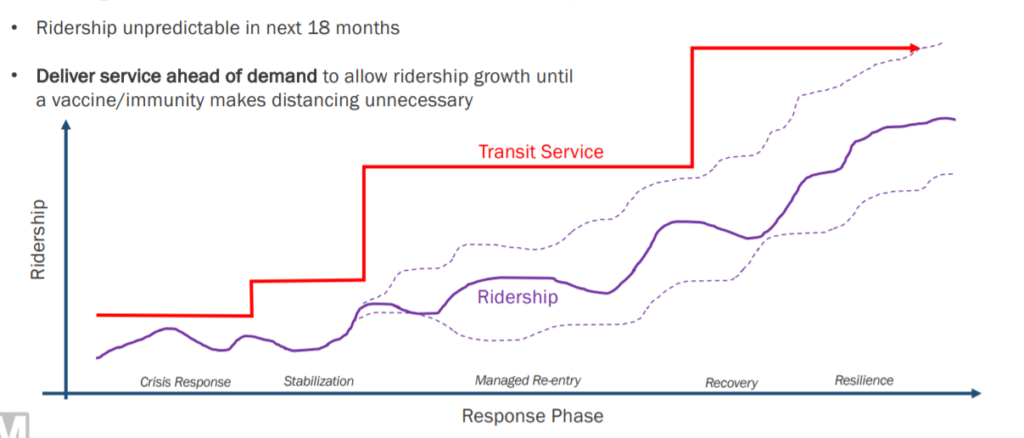
General Manager Paul Wiedefeld said the plan aims to keep riders and employees safe while running enough service to maintain social distancing and earn the public’s trust that the system is clean and safe.
The plan increases service in three phases while staying ahead of rider demand until a vaccine is available. But reduced service hours will remain, likely for the rest of the year. Metro is also asking businesses and the federal government to have flexible schedules and telework to spread out demand.
Response phase.
But the system will also be stymied by the previously-announced closing of a big section of Orange and Silver Line for work and a series of just-announced mini-shutdowns that will close a big chunk of the Yellow Line north of National Airport.
The transit agency leadership is briefing the board this Thursday about the reopening plans.
“Metro cannot do this alone,” Wiedefeld told WAMU. “We need the support of the entire region, particularly from the workforce perspective, as we start to come out of this.”
Three Phases To Return To Normal
Metro had drastically reduced service as stay-at-home orders were issued, shuttering bus lines and rail stations and reducing train frequency to every 30 minutes. The moves also helped protect its workforce. Metro has 81 employees who have tested positive, but no deaths.
Ramping back up will take time — about two months — to develop new schedules, get the equipment ready, assign workers, and give everyone a heads up about the service changes, Metro says. Metro has not said how the plan will affect its budget, but the system did get $877 million in federal funding from the CARES Act.
Wiedefeld said many of the dates are a moving target — an educated guess at this point in time.
“While ridership demand is difficult to predict for the next 12-18 months, our goal is to increase service in stages — ahead of demand — to maintain social distancing for customers to the extent possible,” Metro officials wrote in a brief to the board.
Social distancing will also present space challenges: six feet of space between riders will reduce the capacity of railcars from about 100 people per car to about 20-25 people. On buses, only 10 people should ride at a time, down from about 40 people maximum.
But it’s unclear if Metro will be able to maintain that level of social distancing. During the pandemic, the busy 90, 70, and X2 buses have at times been crowded to the point where social distancing is impossible. Metro has told its operators to skip stops if the bus is full.
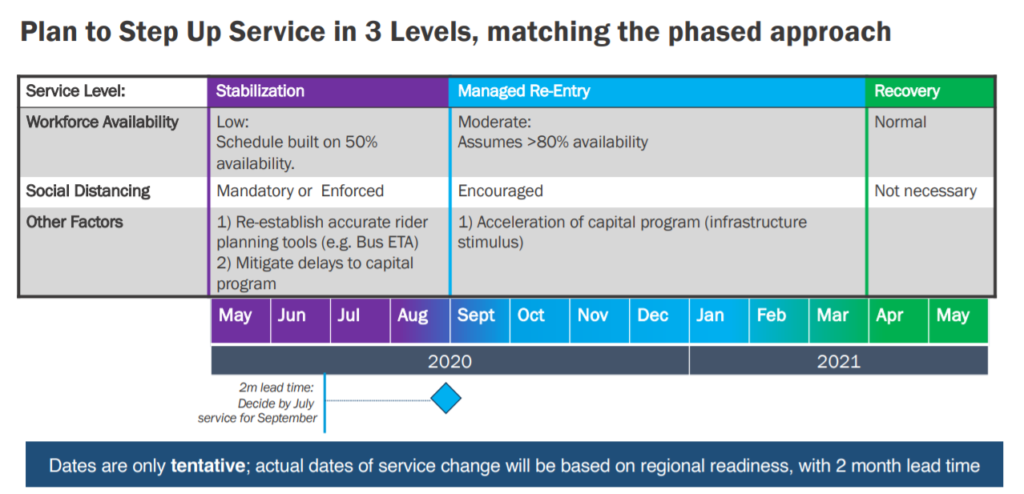
Service increase plan.
The plan rolls out in three phases:
1. Stabilization
- Estimated start in late-May.
- Scenario: Non-essential work travel resumes on a limited basis. Restaurants, bars, and evening activities are likely to remain restricted, and large social gatherings and events are prohibited. Schools and childcare facilities will remain closed. Social distancing is mandatory.
- Service: Slightly higher levels of services with capacity for 40,000 riders on rail, 85,000 on bus.
- Trains: 8-car trains come every 20-minutes on all lines. Red Line trains every 15 minutes.
- Hours remain 5 a.m. to 9 p.m. weekdays and 8 a.m. to 9 p.m. on weekends.
- When safe, reopen first and eighth cars of trains to increase capacity
- Re-open select stations that have been closed due to low ridership.
- Buses: operate Sunday-like headways on Sunday-only routes, running 5 a.m. to 11 p.m. daily.
- Rear boarding and free fares remain. The first 10 seats of every Metrobus will continue to be sectioned off to protect operators
2. Managed Re-entry
- Estimated start around August
- Scenario: Relaxed stay-at-home policies. Businesses, schools and childcare are open. More people are expected to commute to work or travel for other needs. Large-scale telework and persistent unemployment are expected in this phase, and discretionary activities including dining out and entertainment remain limited. Social distancing is still recommended.
- Service: Restore full connectivity, with a reduced level of service for 200,000 Metrorail trips and 110,000 on Metrobus daily:
- Trains: every 10 minutes.
- Hours remain 5 a.m. to 9 p.m. weekdays and 8 a.m. to 9 p.m. on weekends.
- Asking regional employers to stagger work times to increase daily capacity.
- Bus: Return to all local routes with reduced frequency. No peak service. Expand hours to 5 a.m. to midnight daily.
- Rear boarding and free fares remain.
3. Recovery
- Estimated start in March 2021.
- Scenario: The return of pre-pandemic levels of community activities including travel. Timing remains unclear and depends on easy access to testing, a widely-available vaccine and herd immunity. All services may reopen with limited constraints on retail and restaurants, gatherings, and events. Many, but not all, workers eligible to work from home during the pandemic will resume commuting. Tourism may still be depressed. Social distancing is no longer necessary.
- Service: A return to normalcy with room for pre-pandemic levels.
- Trains: Increase service to pre-pandemic levels.
- Hours extended to midnight.
- Buses: Return to full weekday service with all routes operating at pre-pandemic operating hours.
- Resume front-door boarding and end free fares. Metro is evaluating whether to accelerate the installation of SmarTrip machines on rear doors to enable a smooth transition to all-door boarding at this time.
As Life Returns To Normal, What Will Riders Do?
Metro had 982,000 trips per weekday in February, pre-pandemic. While nearly 168,000 trips are currently still happening on bus and rail, many remain working from home and wonder when they will return to work and ride Metro. Many might not return until a vaccine is in place.
“(Riders) perceive riding Metro to be a higher risk than going to the grocery store because of the limited space for social distancing, but appreciate having the service available when it is needed for essential trips,” Metro said in the brief.
WMATA conducted a rider survey and focus groups in April and May.
Metro says gaining public confidence is their main goal — only then will ridership return, Wiedefeld said.
“It’s a very large challenge,” Wiedefeld said, noting the airline industry, movie theaters and others are going through the same thing. “Part of it will be making sure that we are showing the public that the facilities are being kept clean… Then, over time, I believe… people will start to come back.”
Cleanliness remains a top concern, according to the Metro survey. Riders want to see frequent, visible cleaning, and disinfection. Metro is traditionally a cleaner system than say, New York’s MTA subway, but photos of trash and food on trains and buses are regular fodder on social media.
“They physically want to see us clean, which obviously is different than how we historically do it,” Wiedefeld said of the rider feedback. “How you do that safely for both our employees that are doing the cleaning and also the customers that may be around.
“We also have to understand any unforeseen ramifications of any of the cleaning materials and or fluids we may use on some of the equipment we have. So it’s a very, very complex equation. But clearly, we have to do it.”
Riders also want all passengers to be wearing face masks, which Metro says most are doing now. Metro so far has not required masks, but Wiedefeld said they will be required. He did not give an effective date for that order.
However, instances like Cinco De Mayo and the Blue Angels flyover showed that people will continue to flock restaurants and the National Mall while self-policing takes a backseat.
Metro is looking at designating areas to stand and sit to help maintain distance. But Wiedefeld knows they can’t enforce it on every train and bus.
“We will need everyone to engage in social distancing just as we are today,” Wiedefeld said. “We all need to use our own common sense and protect ourselves and protect others.”
Metro Will Have A Series Of Track Work Shutdowns This Summer
Metro also announced a series of “mini-surge” shutdowns to keep up on maintenance.
“Stations will be closed to enable work to be completed more efficiently,” Metro said in its plans. “This enables us to leverage lower ridership and reduced customer impacts while advancing the radio project, as well as several state-of-good-repair projects for the tracks and replacement of the standpipes (part of the tunnel fire suppression system).”
This includes:
June 7-13:
- L’Enfant Plaza to Pentagon work zone
- No stations closed
- No Yellow Line service north of National Airport
June 14-20:
- L’Enfant Plaza to Anacostia/Pentagon work zone
- Closed stations: Navy Yard and Waterfront
- No Yellow Line service north of National Airport
June 21-27:
- L’Enfant Plaza to Shaw-Howard/Pentagon work zone
- Closed Stations: Archives, Gallery Place-Chinatown (Lower), and Mt. Vernon-Convention Center
- No Yellow Line service north of National Airport
June 28-July 12:
- U Street to Ft. Totten work zone
- Closed Stations: Columbia Heights and Georgia Ave.
Shuttles will be available. More closures will be announced in June for July.
This is in addition to the previously-announced Orange Line stations closures this summer and the shuttering of the entire Silver Line over the summer for work to connect it to the second phase of the project set to open next year. Wiedefeld said crews aim to get that work done by Labor Day, but it’s unclear if they will be able to meet that deadline with social distancing measures put in place on the job site.
This story originally appeared on WAMU.
This story was updated to clarify Metro’s mask policy.