 Jordan Pascale
WMATA officials are predicting a grim road ahead for the transit system thanks to the coronavirus pandemic, according to new budget documents released Tuesday.
Metro predicts pre-pandemic levels of ridership, about 994,000 trips per weekday, won’t return until at least summer 2021.
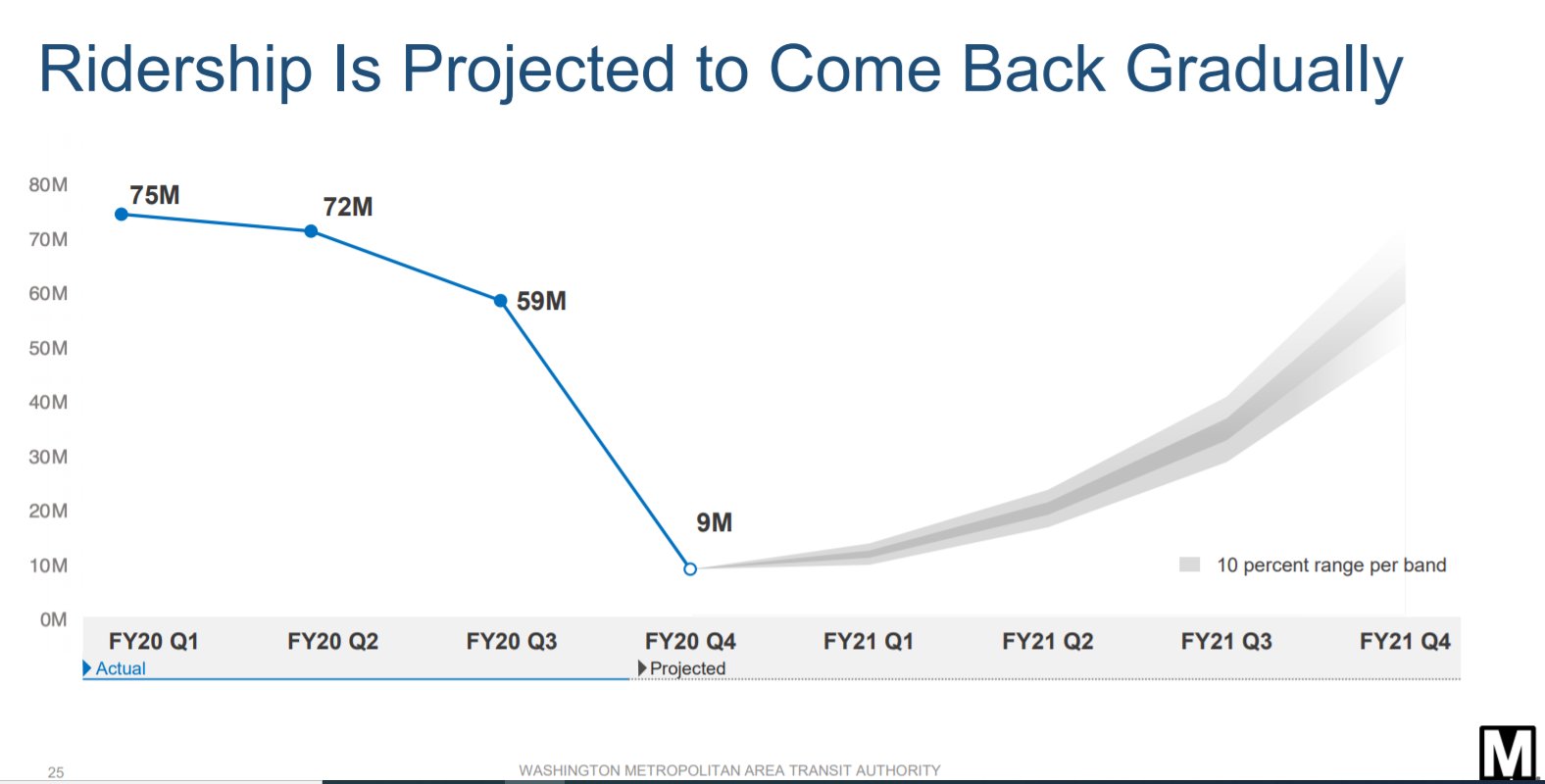
Metro’s ridership predictions. Metro’s fiscal year runs from July 2020 to June 2021.
Many workplace prognosticators say that telework could become the new norm and even Metro predicts that riders will have apprehensions about getting on a train or bus until a vaccine is developed.
That means the fare revenue spigot will be squeezed tight.
Metro predicts a nearly 60-percent drop in fare revenue—$421 million—in the next fiscal year. Fare revenue makes up a relatively small portion of Metro’s $2 billion budget—most of it comes from local government subsidy—still, any dip in revenue will be problematic.
Metro already is taking a $36 million hit by not allowing bus riders to enter at the front of buses, where the fare machines are, in order to protect operators. The authority is looking into installing fare machines at the rear doors.
WMATA also expects costs to increase by about $19 million for more supplies, like personal protective equipment, cleaning products and maintenance.
The authority will freeze open jobs and not fill vacancies, saving $20 million. No layoffs or furloughs are expected. An additional $25 million in savings will come from deferring the purchase of other supplies.
All of these changes are expected to save local jurisdictions about 10% on their annual subsidy to WMATA. In some cases, the savings add up to tens of millions of dollars. At the same time, local governments are expecting their own budget shortfalls as sales tax, gas tax and other revenues are down because of the pandemic.
It appears that localities will get about 10% of their annual subsidy to WMATA back because of all of these changes. pic.twitter.com/OKxlYd1TA6
— Jordan Pascale (@JWPascale) May 12, 2020
Some of the $767 million from the federal CARES Act will help bridge the budget gap.
“We are fortunate to have supporting jurisdictions and a congressional delegation that both understand and advocate for Metro’s role in the region’s mobility and economy, especially during a crisis,” Metro General Manager Paul Wiedefeld said in a statement. “Thanks to CARES relief funding, we have been able to keep people working and continue to move essential workers as safe as possible during an unprecedented crisis.”
Wiedefeld said the agency is grateful for congressional support, but will need more help. On Tuesday, New York’s MTA asked for $6 billion dollars in addition to the nearly $4 billion it already received.
Metro’s board will review the 2020 fiscal year budget update and revised 2021 fiscal year budget on Thursday.
Changing Gears
The transit authority also put its planned service changes—set to start in July—on hold for six months. Those included later Metrorail hours, more weekend service and changes to fares, including a $2 flat weekend fare and general fare increase.
Instead, Metro will adopt a drastically revised service plan that assumes pre-pandemic levels of service will not return until next spring. The overall idea is to have more trains and buses than demand for them in order to allow for socially distancing.
Those changes are expected to save the system another $20 million.
Critics say Metro’s plans are insufficient and they should return to full service well before next spring. Others have criticized WMATA for paying its operators to stay home while running significantly reduced service.
Metro also plans to create flexible transit passes that consider how commuting will change—accounting for fewer people going to the office every day and increased telework.
Ready To Take Advantage Of Stimulus
Metro’s $1.8 billion capital program is largely unaffected. Work on the Orange Line and Silver Line continues this summer. There is also a series of mini-surge work shutdowns planned throughout the summer.
But WMATA is positioning itself for potential infrastructure stimulus money that could come after the pandemic.
Metro says it has $22 billion in projects laid out over the next 10 years—about a third of that doesn’t have funding yet.
The transit authority says it’s ready to put people to work immediately with $1.3 billion of projects that could be awarded to a contractor within two months.
It has another $9.1 billion worth of long-term, large scale projects, “including high visibility projects of regional/national interest.” One potential project, the unfunded second Rosslyn tunnel to expand capacity under the Potomac River.
This story originally appeared on WAMU.