Martin Austermuhle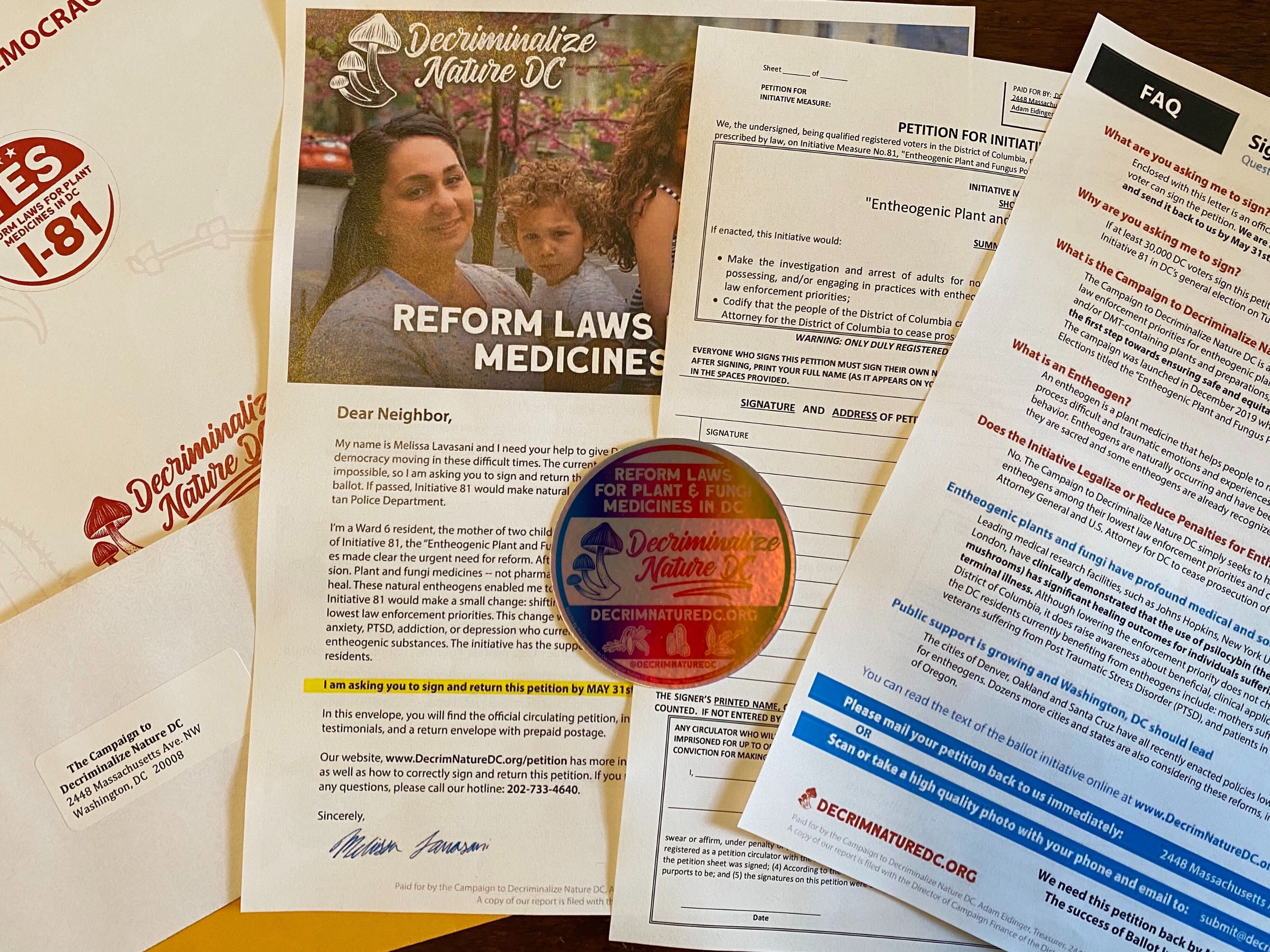
If you’re a registered D.C. voter, there’s a chance that at some point over the next few days you’ll receive a colorful envelope in the mail emblazoned with the message, “Decriminalize Nature D.C.” This mailing is part of an ambitious attempt to loosen the city’s laws on magic mushrooms and other psychedelic plants. Here’s the deal with the campaign — and what exactly is inside that envelope.
What is ‘Decriminalize Nature D.C.’ anyhow?
Decriminalize Nature D.C. is a campaign that started earlier this year to change how the city’s laws on magic mushrooms and other psychedelic plants are enforced. Currently, psilocybin mushrooms or other psychedelics — including cacti, iboga and ayahuasca — are treated as Schedule I drugs, which means that possessing or using them can be met with stiff local and federal penalties.
Despite the name, this new campaign doesn’t formally seek to decriminalize or legalize mushrooms or psychedelics, but rather make enforcement of the laws against them the police department’s lowest priority. This is the same step voters in Denver took last May when they approved Initiative 301, and similar efforts are being launched in cities and states nationwide.
OK, fine, but why not just straight up legalize or decriminalize magic mushrooms?
That’s a fair question — and just by the name of the campaign itself, that’s what you would think is being proposed. But the decision to instead propose making enforcement a low police priority is intimately linked to the last time D.C. voters tried to legalize a drug.
And that was in 2014 with marijuana. After D.C. voters approved Initiative 71, congressional Republicans quickly dropped a provision into the city’s budget prohibiting any further actions to legalize any drugs. And while there was hope that with Democrats in charge of the House that provision would be pulled out, that hasn’t been the case — and it was recently extended through 2021.
So when proponents of Initiative 81 wrote the measure’s language, they had to avoid any formal effort to actually decriminalize or legalize mushrooms and psychedelics.
So why even do this?
Not unlike the movement years ago to legalize marijuana for medicinal uses, proponents say that mushrooms and psychedelic plants have great potential to help people suffering from PTSD, trauma, emotional problems, depression, and other maladies.
Melissa Lavasani, a D.C. government employee and the leader of the Decriminalize Nature D.C. campaign, told us earlier this year that after she gave birth to her two kids, she suffered from severe depression and anxiety that she ultimately treated by micro-dosing magic mushrooms. And while that may sound outlandish to some, researchers at places like Johns Hopkins University are looking into the therapeutic and medical value of psychedelics.
What’s the process to have this happen in D.C.?
The campaign wants to let D.C. voters decide in November, through a process known as a ballot initiative. If you’ve been here for the last few years, you’ll remember Initiative 71, which was approved in late 2014 and legalized the possession and personal use of marijuana, and Initiative 77, which eliminated the tipped wage and got the voters’ nod back in 2018 (it was later overturned by the D.C. Council). This new effort is formally known as Initiative 81, or the “Entheogenic Plants and Fungi Act of 2020.”
Proposing a ballot initiative is easy enough, but actually getting it on the ballot is challenging. It requires getting signatures from 5% of D.C.’s registered voters—roughly 25,000 signatures all told—in a six-month period. And those signatures have to come from a representative sample of voters, at least 5% in five of the city’s eight wards. Many hopeful ballot initiatives have failed to reach this threshold.
Now, Initiative 81 faces an additional hurdle: its proponents are trying to collect all those signatures during a pandemic, which has made circulating petitions the traditional way (at markets, Metro stations, street corners, and festivals) basically impossible.
So what are proponents doing to get Initiative 81 on the ballot?
We’re back to where we started: that envelope you may get in the mail. It will come with information about the effort and a sheet where registered voters are asked to sign if they want to see Initiative 81 appear on November’s ballot. The campaign is asking every voter in a household to sign and send the petition back in — a process they are calling “D.C. Democracy By Mail.”
Right now, this petition-by-mail effort — which has never been tried before in D.C. — is in something of a test phase. The campaign sent petitions out to 10,000 households, and also has them for download on its website. They are waiting to see how many they get back in by the end of the month before deciding whether to go all in and mail out 250,000 more in June.
If all goes to plan, they hope to have enough valid signatures to submit to the D.C. Board of Elections by early July — the deadline to get an initiative on November’s ballot.