Colleen Grablick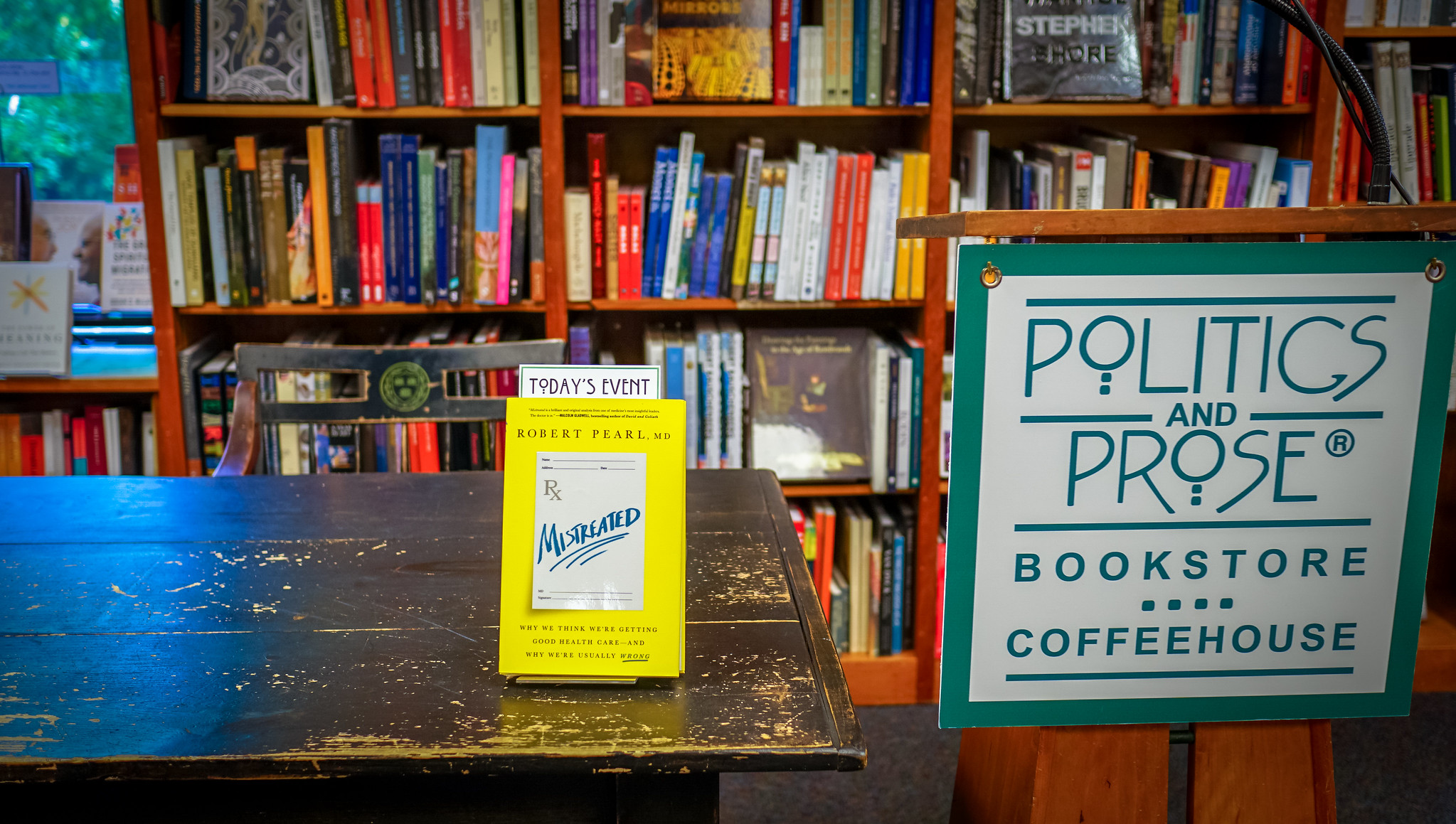
Update 5/21/20: D.C.’s pilot program allowing some nonessential businesses to reopen for curbside delivery or sidewalk pick-up now includes beauty supply stores, sundries, florists, and card shops.
Seventeen different retailers are now participating in the program, including recently added flower shops like Petworth’s She Loves Me and Allan Woods Flowers in Woodley Park, and beauty stores Art of Lash and Marie’s Beauty Supply.
Original:
Starting today, eight local D.C. education and academic retail shops are permitted to operate curbside or sidewalk pick-up, after petitions from local bookstores and nonessential retail shops reached D.C. officials.
Through June 8—the tentative end date of Mayor Muriel Bowser’s extended stay-at-home order—nonessential retailers approved for the EARS pilot program (short for education and academic retail shops) can deliver orders placed online or by phone through curbside and walk-up operations. This program, developed through the Office of the Deputy Mayor for Planning and Economic Development, marks a new step in the city’s gradual reopening efforts.
Several Northwest businesses selling books, art, and music supplies called Ward 3 Councilmember Mary Cheh about possible exemptions to the mayoral order that closed all nonessential business, suggesting various curbside or pick-up operations. Cheh says that a soft openings at these nonessential stores will benefit the city two-fold: by supporting local businesses, and establishing plans for how reopenings could look going forward.
“To me, it didn’t involve very much of a leap to say these [stores] are essential, especially when schools do open up, so I’m happy they’re beginning to do it this way,” says Cheh. “We’re not just going to open up full bore, we’re going to to do it in incremental steps, and this the first of an incremental kind of opening. [The pilot program] is appropriately cautious, but important to start.”
When the program announced the first participating stores on Sunday, three of the four initial businesses that received waivers were those that had reached out to Cheh about possible exceptions from the stay-at-home order: Middle C Music, Child’s Play Toys and Books, and all three Politics and Prose locations (one of which is in Cheh’s ward). Lost City Books in Adams Morgan was also approved in the original launch.
A more geographically diverse set of businesses received waivers on Monday: Fairy Godmother Child Books and Toys on Capitol Hill, Loyalty Bookstores in Petworth, Mahogany Bookstore in Southeast, and Village Art and Craft in Georgetown. The city is receiving applications on a rolling basis.
Politics and Prose owner Bradley Graham reached out to Cheh about possibly opening for curbside or walk-up sales after witnessing bookstores around the country running similar services even under stay-at-home orders. Politics and Prose had started operating pick-up system in mid-March after shutting down in-person retail, but transitioned into strictly online shipping when the stay-at-home order fell on D.C.
“I thought that books were particularly critical, although they weren’t classified under essential under the mayor’s order,” says Graham. “I kept making the point to whoever would listen that it would be a great service to a lot of people if bookstores could be opened to curbside or pick-up service.”
Myrna Sislen, the owner of Middle C Music in Tenleytown, had also asked Cheh to petition to Bowser that her music store to be deemed essential —a proposal that was rejected by the mayor’s office, according to Sislen.
For a majority of the shutdown, Sislen has been delivering orders from the store herself—piling over 20 music books into her backpack and delivering the orders on her bike. In early May she developed a mutually beneficial system with a local restaurant a few blocks down, Seoul Spice, that allowed her drop-off called-in orders at the storefront for customers in desperate need of an essential musical.
“I understand no one’s going to die without music, but I had gotten so many calls and emails from people saying ‘[music] is keeping me sane, I need to have a string, I need to have a reed, in order to continue to play,'” says Sislen, whose business also teaches over 600 musical students.
Sislen’s jerry-rigged pick-up system isn’t the only one of its kind in D.C.—other retail businesses like Kramerbooks and the yarn store Looped Yarn Works have advertised curbside delivery on their Instagram accounts. Under Bowser’s stay-at-home order, “remote delivery of services formerly provided in-person” is permitted to take place at nonessential businesses, but the order doesn’t specify if curbside or walk-up services are considered remote.
Child’s Play Toys and Books on Connecticut Avenue was the third of the originally approved businesses that reached out to Cheh for a possible stay-at-home order exemption. According to Child’s Play president Steven Aaron, an employee of the store had seen a Michael’s Craft Store in the city operating curbside delivery in early May, which prompted Aaron to contact Cheh and Ward 3 Advisory Neighborhood Commissioners for help from the mayor’s office. A week later, the program had been announced, and Stevens heard back within hours of submitting his application that his store had been approved for sidewalk service.
To apply for a waiver under the EARS pilot, a business must provide in detail the safety measures that will be put in place for operation. Curbside delivery requires approved parking spaces with appropriate social distancing designations (as customers stay in their cars and employees load orders into a trunk), while walk-up services allow businesses to operate a contactless drop-off by leaving items outside a store at a safe distance for customers to retrieve.
Aaron is waiting on approval from the D.C. Department of Transportation for his curbside plan. He says that after he submitted his application, a representative with DMPED asked permission to share copies of his detailed drawings with other businesses. According to DMPED, participating stores will be asked to provide metrics on their sales, numbers of customers served, and hours of operation throughout the pilot, and make recommendations for other retailers looking towards reopening in the near future.