Elliot C. Williams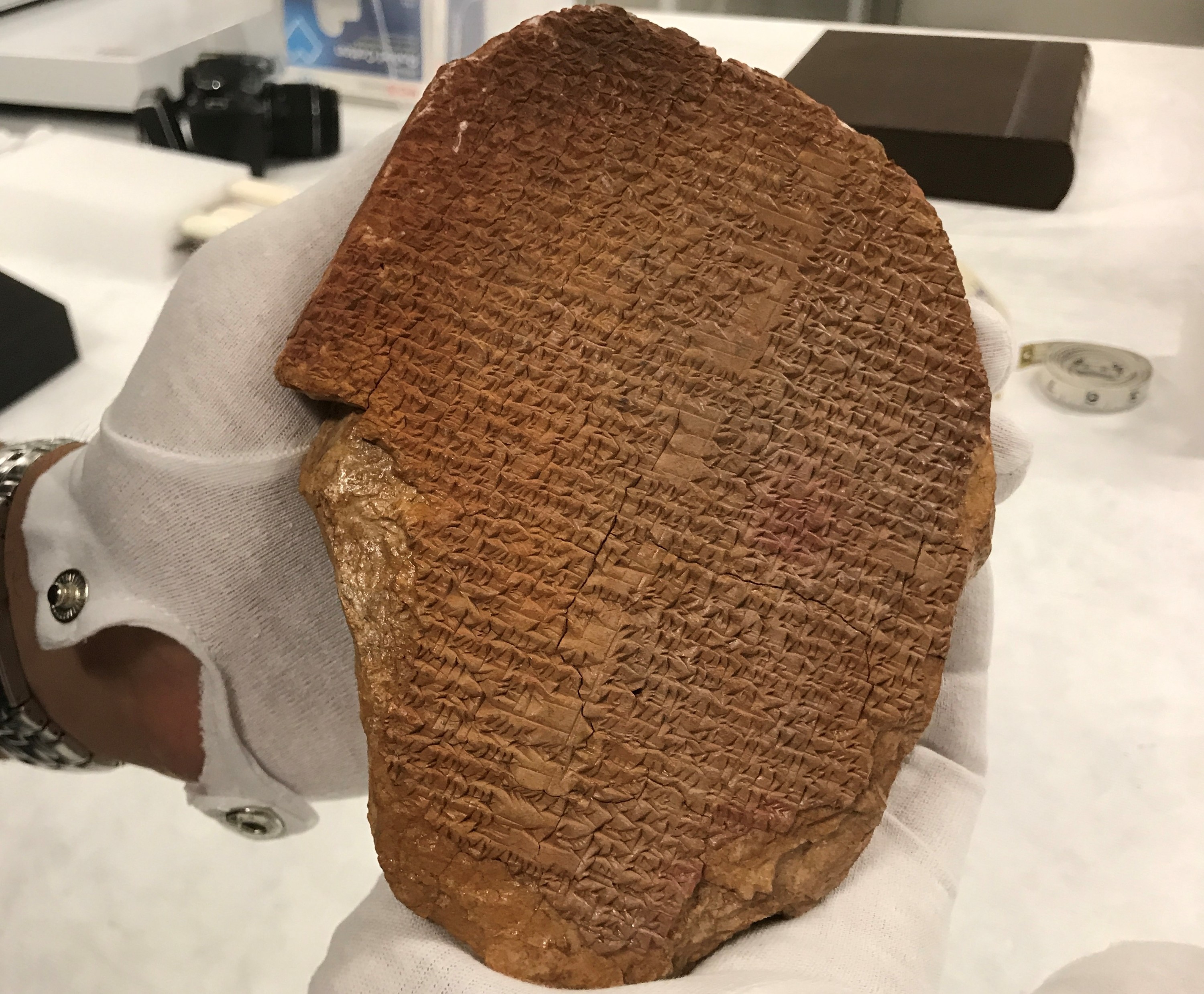
Like all D.C. museums, the private Museum of the Bible has been temporarily closed for months, in adherence with the mayor’s stay-at-home order for the coronavirus pandemic. And yet, even with its doors closed, the museum finds itself involved in a major legal case surrounding a prominent artifact it briefly displayed.
On Monday, federal prosecutors in the Eastern District of New York filed a civil action to forfeit a clay tablet, formerly housed at the Bible museum, called the “Gilgamesh Dream Tablet.” The tablet contains a portion of the “Epic of Gilgamesh,” an epic poem written in cuneiform, the ancient Mesopotamian writing system, and one of the oldest pieces of literature in the world.
Hobby Lobby, the arts-and-crafts company behind the Bible museum, bought the rare piece for $1.6 million in 2014 from an international auction house, which failed to disclose the tablet’s true origins, prosecutors say. U.S. Department of Homeland Security investigators discovered that the piece was stolen from Iraq and sold to an unidentified U.S. antiquities dealer in 2003—not “well before” 1981, as the auction house had told Hobby Lobby.
The tablet was sold again, in 2007, with a false provenance letter that traveled with it from owner to owner and was given to the auction house, according to court documents.
Despite the Bible museum’s and Hobby Lobby’s inquiries, the auction house didn’t reveal the truth about the object’s origins, the complaint says. Homeland Security agents seized the 6-by-5-inch tablet from the museum last September, and now, the U.S. is seeking to return it to Iraq. (The tablet was displayed at the museum for a short time before its false provenance came to light.)
“Whenever looted cultural property is found in this country, the United States government will do all it can to preserve heritage by returning such artifacts where they belong,” said Richard Donoghue, the U.S. attorney for EDNY, in a statement. “In this case, a major auction house failed to meet its obligations by minimizing its concerns that the provenance of an important Iraqi artifact was fabricated, and withheld from the buyer information that undermined the provenance’s reliability.”
While the federal filing doesn’t mention the name of the auctioneer, Hobby Lobby is suing British auction house Christie’s, which the Bible museum identifies as “the source of the item.” The chain alleges that, in orchestrating the sale, the auction house violated the National Stolen Property Act and other restrictions on importing artifacts from Iraq. The suit was filed Monday by New York City-based law firm Pearlstein & McCullough.
We support the Department of Homeland Security’s efforts to return this Gilgamesh fragment to Iraq. Christie’s, the source of the item, is now the subject of a lawsuit filed by Hobby Lobby, which loaned the item to us. (1/3)https://t.co/wOKl1EBLnX
— Museum of the Bible (@museumofBible) May 19, 2020
The 430,000-square-foot Museum of the Bible prides itself on providing “an immersive and personalized experience with the Bible and its ongoing impact on the world around us,” per its website. David Green, the Hobby Lobby founder and evangelical billionaire and his son Steve, the company’s president, have spent tens of millions of dollars to gather the museum’s sprawling collection.
Still, the museum had problems with the authenticity of its artifacts even before it opened in late 2017. In 2015, Hobby Lobby was investigated for buying a few hundred misrepresented cuneiform-inscribed tablets. Then, months before the museum’s debut, Hobby Lobby was hit with a $3 million fine and had to return thousands of smuggled Iraqi artifacts. (The museum distanced itself from the lawsuit against the crafts chain, claiming that none of the stolen artifacts belonged to its collection.)
Last month, the New York Times reported that the Green family’s major critics were actually applauding the museum owners for their transparency. The museum had hired a research firm to evaluate the authenticity of its Dead Sea scroll fragments. In a big reveal, they were found to be forgeries from the 20th century.
Steve Green issued a statement in March saying he “trusted the wrong people to guide me, and unwittingly dealt with unscrupulous dealers in those early years.” He also announced that the Museum of the Bible had about 11,500 objects with “insufficient provenance” which it was working to return to Egypt and Iraq. “One area where I fell short was not appreciating the importance of the provenance of the items I purchased,” Green said in the statement.
The Gilgamesh Dream Tablet is believed to be one of 12 tablets discovered in 1853 Assyrian ruins located in northern Iraq, according to court filings. In the epic poem, Gilgamesh’s mother interprets his dream about the arrival of a new friend, telling him, “You will see him and your heart will laugh.”
The 3,500-year-old antique is currently sitting in a DHS warehouse in Queens, New York, reports NPR. Iraq’s ministry of antiquities told the outlet that it’s examining whether the tablet was one of thousands of items stolen from an Iraqi museum in 1991, when several Iraqi museums were looted around the time of Saddam Hussein’s invasion of neighboring Kuwait.