Martin Austermuhle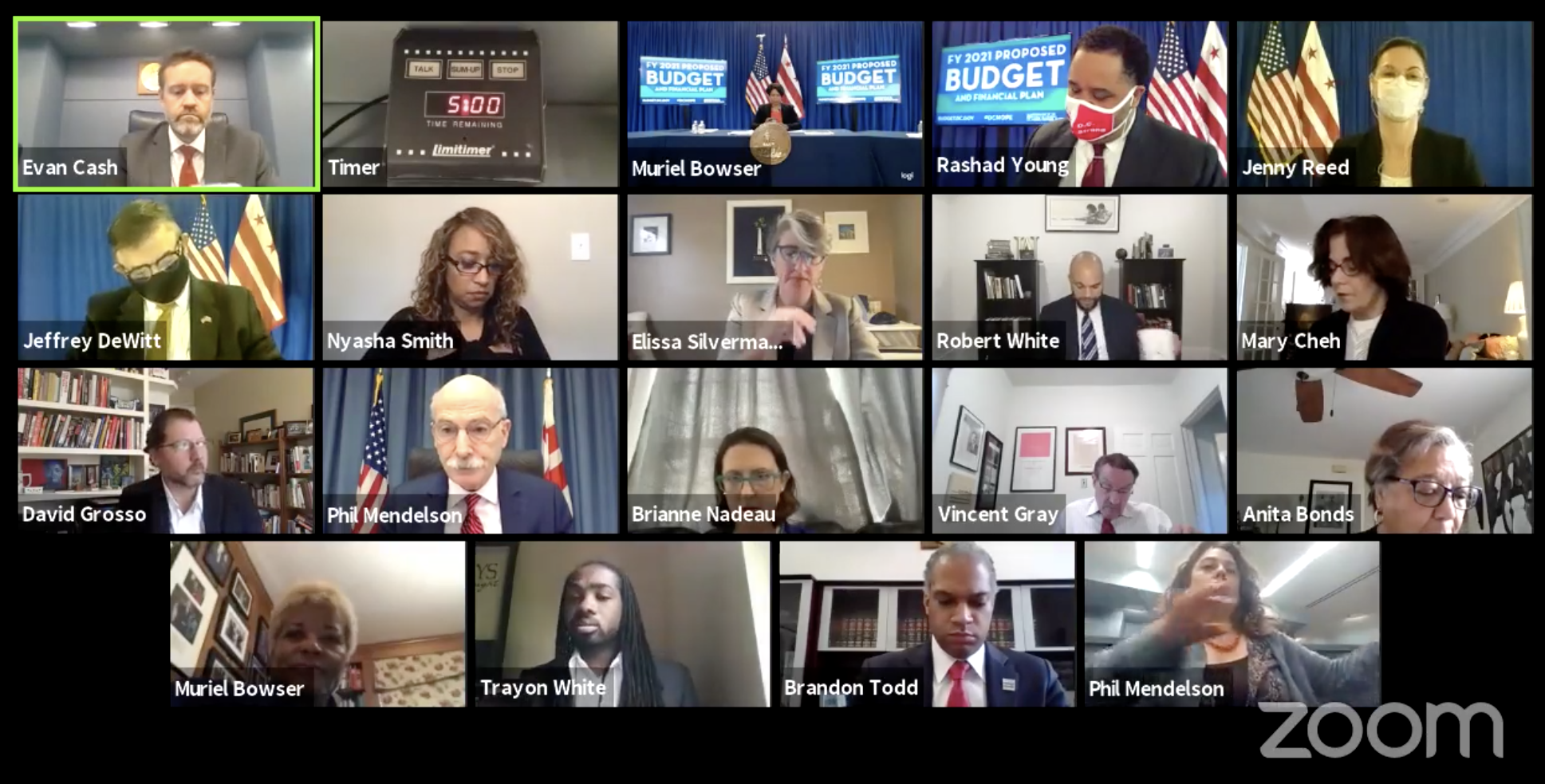
Faced with the first budget in almost a decade stricken by revenue shortfalls instead of surpluses, D.C. lawmakers on Tuesday alternated between praising Mayor Muriel Bowser for her proposed 2021 spending plan and gently hinting that they’re looking for new sources of money — including possible tax increases — for affordable housing, schools, health care, and violence prevention programs.
Bowser’s $8.5 billion budget, which she unveiled on Monday, largely relies on a pay freeze for D.C. government employees and the use of rainy day funds and past budget surpluses to make up for a $774 million shortfall in revenue caused by the pandemic’s shutdown of the city’s economy.
“While this budget reflects the impacts of the global coronavirus pandemic, I am proud that it also reflects our ongoing commitment to good government and fiscal responsibility without compromising our shared D.C. values,” said Bowser, touting a 3% increase in per-pupil funding for public schools, $100 million to build affordable housing and more than $300 million to build a new hospital at St. Elizabeths.
Her approach drew plaudits from two of the Council’s longest-serving members — who also happen to be among the few sitting lawmakers who have dealt with past budgets that required significant cuts.
“It’s got some very sound fundamentals and some good approaches,” said Ward 7 Councilmember Vincent Gray, who chaired the Council during the Great Recession and later served as mayor.
Ward 3 Mary Cheh highlighted Bowser’s decision to use more than $200 million from the city’s rainy day fund to make up for lost revenue.
“The way this was put together, especially the way we used our reserves… we’ve been very careful to build up those reserves for when we needed them, despite having calls to use that money before,” said Cheh.
But that praise quickly gave way to concerns over programs that saw funding cuts or initiatives that received no money at all. Cheh asked about school healthy food programs that are facing less money, At-Large members Elissa Silverman and Anita Bonds inquired about decreases in funding for some affordable housing and child care assistance programs, and Ward 8’s Trayon White said he didn’t believe the city could stand to decrease funding for a particular violence interruption program.
“This budget is not sufficient” for residents of wards 7 and 8, said White.
“Certainly COVID has become the number one issue for us, but affordable housing isn’t far behind it,” offered Silverman, expressing particular concern for a significant decrease in funding for a program to preserve existing affordable housing.
And others — echoing some activists and progressive groups — said that while the budget wasn’t as bad as it could have been, it also doesn’t do enough to address structural problems exposed by the pandemic, like dramatic disparities in health care and education.
But city officials insisted that they were doing what they could with the cards they had been dealt, and that some tradeoffs were to be expected.
“It required some really difficult choices,” said City Administrator Rashad Young of the budget, highlighting the fact that while Bowser was proposing freezing cost-of-living pay increases for 35,000 D.C. government employees, that was done to avoid wide-scale furloughs or layoffs.
Young also said the city would be looking to federal aid — some of which has not yet been approved by Congress — to help cover the costs of certain programs, like assistance to child care facilities that have been battered by the two-month citywide shutdown.
Still, calls to seek out new sources of revenue from progressive activists and candidates running for office did find a voice in Ward 6’s Charles Allen, who said he would like to reverse a three-year-old tax break for people making more than $350,000 a year and use the additional revenue to help fund programs that would benefit lower-income residents.
“We definitely have some families that can telework. They have access to recreation, they don’t stress over if they’ll have access to fresh food,” he said. “We should also be asking for sacrifices for households that are the least impacted, that can most weather the storm.”
Bowser has said she doesn’t believe tax increases are necessary, though her budget does close a number of small tax loopholes.
Some lawmakers, including At-Large member Robert White and Council Chairman Phil Mendelson, pushed officials on whether using more from the city’s rainy day fund — which started the year at $1.4 billion, but has since fallen by more than $200 million — would be possible to sustain funding for programs and services.
But that drew warnings from Chief Financial Officer Jeffrey DeWitt, who said keeping money in the bank would both let the city keep it’s high credit rating and help survive a possible second shutdown should the virus re-emerge in the fall. He estimated that a second shutdown would cost an additional $300 million in lost revenue.
“Using more reserves will cost you more than you’ll get out of it,” he said.
A month’s worth of public budget hearings start on Thursday, and the D.C. Council is expected to vote on the 2021 budget — and a revised 2020 budget — in late July.
More:
Bowser Unveils Cuts To D.C. Budget, But Previous Surpluses May Limit The Pain