 Jordan Pascale
Metro knew it was going to be difficult to enforce its mandatory mask policy that went into effect on Monday.
During a teleconference with WMATA workers last week, General Manager Paul Wiedefeld said the mask policy and maintaining social distance on buses and trains is “extremely tough. People are going to do what they’re going to do, but we’ve got to convince them to do it on their own.”
“I think overall, you’re going to start to see people, from a social standpoint, put pressure on each other to wear a mask,” said Metro COO Joe Leader during the same teleconference.
Metro police won’t ticket people who aren’t wearing masks.
The Centers for Disease Control and Prevention recommends wearing a mask to stop the spread of droplets that could contain the coronavirus. Some with the disease remain asymptomatic for weeks, so wearing a mask is a preventive measure from accidentally spreading it to others. The idea is that if everyone wears a mask, it could drastically reduce transmission.
Dr. Amira Roess, a professor of global health and epidemiology at George Mason University, says it’s too early to know how well the strategy is working, but she says we should use all of the tools at our disposal.
“[Wearing a mask] is new to our country,” Roess said. “It’s not a cultural norm. One thing we know from behavioral science work is that we have the ability to change, and our behavior can change with the right pressures.”
If people in your social circle and those we look up to wear masks, you’re more inclined to wear one, too, she said.
“Or maybe you’ve known someone who was infected and had serious symptoms and so [coronavirus] hits closer to home and you’re more likely to take it seriously,” she said. “Or maybe you have underlying conditions and higher risk factors or you live with someone who is vulnerable.”
Majority Of Riders Follow Rules
Most people are already wearing masks on Metro, officials said. Some localities, like Maryland and D.C., required masks to be worn in certain places for months. Some people don’t choose to because of medical reasons, or because they say it infringes on their liberty — or they just don’t want to.
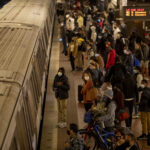
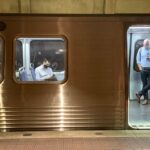
On Monday afternoon, about 90-95% of people wore masks on board two Yellow Line trains at the Georgia Ave.-Petworth station. Some trains were crowded as people sat within 6 feet of each other. Overhead speakers played educational messages about Metro’s new policy and why wearing a mask is safer for everyone.
Police congregated outside the station but did not appear to be enforcing or educating people without masks at the nearby bus stop about the policy.
Enforcement is far laxer than in some places. In Beijing, guards are now stationed at subway entrances to ensure everyone is wearing a mask and gets their temperature taken.
Wiedefeld said WMATA surveys show most riders want to see other riders wear masks. The mask policy is also key to WMATA’s plans to build back rider confidence.
Metro’s union, ATU Local 689, also pushed for the mask requirements. The union applauded executive orders from Maryland and D.C., which gave the mask requirements some teeth.
“This mask order is first and foremost about public health and safety,” said Brian Wivell, Local 689’s spokesperson. “It’s about making it clear for all public transit riders in this region that you should have a mask on regardless of what jurisdiction you’re in.
“Prior to WMATA’s rule, you could be on a bus that starts in (one place), where masks were not required and by the end of your route be in Maryland where they were required.”
Wivell points out that operators are not responsible for enforcing the rule: “The entire point of current safety policies is to limit contact with the riding public and maintain social distancing.”
Ride On In Montgomery County Has Given Out 4,000 Free Masks
Montgomery County’s Ride On bus system has taken a different approach, by handing out masks to riders who don’t have them.
Chris Conklin, the county’s department of transportation director, said he was initially nervous about mandating masks.
“I was apprehensive of this strategy, but it has gone very well,” Conklin said. “We’ve had very little confrontation about wearing masks.”
In Philadelphia, police dragged a man off a bus in April because he was not wearing a mask. That transit agency ended its mandatory mask policy after the incident.
Most Ride On bus riders are already wearing masks when they get on a bus, Conklin said. If they aren’t, the bus driver uses the intercom system to ask them to comply. If they don’t, they’ll be asked to leave the bus. A manager and Montgomery County Police can also get involved if needed.

Montgomery County’s Ride On buses each have a bucket filled with individually bagged masks.
But Conklin said one program has helped avoid confrontations and lowered the barrier for riding.
Each Ride On bus has a bucket filled with individually-bagged masks. Conklin says riders have used 4,000 of them over the first three weeks of the pilot program. The county’s Department of General Services procured tens of thousands of masks for less than $1 each for county use back in March. Half a million masks are on order.
“It’s provided more comfort for everyone,” Conklin said.
Ride On started the free mask program April 28 in the Silver Spring area, but expanded it systemwide a week later. The transit agency sees about 65,000 trips a week, a small fraction of WMATA’s 837,000 weekly trips.
But Conklin said he thinks other transit agencies could do the same.
“The main limitation is just making sure that there’s an available inventory for people to distribute,” Conklin said. “I mean, logistically, the larger you are, obviously it’s more difficult. But I think those barriers could be overcome if there was really a desire to do it.”
Roess, the GMU epidemiologist, agrees and said some people simply can’t afford or can’t find masks.
“It’s a real barrier, but [there’s] something we can do about it,” Roess said of providing free masks. “Now, that won’t change the mind of someone who doesn’t want to wear a mask, but we have to do the best we can.”
Metro says it may hand out masks if it has enough supplies, but the overall thinking is that most people will bring their own.
This article originally appeared on WAMU.