Martin Austermuhle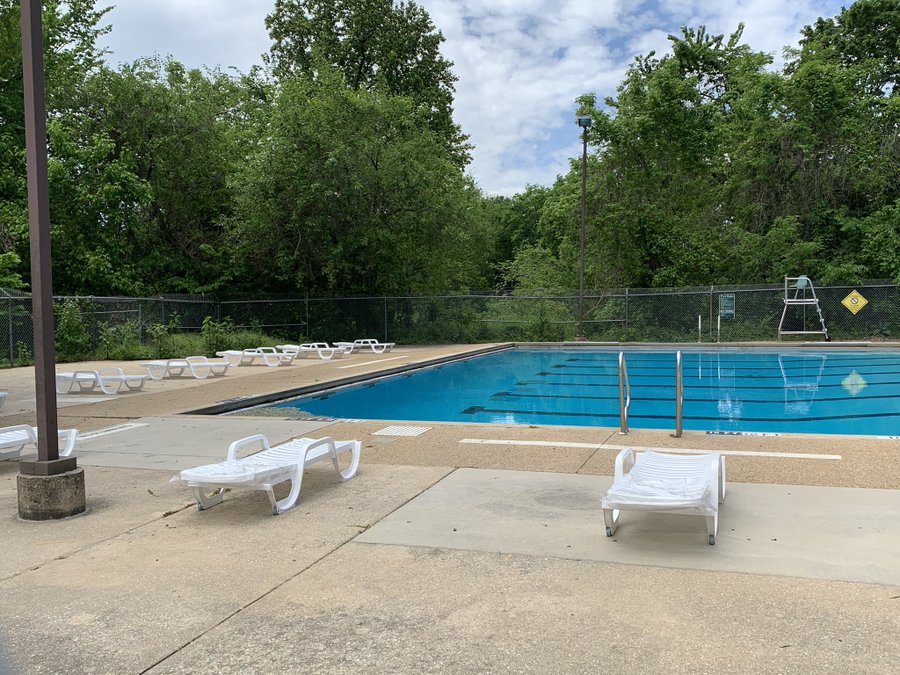
At this point during any normal year, Nathan Darling would be putting the finishing touches on opening the Cheverly Pool in Prince George’s County. Lifeguards would have been scheduled, pool furniture fixed and laid out, and the snack bar stocked for the summer pool season that stretches from Memorial Day to Labor Day.
But this is no normal year, and Darling and the community pool’s members — more than 1,000 of them, including his kids, aged 15, 11, and 8 — are instead in a holding pattern, like kids impatiently awaiting the end of an adult swim session that’s dragging on. There’s no guidance on when the pool will open, and when it does, what going to the pool will even be like. And with that uncertainty comes mixed feelings of a summer mainstay lost, or at least significantly altered.
“We know the pool is a second home to many in the summer, and it will be sad if we can’t open as fully or as long as we normally would,” he says. “At the same time, you know, no one wants to be the site of the next the the next hot spot, right?”
The COVID-19 pandemic has upended all manner of routines and traditions since mid-March, and it’s likely to continue doing so as days get longer, school (distant as it may be) lets out, temperatures tick up, and families seek refuge at public and private pools across the Washington region. The District and surrounding suburban counties are likely to remain under stay-at-home orders until at least late May or early June. That means gatherings of more than 10 people are still prohibited and face masks are encouraged when social distancing isn’t possible.
But even when local governments give pools the green light to open, the only thing that’s clear is that the pool-going experience won’t be the same: Social distancing rules are likely to remain in effect, shared bathrooms will either have to be closed or cleaned much more frequently, and swim teams may not be able to compete. And that’s left community pools and local governments to prepare for a summer swim season that, if it happens, will be different — but no one yet knows how different.
“It’s an ever-changing situation, and it’s really like trying to pin down Jell-O,” says Dan Drummond, president of the board of the Fairfax Pool, which has 450 member families.
In Virginia, Gov. Ralph Northam’s initial phase of reopening has already started — though counties in Northern Virginia, where COVID-19 cases have been centered, have been given a two-week extension on their current restrictions. But even after that, Northam’s Phase 1 guidance says that while outdoor pools can open, it will be “with one person per lane.”
Much the same holds for Maryland, where Gov. Larry Hogan’s initial stage of reopening has excluded Montgomery and Prince George’s counties, both of which have said that pools will remain closed for the time being. In D.C., Mayor Muriel Bowser is set to announce plans for the city’s public pools on Friday, but no one expects her to surprise the city this year with the traditional mayoral cannonball into a local pool. In a report issued Friday, though, the Reopen D.C. Advisory Group said pools may not open until community transmission of COVID-19 is “sporadic.”
The government go-ahead will be the simple part. What’s more complicated is what happens if rules remain in place requiring crowd limits or social distancing. Inside the pool, relatively speaking, is easy.
“We are heartened by the fact that it appears chlorine is like a great big sanitizing wipe and kills the coronavirus. So in the pool we would would feel a little more comfortable not having to necessarily maintain a 6-foot separation,” says Elizabeth Duffy, board president of the Prince George’s Pool in Hyattsville, which has more than 600 memberships amounting to 2,400 people.
But it’s the areas around the pool — the deck, any grassy areas, snack bars, bathrooms — that are keeping pool presidents up at night.
“Most of the guidance I’ve been seeing for outdoor recreation is asking people to maintain the 6-foot protocol,” says Darling. “What does that look like on an open grounds where people just are usually free to set up chairs wherever they wish?”
Darling says the pool’s board has contemplated taping off squares for individuals or families to occupy, but in an email to members this week admitted it would be challenging. “It will be difficult, if not impossible. We will rely heavily on members to self-police,” he wrote. (There’s a general consensus that lifeguards will not double as social distance enforcers.)
And all of this assumes local governments will lift the restrictions on crowds. But what if they don’t, or not by enough? For some of the many private community pools across the Maryland and Virginia suburbs, that’s raising an even more difficult possibility: that they won’t open at all.
“Clearly, if they have a gathering restriction of, you know, 100 people or less, that’s really not worthwhile for us to necessarily open up the pool,” says Duffy. “We would need to see the crowd size be at least 250 or higher in order to make it worthwhile for us.”
At the Fairfax Pool, Drummond says concerns around crowd sizes and social distancing forced them to cancel the summer’s swim meets. But when it comes to normal pool operations, everything remains a question mark.
“Ideally, we would have some more specific guidance from the governor and the county health department. But I think they’re also still learning as well, to be fair to them,” he says.
On the government side, officials say they’re also learning as they go.
“Our plans will change as the guidance changes,” says Carmen Berrios Martinez with Montgomery Recreation, which runs seven public pools. “But some of the things that we’re looking at right now is limiting the number of people allowed into the pool at one time. Where you might have had a capacity of a couple hundred or even 1,000 folks at some of our bigger outdoor pools, those numbers will be much smaller this time around.”
In the meantime, the biggest adjustment may be psychological. A summer tradition is being taken away, and those most impacted could be families for whom a trip to the public pool is not only a cheap means of recreation, but also one of the best ways to stay cool during the steamy summer months.
For Duffy, a delayed opening and shorter pool season means less time with her “pool family.”
“I joined the pool the 10 years ago as a recently divorced woman, and the pool families, as we call them, helped me raise these kids,” she says of her three children, ages 19 and 17. “I so looked forward to the socialization and getting out and seeing other adults. We call it our new family. I was really disheartened to think that I wouldn’t be able to spend three months with our pool family.”
This story originally appeared on WAMU.