 Jordan Pascale
Metro is closing six Orange Line stations and the entire Silver Line starting Saturday, and Northern Virginia business groups are not happy with the rollout.
The closures will affect nine stations: four on the Orange Line (Vienna, Dunn Loring, West Falls Church, East Falls Church) and five on the Silver Line (Wiehle-Reston East, Spring Hill, Greensboro, Tysons Corner, McLean).
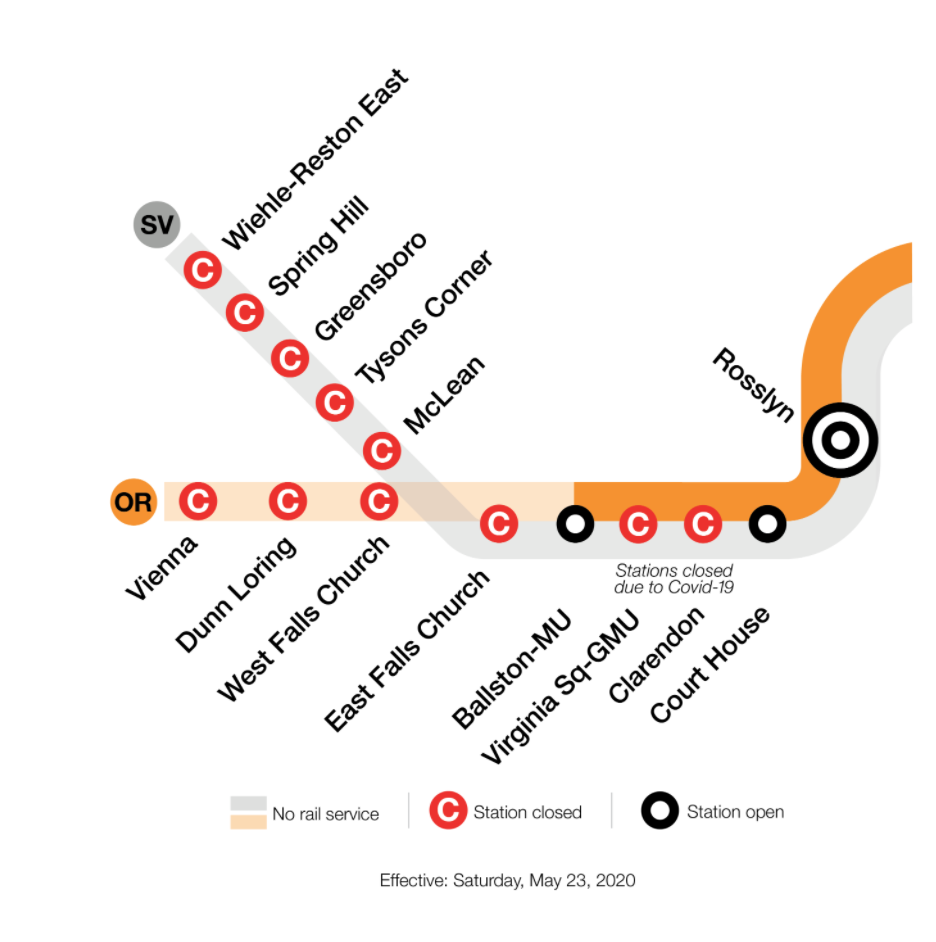
Closed Metro stations coming May 23 through at least Labor Day — and likely longer.
All nine will be closed starting on Saturday, and are expected to remain closed for the entire summer. They could reopen around Labor Day, depending on how fast the construction can get done, given social distancing requirements.
Three of the stations (East Falls Church, MacLean, and Greensboro) have already been closed due to low ridership during the pandemic.
Metro took a gamble betting that life would not get back to normal by this summer. Northern Virginia plans to enter Phase One of reopening, lifting some restrictions on May 29, a week after the Silver Line closes.
Some business groups were unhappy with that bet.
Sol Glasner, CEO of the Tysons Partnership, says Metro has now all but assured that the comeback will be delayed in Tysons. He said he was disappointed and frustrated with how Metro handled the Silver Line shutdown.
“Metro is not an amenity in Tysons, it’s an essential utility,” Glasner said. “Our businesses, our employees, our customers are dependent on Metro.
“Without Metro, when we’re looking for economic recovery, it creates a self-defeating cycle.”
Northern Virginia Chamber of Commerce’s CEO Julie Coons says Metro’s timing makes sense since much of the workforce is home right now, so the impact is limited.
“However, the Chamber is working … to advocate for better communication going forward,” Coons said. “We all rely on Metro and need to be at the table together.”
Tysons has 120,000 workers, five Fortune 500 companies headquarters and a sizable retail presence with one of the largest malls in the region. While many white-collar workers can likely still work from home this summer, retail workers are already going back to the mall, which is open for pick up orders.
Glasner said his group wasn’t consulted before the closure was announced, though they have been looped in on weekly meetings since.
“I think it would’ve been useful for Metro to hear the perspective of employers who are planning for reopen,” he said. “To have the uncertainty of no specific reopening date (for the Silver Line) it becomes impossible to plan for economic recovery.”
WAMU has reached to Metro for comment and will update this post when we hear back.
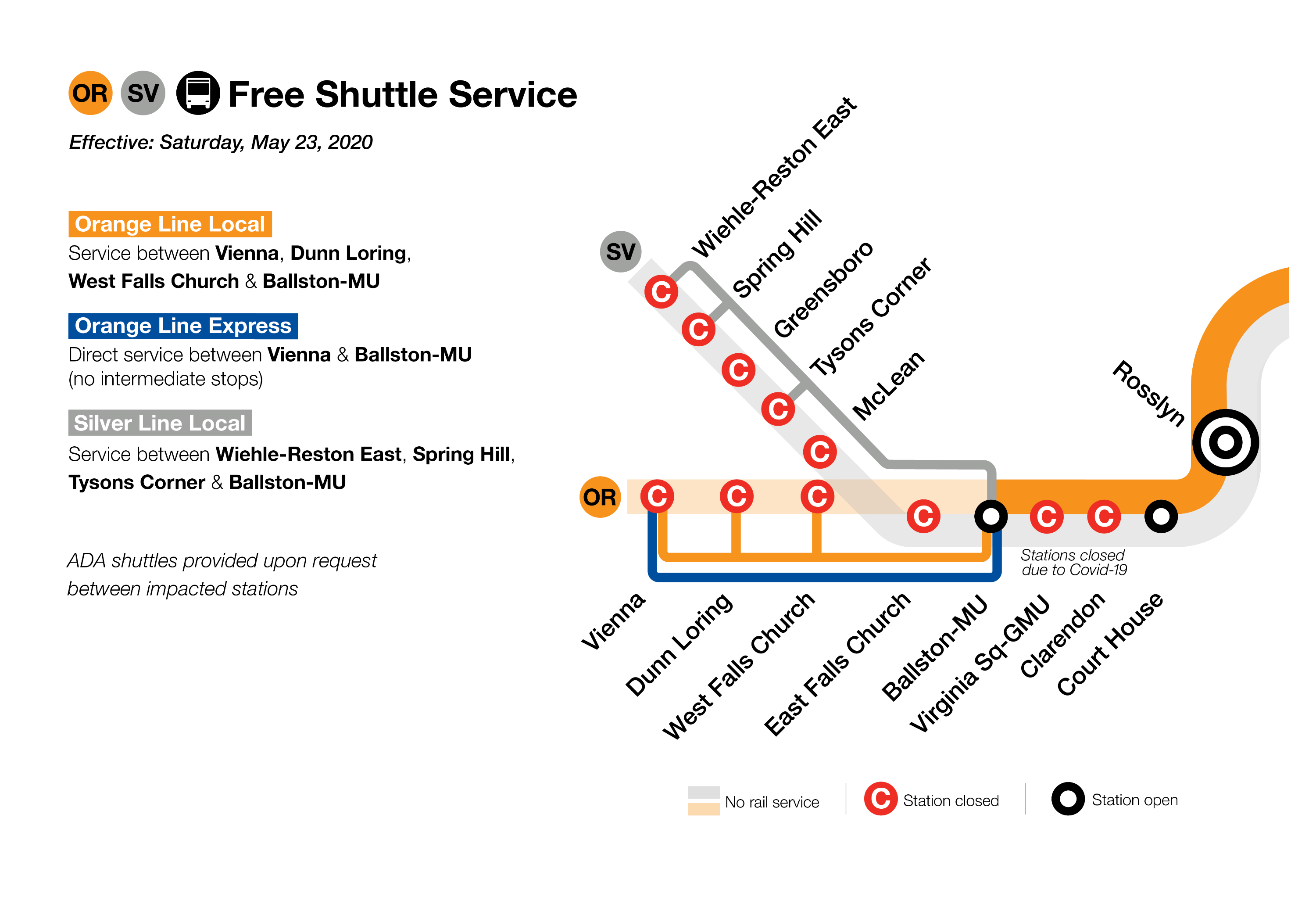
WMATA’s shuttle plan.
Alternate Transportation
Combined, all nine stations only saw about 1,250 trips on an early-April pandemic weekday, about 3% of usual weekday ridership.
The summer shutdown on the Orange Line, which will allow WMATA to rebuild its concrete platforms, has been planned for a while.
The Silver Line closures were announced a month ago. They’ll give Metro the chance to do the software and communications testing necessary to connect Phase 1 of the Silver Line (which is already operational) to Phase 2 of the Silver Line, which is expected to open sometime in 2021.
Free shuttles, that will run every 10 minutes, will be available. You can find all of Metro’s travel alternatives and a map of shuttle locations on their website. Shuttles will not run to stations closed because of low ridership during the coronavirus.
Only 25 riders at a time will be allowed on board. Metro says the contracted fleet they hired has the ability to add more buses if needs grow.
Avoiding Last Year’s Mistakes
Andrew Kierig, co-chair of Metro’s Rider Advisory Council, usually takes the train from Virginia Square to Vienna and a shuttle to his job at George Mason University.
He’s working from home and is unsure when he’ll be asked to come back to work.
“(Metro’s plan) has the potential to go wrong if folks start to go back to work,” Kierig said. “I worry the shuttle service will be inadequate and we’ll be repeating the same mistakes as last year.”
Long shuttle lines last year formed during last year’s shutdown on the Blue and Yellow lines. Coach bus drivers didn’t know the routes and riders couldn’t track the shuttle’s live GPS positions.
Metro says they are training drivers earlier this year, but won’t initially have live tracking of bus shuttles since buses come every ten minutes. But as MetroHero’s James Pizzurro points out, buses will leave when they are full, which could throw off schedules.
While Metro is taking advantage of low ridership to get work done, Kierig said his biggest concern is how it will affect essential workers.
“They don’t have any other options,” he said. “They can’t be forgotten.”
Kierig says Metro also needs to provide masks and hand sanitizer on every bus.
Glasner, the head of the Tysons Partnership, said he’s also concerned shuttles won’t have enough capacity. Glasner said he’s pushed for dedicated bus lanes to speed the travel and make the buses more efficient and is working with Fairfax County and the Virginia Department of Transportation to make that happen.
Metro says the 10-minute shuttle headway would provide more frequent service than the rail plan they had in place for the Orange Line closures.
Glasner pushed back on the plan not to have a shuttle stop at McLean and Greensboro stations, which serve major companies like Capital One and MITRE. He calls that plan “problematic.”
This story originally appeared on WAMU.