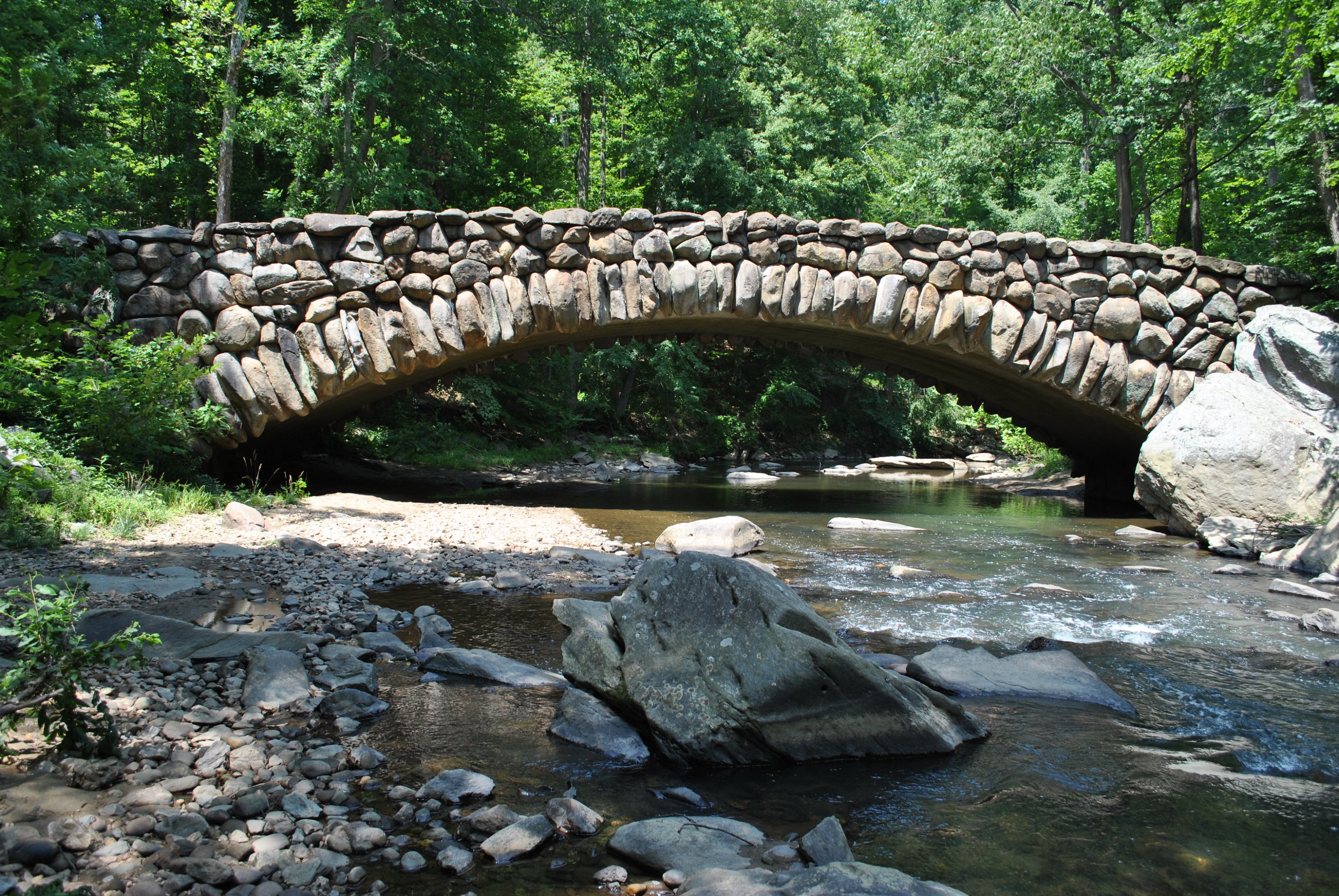
Rock Creek Park has lured crowds of locals seeking an outdoor escape during the pandemic, but the city’s signature oasis — created as America’s fourth national park — was supposed to be the president’s backyard.
The Rock Creek Valley was part of a sparsely settled rural expanse beyond the northern limits of the L’Enfant Plan, which ended at Boundary Street, the current Florida Avenue NW. Residents who hadn’t devoted much attention to Rock Creek were jolted into awareness when more than 10,000 Confederate troops invaded the District on July 11, 1864.
The next day, sharpshooters barely missed President Abraham Lincoln as he stood at Fort Stevens, near the modern park’s edge of 16th Street NW. Guns at Fort DeRussy, the stronghold guarding the creek itself, blasted 100-pound shells at enemy forces. The Confederate forces were ultimately pushed back.
In 1866, after the Civil War, the swath of land attracted the attention of Congress, then in pursuit of options for an executive real estate upgrade.
Urban encroachment had rendered the White House uncomfortable at best, a situation that had prompted Lincoln and his family to live in a cottage at the Old Soldiers’ Home for more than a quarter of his presidency. The fresh air there compared favorably to the White House’s proximity to the Washington City Canal, an open sewer along what is now Constitution Avenue NW. Any south wind would deliver that stench to the president’s door, along with the ruckus of cattle pens and a slaughterhouse operating in the stumpy shadow of the half-finished Washington Monument.
Maj. Nathaniel Michler, who managed D.C.’s public spaces for the U.S. Army Corps of Engineers, called the canal “extremely disgusting to the sense of both sight and smell.” His congressional directive: Survey any suitable locations for “a park and site for a presidential mansion.”
Those linked objectives were prominently listed on the elaborate map Michler prepared, but he basically ignored half of the assignment.
“The Senate resolution would seem to imply that one and the same tract of land should be designated for a site for grounds for a presidential mansion as well as for a public park,” he wrote in his 1867 report to Congress, “but as it is not definitely so stated, it has been judged best by me to separate the subjects.”
The wildness of the Rock Creek woodlands dazzled Michler as much as its location mere footsteps outside the city limits.
The most prominent green space available at that time in D.C. was a derelict version of the National Mall, detached from downtown by the canal and most welcoming to weeds and livestock. The Mall dissolved at 17th Street, where today’s World War II Memorial would have sunk in the Potomac River mud.
So Michler mapped a park that encompassed the entire Rock Creek Valley and blended natural resources with cultural heritage sites in ways recognizable in 2020.
He imagined observatories, botanical conservatories and a zoo, all set against the forested hills and forts that had defended the capital. He did identify other spots for a new presidential residence, yet he fixated on advocating for “a grand national park in the District of Columbia, at the expense of the United States government.”
Missouri Sen. Benjamin Gratz Brown evangelized for that dream. As chair of the Senate Committee on Public Buildings and Grounds, he introduced a bill to authorize a national park in D.C. two weeks after Michler’s report — with no reference to any White House changes.
Brown compared the $500,000 land expense to community libraries or gardens that anyone could visit “to wonder and to learn, and in which all may feel a rightful patriotic pride.”
The bill passed in the Senate but didn’t make it through the House, which was working through the night on the last day of the legislative session. Issues affecting the trajectory of America occupied much of the final docket, including the passage of the Reconstruction Act over a veto as Congress battled with President Andrew Johnson, whom they would impeach the following year.
House members tabled the national park bill just before a recess at 8:45 a.m. Brown never returned to the Capitol after his Senate term ended that day. Meanwhile, Yellowstone went on to become the first national park five years later in 1872 and Mackinac Island, in Michigan, the second in 1875 (though it was transferred back to state control in 1895).
A group of D.C. social elites revived the idea in the late 1880s, years after Michler died. Citizens even lobbied House lawmakers at a hearing in January 1889.
They were passionate about the park for the same reasons, but the Evening Star reported a refrain of disenfranchisement familiar to modern-day D.C. statehood advocates: “Although we are compelled to pay taxes we can take no part in the legislation which disposes of them, so our only recourse is to present our case as clearly and as earnestly as possible to those whose legislation and action must determine our interests.”
Their dream was realized on Sept. 27, 1890, when Congress approved Rock Creek Park to be “dedicated and set apart as a public park or pleasure ground for the benefit and enjoyment of the people.” (That phrase also appeared in the first three federal park bills before the bill to establish Rock Creek Park; Sequoia National Park was created just two days earlier.)
Michler once called Rock Creek “the most economical and practical means of providing all, old and young, rich and poor, with the greatest of all needs, healthy exercise in the open country.” With D.C. now under a state of emergency order, many residents have substituted the park for closed fitness studios or Instagram cycling classes. Some people have even donated their gym membership fees to the nonprofit Rock Creek Conservancy, according to executive director Jeanne Braha.
The park can offer other benefits too, as park superintendent Julia Washburn knows. Her father helped forge the U.S. intelligence apparatus during the Cold War, and he told her that daily walks in Rock Creek Park saved his life.
“His job was so stressful,” she says. “It was walking in the park that enabled him to stay sane and keep doing his work.”
Michler might have smiled. One of his central arguments in lobbying for Rock Creek Park was not simple enjoyment but true wellness in a crowded city, a purpose the 1,754-acre area continues to serve today.
“People say, ‘I don’t know if I could live in D.C. if I didn’t have this place to exercise and find mental peace.’ We hear that a lot,” says Dana Dierkes, the park’s chief of interpretation, education, and outreach. “And that’s before the pandemic.”