June 7, 1:00 p.m.: The District, Maryland, and Virginia reported 1,838 new cases of COVID-19 on Sunday morning, bringing the total to 117,986 known cases in all. That total number of new infections is up from the past few days, driven by an uptick in cases in Virginia.
On Friday, most of Maryland and Virginia moved into Phase Two of reopening plans, but D.C. and the surrounding counties still remain in Phase One.
An additional 27 people have died of the coronavirus, bringing the death toll across the three jurisdictions to 4,710.
The totals include all confirmed and probable cases and deaths linked to the coronavirus that are reported by local jurisdictions. Here’s what the numbers look like in each jurisdiction.
The District
The District reported another 63 new positive cases—the lowest count in five days—bringing the city’s total caseload to 9,332. Another six people have died, the highest death toll in eight days, marking a total of 489 coronavirus-related deaths in D.C. Its positivity rate is 17.1%.
Ward 4 continues to have the most cases (1,955), while Ward 8 has seen the greatest number of deaths (99 people).
The District has seen six days of “sustained decline” in the community spread of COVID-19 after a spike in cases on May 30. D.C. officials used this metric to determine the Phase One reopening date. D.C. could enter Phase Two on June 19 at the earliest, officials say.
Maryland
Maryland reported 491 new cases, its lowest count in weeks, bringing the state’s total to 57,973. It tallied an additional nine deaths, also its lowest count in weeks, for a total of 2,749 fatalities.
The state reports a positive test rate of 7.63%, down from 8% yesterday and much lower than its peak of 26.9% on April 17. National public health experts have recommended that health departments reach a positivity rate of 5% over 14 days to know if they’re testing enough.
On Friday, most of Maryland entered Phase Two of reopening and began easing restrictions on nonessential businesses like nail salons and tattoo parlors.
Virginia
Virginia reported 1,284 new positive cases today, its highest count in almost two weeks, bringing its total to 50,681. An additional 12 people died, and there are now 1,472 coronavirus-related deaths in all. The positivity rate stands at 10.5%.
Most of the commonwealth—excluding Northern Virginia, which continues to be hardest-hit—entered Phase Two of reopening on Friday. Fairfax, Prince William, Loudoun, and Arlington counties continue to see the most cases, in that order. —Julie Strupp
More Stories From Saturday

Cases Across D.C., Maryland, And Virginia Surpass 116,000
June 6, 12:30 p.m.: The District, Maryland, and Virginia reported 1,645 new cases Saturday morning, pushing the total caseload to 116,148.
Much of Maryland and Virginia have moved into Phase Two of reopening plans, but D.C. and the counties immediately surrounding the city still remain in Phase One.
An additional 49 people have died of COVID-19, bringing the death toll across the three jurisdictions to 4,683.
The totals include all confirmed and probable cases and deaths linked to the coronavirus that are reported by local jurisdictions. Here’s what the numbers look like in each jurisdiction.
The District
The District reported another 70 new positive cases—the lowest count in four days—bringing the city’s total caseload to 9,269. Another four District residents died, marking a total of 483 coronavirus-related deaths in D.C.
Ward 4 continues to have the most cases (1,943), while Ward 8 has seen the most COVID-19 deaths, at 99 people.
The District has seen five days of “sustained decline” in the community spread of COVID-19 after a spike in the data on May 30. D.C. officials used this metric to determine the Phase One reopening date. D.C. could enter Phase Two as early as June 19, officials say.
Maryland
Maryland reported 712 new cases, bringing the state’s total to 57,482, and an additional 38 deaths. A total of 2,740 people have died.
The state reports a positive test rate of 8%, much lower than its peak of 26.9% on April 17. National public health experts have recommended that health departments reach a positivity rate of 5% over 14 days to know if they’re testing enough.
This comes a day after Maryland began easing restrictions on nonessential businesses like nail salons and tattoo parlors, entering Phase Two of the state’s reopening plan.
Virginia
Virginia reported 863 new positive cases, bringing its total to 49,397. An additional 7 people died of COVID-19, the lowest number in a week. Virginia now reports a total of 1,460 coronavirus-related deaths.
Most of the commonwealth, excluding Northern Virginia, entered Phase Two of reopening yesterday. Fairfax, Prince William, Loudoun, Arlington, and Alexandria counties continue to see the most cases, in that order. — Elliot Williams
More Stories From Friday
- U.S. National Arboretum To Reopen After 11-Week Closure
- D.C. Could Enter Phase Two Of Reopening As Early As June 19
- Cases Pass 114,500 In D.C., Maryland, And Virginia
- Virginia Governor Northam To Be Tested For COVID-19

U.S. National Arboretum To Reopen After 11-Week Closure
June 05, 5:20 p.m.: The National Arboretum will open again to visitors on Monday, June 8, with limited capacity and hours, as well as new rules intended to prevent the spread of the coronavirus. The 446-acre facility closed March 24, after reports that thousands of visitors had flocked there the weekend prior, without practicing social distancing.
Arboretum grounds will be open Monday, Wednesday, and Friday from 1 to 5 p.m. Parking will be limited to 200 cars, and the site will be accessible from only the New York Ave. entrance (the R St. entrance will remain closed). Arboretum officials request visitors wear masks, and “come prepared to walk,” as most roads will be closed to cars. There will be no drinking water available and no food or drink for sale, but bathrooms will be open.
Some areas of the arboretum will remain closed, where officials deem social distancing is not possible due to their “intimate nature.” That includes the Bonsai Museum, the Visitor Center, the Arbor House, the Asian Collections, Fern Valley, and the Herb Garden.
The new hours and policies will remain in effect until further notice. –Jacob Fenston

D.C. Could Enter Phase Two Of Reopening As Early As June 19
June 5, 3:55 p.m.: D.C. could begin its second phase of reopening on June 19 at the earliest, provided it meets the “recommended metrics” outlined by D.C.’s health director Laquandra Nesbitt at a press conference today. The metrics D.C. will be tracking include community spread of the virus, percent positivity of tests, and contact tracing and hospital capacity.
Nesbitt said these metrics are things they would “like to see before Phase Two,” and noted that any triggers or spikes in those metrics in the following days could lead to new restrictions or further delay the second phase of reopening.
Much like the Phase One metrics, the city wants to see 14 days of decline in community spread of the coronavirus in order to enter into Phase Two. The community spread metric measures the trend of the disease in the general population, and excludes communal centers like nursing homes and jails.
For the purpose of figuring out when to further reopen, D.C. will begin counting the trend of community spread starting today, June 5. That’s because impacts of new behavior under Phase One wouldn’t likely show up in the data in the days immediately after the city began easing restrictions on May 29, according to Nesbitt. There have been four days of sustained decline in community spread since Phase One started, following a spike on May 30.

Officials are looking for a percent-positive rate below 15 percent for seven consecutive days (currently at 17.7%) and health system capacity at less than 80 percent for 14 days.
Lastly, officials want to further boost contact tracing before Phase Two begins. Currently, a first contact attempt one day after a new confirmed case occurs in 56% of new cases. This ought to happen in 90% of cases before the city further eases restrictions, according to Nesbitt.
As of today, D.C. reported 79 new cases, bringing the total to 9,199. The city also saw four more deaths, bringing its toll to 479. —Colleen Grablick
June 5, 11:50 a.m.: There are over 114,500 known cases of COVID-19 in D.C., Maryland, and Virginia, according to new numbers released Friday. The jurisdictions’ positivity rates—the proportion of people who test positive out of the overall number of people tested—continue to decrease.
There are 1,669 new known cases of the coronavirus in the three jurisdictions, marking 114,503 in all. Forty-six more people have died, same as yesterday’s toll, bringing the total to 4,634 local fatalities.
On May 30 the District saw a spike in community spread of the virus, which may impact the next phase of the city’s reopening. The community spread metric attempts to measure the trend of the disease in the general population. D.C. officials are expected to speak about the spike and Phase Two of reopening at a press conference this afternoon.
The totals include all confirmed and probable cases and deaths linked to the coronavirus that are reported by local jurisdictions. Here’s what the numbers look like in each jurisdiction.
The District
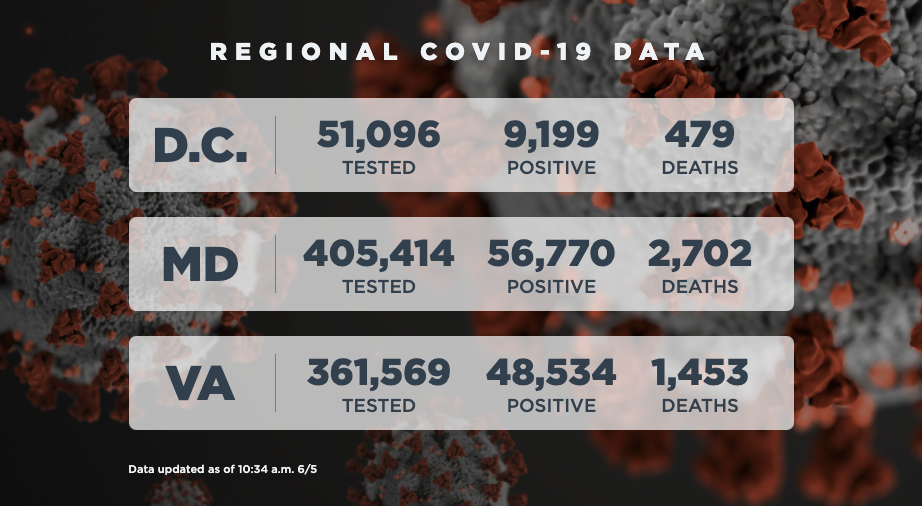
The District tallied 79 new positive cases, down from the past two days. That brings its total to 9,199 cases with 51,861 tests administered. D.C. also reported four more deaths today, up from the past four days, for 479 deaths in all.
This death information was provided in a press release but not updated on the city’s website. The mayor’s office did not immediately respond to a request for clarification.
The District’s positivity rate is 17.7%, down from 17.8% yesterday. (The more tests, the lower the rate should fall because more people in the general population are being tested, not only those who are displaying symptoms of the virus.)
Ward 4 continues to see the most cases (1,926, and 68 deaths, up one from yesterday), and Ward 8 has the most deaths (97, unchanged from Wednesday, with 1,340 cases). By neighborhood, Columbia Heights and 16th Street Heights continue to see the highest number of infections, with 593 and 534 cases respectively. (You can read amore detailed breakdown of this neighborhood data here.)
The District has seen four days of “sustained decline” in the community spread of COVID-19 during Phase One of reopening, following a new peak in cases on May 30. D.C. officials waited to see a 14-day decline in this measure (among other indicators) before beginning to reopen the city.
Virginia
Virginia reported 678 new cases and eight deaths this morning, the lowest toll in four days. The Commonwealth’s positivity rate stands at 10.1%, down from yesterday’s 10.6%, with 361,569 tests administered. A positivity rate of 10% or less is one of the key metrics to reopening the economy.
Today most of Virginia — excluding Northern Virginia — will enter Phase Two of reopening. Northern Virginia jurisdictions, which continue to be hardest-hit, began Phase One of reopening last Friday behind the rest of the state.
Fairfax, Prince William, Loudoun, Arlington, and Alexandria counties continue to see the most cases, in that order. Northern Virginia added another 295 cases this morning, lower than its moving 7-day average of 395.6 cases.
Maryland
Maryland reports 912 new cases, bringing the total to 56,770 since the pandemic began, and 38 new deaths. In all, 2,702 people have died. Today the state is easing restrictions on nonessential businesses like nail salons and tattoo parlors.
The state’s positivity rate has dropped to 8.4%, down from 8.9% yesterday, with 405,414 tests conducted thus far. (The state’s positivity rate peaked on April 17 at 26.9%.) Hospitalizations continue to decline, with 20 fewer than yesterday, for 1,076 total. This is their lowest level since April 13. So far 4,159 people have been released from isolation.
“We are and will continue to be much better positioned than most states when it comes to testing, and our strategic stockpile of tests and our successful long-term strategy will ensure that we have a strong and fully functioning supply of tests until such time as there is a vaccine,” said Maryland Gov. Larry Hogan in a press release today.
Prince George’s and Montgomery counties still have the highest number of deaths and cases in the state, with 16,169 and 12,434 cases respectively. The two counties began their first phase of easing restrictions Monday, later than the rest of the state. —Julie Strupp
Virginia Governor Northam To Be Tested For COVID-19
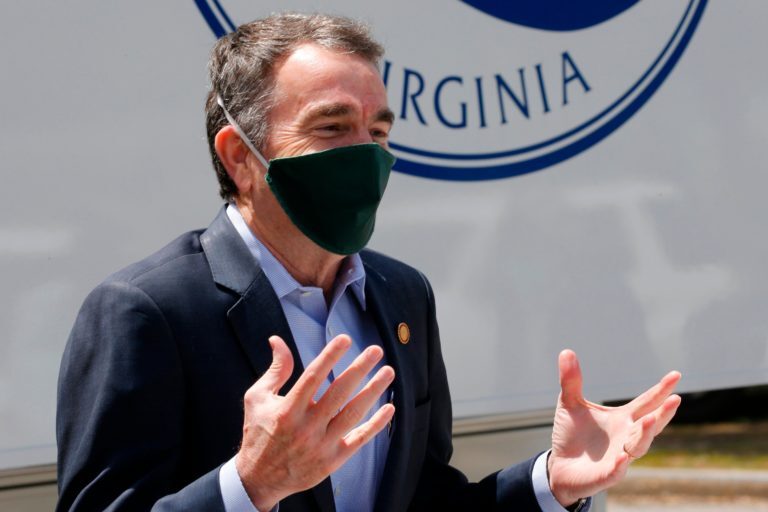
June 5, 9:45 a.m.: Virginia Gov. Ralph Northam will be tested for COVID-19 today at 10:00 a.m. in Chesapeake, VA according to his public schedule.
The community testing event is organized by the Virginia Office of Diversity, Equity, and Inclusion, Urban League of Hampton Roads, Chesapeake Regional Healthcare, Chesapeake Health Department, and other community leaders. The testing center is located in the Geneva Square area of Deep Creek and will be open today from 10:00 a.m. until 2:00 p.m. for 400 participants to receive nasal-swab tests, according to a press release from Chesapeake Regional Healthcare.
Those who are asymptomatic are encouraged to receive tests. The testing center is open to Virginia residents and results will be delivered within 48 hours. —Victoria Chamberlin
More Stories From Thursday
- Prince George’s County Will Not Yet Move Onto Phase Two Of Reopening
- The City of Alexandria Could Move Into Phase 2 Next Week
- Cases Near 113,000 In D.C., Maryland, And Virginia As Positivity Rates Continue To Slump
Prince George’s County Will Not Yet Move Onto Phase Two Of Reopening
June 4, 10:55 p.m.: As parts of Maryland move into phase two of the state’s three-tier reopening plan, Prince George’s County will stay in its current modified version of phase one.
The county has one of the highest infection, hospitalization, and death rates in the state, County Executive Angela Alsobrooks wrote in a press release. As a result, it has lagged behind other jurisdictions reopening.
Gov. Larry Hogan announced on Wednesday that all nonessential businesses in Maryland will be allowed to reopen on Friday, but left room for jurisdictions — like Prince George’s and Montgomery counties — to reopen at their own pace. Both of those counties announced a modified phase one reopening on Monday.
Alsobrooks wrote that the county could enter a modified phase two as early as June 15. For that to happen, Prince George’s County Health Department officials must see a decline in coronavirus deaths. They will also assess positivity rates, hospitalizations, and medical/surgical bed utilization in determining whether to move onto the next phase.
“We are encouraged by the trends we are seeing in our data since announcing our modified phase one reopening, but we must remain vigilant,” Alsobrooks wrote. “All of our indicators tell us that COVID-19 is still active in our community, and while I am eager to continue reopening our County, we must do so in a safe, smart and responsible manner that is data driven.”
A modified phase two would allow a soft reopening for personal services, outdoor recreation, retail and food establishments, and houses of worship. A full phase two reopening in Maryland allows all nonessential businesses to reopen at 50% of maximum capacity and with safety protocols, such as requiring workers and customers to wear face coverings.
Ball courts, playgrounds, fitness facilities, beauty salons, tattoo shops, and county government buildings remain closed under phase one restrictions. –Christian Zapata
The City of Alexandria Could Move Into Phase 2 Next Week
June 4, 4:22 p.m.: Alexandria City Mayor Justin Wilson said it’s possible that the city could move into Phase 2 of reopening by next Friday, at the earliest, though he cautions that it will be the data that will make the determination for them. He made the comments on Wednesday night at a virtual town hall meeting, as first reported by Alexandria Now.
“The rest of the commonwealth will move into Phase 2 on Friday. We would not move into Phase 2 until, at the earliest, the following week — next Friday,” Wilson said. “Ultimately, we will have to see where the data goes before we determine when to move into Phase 2.”
Virginia — save for Richmond and Northern Virginia — is moving into Phase 2 tomorrow. This means that restaurants can operate indoors at 50 percent capacity and will allow social gatherings of up to 50 people. Places like museums, zoos, botanical gardens, and outdoor concerts, sporting, and performing arts venues are also allowed to reopen. Swimming pools, as well, can be open for exercise and instruction. Masks will continue to be required indoors.
Since May 28, the number of cases in Alexandria is on a notable downward trajectory as is the positivity rate. It’s now at about 10 percent when it was at 17 percent two weeks ago.
However, the number of testing encounters in the city has fluctuated over the last weeks, spiking on May 26 while dropping this past week.
Wilson told DCist/WAMU that the city is looking for progress on reductions of positive tests and hospitalizations, along with an increase in contract tracing and hospital capacity before moving to Phase 2. While the region isn’t there yet, he says, it is continuing to move in the right direction.
He also noted that Phase One was intended to last for two to four weeks and the rest of the commonwealth is moving forward after week three. Meaning, if Northern Virginia is on the same schedule, that it could be June 19th when the region moves into Phase Two.
“Maybe the gap narrows by a week,” said Wilson. “We will see.” –Matt Blitz

Cases Near 113,000 In D.C., Maryland, And Virginia As Positivity Rates Continue To Slump
June 4, 1:42 p.m.: There are nearly known 113,000 cases of COVID-19 in D.C., Maryland, and Virginia. The jurisdictions’ positivity rates—the proportion of people who test positive out of the overall number of people tested—continue to decrease.
There are 1,931 new known cases of the coronavirus in the three jurisdictions, up from the past four days, marking 112,834 in all. Forty-six more people have died, bringing the total to 4,588 local fatalities.
Meanwhile D.C. Health reported the city saw a spike in community spread on May 30, which may impact the next phase of the city’s reopening. The community spread metric attempts to measure the trend of the disease in the general population.
The totals include all confirmed and probable cases and deaths linked to the coronavirus that are reported by local jurisdictions. Here’s what the numbers look like in each jurisdiction.
The District
D.C. reported two more deaths today and 104 new positive cases, down from yesterday but higher than the previous three days. That brings its total to 9,120 cases with 51,096 tests administered.
The District’s positivity rate is 17.8%, a drop from 18.2% yesterday. (The more tests, the lower the rate should fall because more people in the general population are being tested, not only those who are displaying symptoms of the virus.)
Ward 4 continues to see the most cases (1,913, and 67 deaths, up one from yesterday), and Ward 8 has the most deaths (97, unchanged from yesterday, with 1,323 cases). By neighborhood, Columbia Heights and 16th Street Heights continue to see the highest number of infections, with 582 and 531 cases respectively. (You can read a more detailed breakdown of this neighborhood data here.)
The District has seen three days of “sustained decline” in the community spread of COVID-19 during Phase One of reopening, following a new peak in cases on May 30. D.C. officials waited to see a 14-day decline in this measure (among other indicators) before beginning to reopen the city; officials said they would lay out their metrics for moving to Phase Two sometime this week.
Virginia
Virginia reported 951 new cases and 17 deaths today. The commonwealth’s positivity rate stands at 10.6%, down from yesterday’s 11%, with 351,354 tests administered. A positivity rate of 10% or less is one of the key metrics to reopening the economy.
But tomorrow, most of Virginia — excluding Northern Virginia — will enter Phase Two of reopening.
Fairfax, Prince William, Loudoun, Arlington, and Alexandria counties continue to see the most cases, in that order. Northern Virginia jurisdictions began phase one of reopening last Friday.
Maryland
Maryland reports 876 new cases, bringing the total to 55,858 since the pandemic began, and 27 new deaths. In all, 2,668 people have died.
The state’s positivity rate has dropped to 8.91%, down from 9.49% yesterday, with 392,240 tests conducted thus far. (That positivity rate peaked on April 17 at 26.9%.) Starting Friday, the state is further easing coronavirus restrictions, and nonessential businesses like nail salons and tattoo parlors will be able to reopen.
Prince George’s and Montgomery counties still have the highest number of deaths and cases in the state, with 15,940 and 12,226 cases respectively. The two counties began their first phase of easing restrictions Monday, later than the rest of the state. —Julie Strupp and Jordan Pascale
More Stories From Wednesday
- Maryland Will Allow Nonessential Businesses To Reopen Starting Friday
- D.C. Sees Case Surge After Uptick In Testing; Positivity Rates Continue To Drop
- D.C. Region Fares Slightly Better Than Nation With Unemployment
Maryland Will Allow Nonessential Businesses To Reopen Starting Friday
June 3, 7:27 p.m..: Nonessential businesses in Maryland will be able to reopen starting Friday, including nail salons, tattoo parlors, and the state’s Motor Vehicle Association.
Gov. Larry Hogan announced on Wednesday he is once more allowing jurisdictions to move into the next stage of his three-step “Maryland Strong Roadmap for Recovery” plan at their discretion, according to the Baltimore Sun.
Previously, Howard, Anne Arundel, Montgomery, and Prince George’s counties took additional time before easing restrictions. Prince George’s and Montgomery counties began reopening on Monday.
Facilities are limited to 50 percent of their maximum capacity at this stage, and businesses like barbershops and beauty salons can only take appointments made in advance. Maryland’s Motor Vehicle Administration will also reopen on an appointment-only basis.
Outdoor recreation areas such as campgrounds, drive-in movie theaters, and swimming pools will also reopen, as well as all manufacturing businesses. Last month, Montgomery and Prince George’s counties said pools will remain closed for the time being. At the time, Montgomery County said indoor pools would observe capacity limits similar to other businesses once they open, and visitors might have to bring their own chairs, according to WTOP.
Nonessential businesses will be able to partially reopen across the state with restrictions seen in other regional reopenings, such as requiring workers and customers to wear face masks.
The rate of positive cases in Maryland has dropped nearly 10 percent as of Wednesday — down more than half its peak in April. Prince George’s and Montgomery counties still have the highest rate of cases and deaths in the state. —Christian Zapata

D.C. Sees Case Surge After Uptick In Testing; Positivity Rates Continue To Drop
June 3, 12:28 p.m..: Nearly 111,000 cases of COVID-19 have been identified in D.C., Maryland, and Virginia. Positivity rates (the proportion of people who test positive out of the overall number of people tested) keep falling as testing continues to ramp up.
The three jurisdictions reported 1,603 new known cases of the coronavirus today, for 110,903 in all. Sixty-eight more people have died—the highest count in five days—bringing the total to 4,542.
The totals include all confirmed and probable cases and deaths linked to the coronavirus that are reported by local jurisdictions. Here’s what the numbers look like in each jurisdiction.
The District
D.C. reported three more deaths this morning and 130 new positive cases, a big jump from the past three days that corresponds with an uptick in new tests. That brings its total to 9,016 cases with 49,562 tests administered.
The District’s positivity rate is 18.2%. (The more tests, the lower the rate should fall.) Another person has recovered, for 1,138 total.
Ward 4 continues to see the most cases (1,852, and 66 deaths), and Ward 8 has the most deaths (97, with 1,278 cases). By neighborhood, Columbia Heights and 16th Street Heights continue to see the highest number of infections, with 577 and 525 cases respectively. (You can read a more detailed breakdown of this neighborhood data here.)
The District has hit three days of “sustained decline” in the community spread of COVID-19 during Phase One of reopening. The community spread metric attempts to measure the trend of the disease in the general population. D.C. officials waited to see a 14-day decline in this measure (among other indicators) before beginning to reopen the city; officials said they would lay out their metrics for moving to Phase Two sometime this week.
Virginia
Virginia reported 21 deaths today, the highest number since Friday, and tallied 666 new cases, which is the lowest count since May 24. The Commonwealth’s positivity rate has dropped to 11%, with 340,197 tests administered.
Yesterday, Gov. Ralph Northam announced that most of Virginia — excluding Northern Virginia — will enter Phase Two of reopening this Friday, June 5. Fairfax, Prince William, Loudoun, Arlington, and Alexandria counties continue to see the most cases, in that order.
Today the Northern Virginia region recorded another 355 cases of the virus, which is lower than its moving seven-day average of 467.3. Northern Virginia jurisdictions began Phase One of reopening last Friday.
Maryland
Maryland recorded another 44 deaths this morning and 807 new cases, with a high number of new tests. Last Friday the state further relaxed restrictions on activities like youth sports and outdoor summer camps.
The state’s positivity rate has dropped to 9.49% with 380,716 tests administered. That positivity rate is down by more than half from its April 17 peak of 26.9%. So far 3,970 people have recovered, and hospitalizations dropped by 39 today for 1,109 total.
Both Prince George’s and Montgomery counties began easing restrictions on Monday, though they still have the highest number of deaths and cases in the state, with 15,738 and 11,924 cases respectively. —Julie Strupp

D.C. Region Fares Slightly Better Than Nation With Unemployment
June 3, 11:13 a.m.: Fresh numbers from the Bureau of Labor Statistics show how insulated the D.C. region has been from the economic wreckage of COVID-19 compared to other dense parts of the country.
While 12 U.S. metro areas had jobless rates of at least 25% last month, two populous hubs in the D.C. region fared better than any other divisions in the country (divisions refer to employment centers within metropolitan areas). In Maryland, Silver Spring-Frederick-Rockville had the lowest unemployment rate of all 38 metropolitan divisions in the U.S., at 8.8%. It was followed by Washington-Arlington-Alexandria/D.C.-VA-MD-WV, at 10.1%.
These places also saw the smallest jumps in unemployment since April 2019, according to BLS data. Joblessness in Silver Spring-Frederick-Rockville increased 6.2 percentage points over the year, with Washington-Arlington-Alexandria/D.C.-VA-MD-WV rising 7.3 points.
By comparison, unemployment is substantially higher in the Michigan divisions of Detroit-Dearborn-Livonia (25.9%), followed by Warren-Troy-Farmington Hills (23.6%). Both also experienced the sharpest unemployment rate increases of any U.S. division, at 21.6 and 20.3 points over April 2019, respectively.
The broader Washington metropolitan area had an unemployment rate of 9.9% last month, up from 2.8% in April 2019. The national unemployment rate was 14.7%. —Ally Schweitzer
More Stories From Tuesday
- Most of Virginia—But Not NoVa—Can Begin Phase Two Reopening Friday
- Instacart To Offer Workers Expanded Paid Leave, Other Benefits After Request By D.C. Attorney General
- Cases Top 109,000 In D.C., Maryland, And Virginia
Most of Virginia—But Not NoVa—Can Begin Phase Two Reopening Friday
June 2, 5:47 p.m.: Most of Virginia — though not Northern Virginia — will enter Phase Two of the governor’s plan to reopen after weeks-long coronavirus shutdown.
“We’ve been in Phase One for nearly three weeks, and our health data continues to look good,” Northam said at a press briefing.
Northern Virginia, which has been hit hard by the virus, only began its initial Phase One reopening Friday, two weeks after most of the state. Gov. Ralph Northam has not set a day for when the region will advance to the second stage of loosened restrictions.
“We need more time to monitor their health data,” the governor said.
He cited several positive trends to support moving most of the Commonwealth into Phase Two, including steady hospital bed capacity, an increase in testing and a decline in Virginia’s percent positivity rate, which calculates the number of positive COVID-19 tests compared to the total conducted. When you exclude Northern Virginia, that figure is about 10%, Northam said.
The World Health Organization advises that countries, states and localities should aim for a rate below 10%, if not 5%.
Virginia’s second stage of reopening allows restaurants to offer their outdoor seating at 50% capacity, gyms can reopen their facilities at 30% capacity, and entertainment venues like museums, zoos and gardens can reopen with some restrictions.
“But we are still safer at home,” Northam said, “Gatherings will be limited to 50 people rather than 10. We still strongly encourage teleworking and physical distancing.” He has also issued a requirement to wear masks in indoor public places, though enforcement can be a challenge.
Northam said more information would be posted online later today and that he would address the Phase Two reopening in more detail at his press briefing on Thursday.
Leaders from Northern Virginia, who requested that Northam delay reopening the region, had said they would like the whole state to move into Phase Two together, “if the data supports it.”
Justin Wilson, the mayor of Alexandria, says that one week into reopening, the region continues to see progress in key data metrics but isn’t yet prepared to lift more restrictions.
“Like we said from the beginning, politicians are not going to make this schedule. The virus is. The virus is going to dictate when and what we do,” he said.
The city of Richmond and Accomack County also delayed their initial reopening. Richmond will stay in Phase One along with Northern Virginia, but Northam said that Accomack — which experienced an outbreak at a poultry plant — could enter Phase Two on Friday. –Hannah Schuster

Instacart To Offer Workers Expanded Paid Leave, Other Benefits After Request By D.C. Attorney General
June 2, 4:08 p.m.: Grocery delivery company Instacart will begin allowing its workers to access up to 14 days of paid sick leave if they are diagnosed with COVID-19 or someone they live with tests positive for the disease, says D.C. Attorney General Karl Racine’s office.
As part of an agreement that Instacart and Racine’s office reached after the latter asked the San Francisco-based company to expand eligibility for its extended pay program during the coronavirus pandemic, Instacart will now allow workers who are experiencing symptoms of COVID-19—even if they’re not tested but have a diagnosis from a doctor—to take paid leave. Instacart will also provide workers who have symptoms with free telemedicine appointments through Doctors on Demand. The telemedicine option will be piloted in D.C. before being expanded to other places, according to Racine’s office.
“During this pandemic, grocery delivery workers are risking their health to connect District residents to essential goods,” Racine says in a press release. “Instacart’s new policy will ensure that workers who are sick can stay home and seek care, and it helps protect their colleagues, consumers, and the public during this crisis.”
In the District, the company will provide up to 14 days of financial assistance in June to workers whose child’s school or daycare is closed due to the pandemic. “The assistance will be based on workers’ recent earnings and will be available to active Instacart workers who meet certain conditions,” Racine’s office says. In addition, Instacart will donate $50,000 to the Capital Area Food Bank to help residents facing food insecurity in the crisis.
“As this pandemic continues to affect our communities, we believe it’s important to expand our offerings to support the ongoing needs of shoppers during this critical time,” says Nilam Ganenthiran, Instacart’s president, in a statement.
Shoppers for Instacart and other gig-economy platforms such as Shipt, which is owned by Target, have reported increased competition from their peers and, in some cases, reduced earnings and insufficient personal protective equipment provided by the platforms. Instacart previously told DCist that it anticipated hiring 36,000 new shoppers in D.C. because of the surge in demand for grocery deliveries during the pandemic. —Andrew Giambrone

Cases Top 109,000 In D.C., Maryland, And Virginia
June 2, 12:15 p.m.: D.C., Virginia, and Maryland reported 62 more COVID-19 deaths this morning, up from the past two days, for a combined toll of 4,474 people. The three jurisdictions reported 1,718 new infections, bringing the number of known cases to 109,300 in all.
The totals include all confirmed and probable cases and deaths linked to the coronavirus that are reported by local jurisdictions. Here’s what the numbers look like in each jurisdiction.
The District
On Tuesday, D.C. reported 29 new cases—its lowest count in months—bringing its total to 8,886. The District also reported two new fatalities, and 470 people have died in all.
On May 29 D.C. saw a jump in community spread, a metric that looks to measure case trends in the general population. (Officials wanted to see 14 days of decline before entering Phase One of reopening, which began on Friday.) According to an update on the District’s coronavirus website, the city is restarting its community spread count at the beginning of each reopening Phase. There’s been a day of decline as of May 30, the latest day for which data is available.
This comes after the District began to ease restrictions and large-scale protests over the murder of George Floyd rattled the city over the weekend and into Monday night. It remains unclear how the reset will impact the District’s reopening plans.
Virginia
Virginia reported 15 deaths today. It also tallied 841 new cases, a slight increase after reporting their lowest numbers in a week yesterday. The Commonwealth’s positivity rate dropped slightly, though, to 11.5%, and it has administered 328,889 tests.
Fairfax, Prince William, Loudon, Arlington, and Alexandria counties still have the highest number of cases, in that order. Northern Virginia began phase one of reopening on Friday, two weeks later than the rest of the Commonwealth.
Maryland
Maryland recorded 43 deaths today, more than double the number the state reported one day earlier, which had marked its lowest toll since early April. The state’s positivity rate continued to drop to 10.54%, with a total of 366,331 tests administered.
Prince George’s and Montgomery counties, which began easing restrictions on Monday, continue to see the highest number of cases. Prince George’s recorded 200 new cases today, with a new total of 15,553, and Montgomery saw an even sharper increase of 255 cases, bringing its new total to 11,731. The state reported 848 new cases overall.
This week both D.C. Mayor Muriel Bowser and Maryland Governor Larry Hogan voiced concerns that their local jurisdictions might see spikes in new cases stemming from the protests, and Bowser urged participants in D.C. to get tested and self-isolate. —Nathan Diller
Stories from Monday
- Cases Top 107,000; D.C. Data Not Updated This Morning
- Local Officials Worry Protests May Lead To Spike In COVID-19 Cases
Cases Top 107,000; D.C. Data Not Updated This Morning
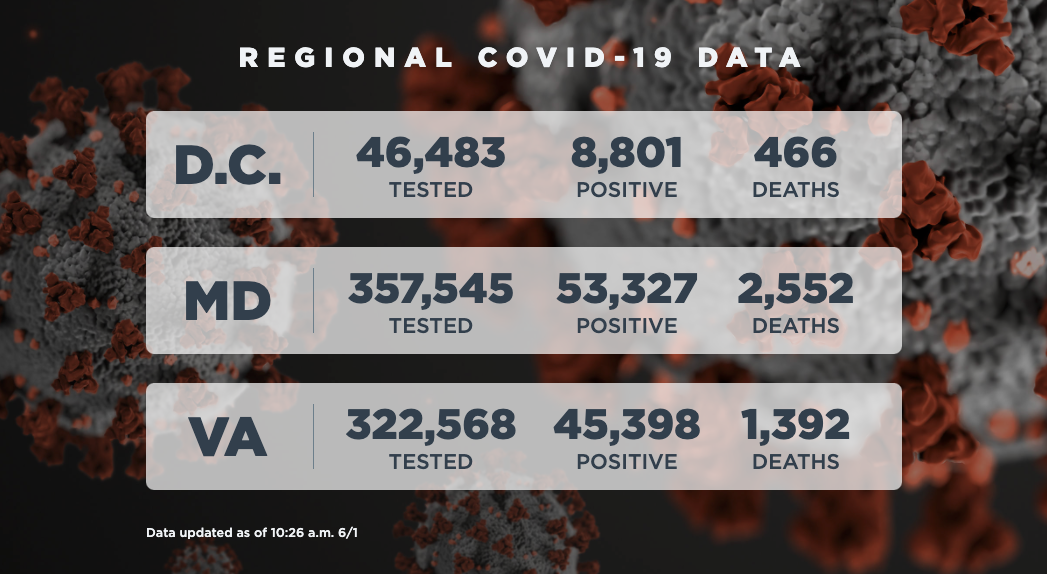
June 1, 11:55 a.m..: Maryland and Virginia tallied another 1,340 cases of the coronavirus this morning, for a total of 107,526 known infections in the two states and D.C. This total does not include new D.C. numbers because its data was not updated this morning.
Thirty-seven more people have died in Maryland and Virginia, for a total of 4,410 fatalities to date in the three jurisdictions.
The totals include all confirmed and probable cases and deaths linked to the coronavirus that are reported by local jurisdictions. We will update the numbers once new D.C. data is available.
Both D.C. Mayor Muriel Bowser and Maryland Gov. Larry Hogan expressed concern that there could be a surge in COVID-19 cases following this weekend’s protests. Hogan said officials would be watching for a related spike in cases in coming weeks, and Bowser urged demonstrators to get tested or self-isolate depending on their exposure.
The District and Northern Virginia began reopening certain businesses on Friday, and Prince George’s and Montgomery counties began easing restrictions today.
Here’s what the numbers look like in each jurisdiction.
The District
D.C.’s numbers have not yet been reported for today. Yesterday D.C officials said they are investigating a potential peak in community spread after 17 days of decline.
Virginia
Virginia reported 17 deaths today and tallied 791 new cases, its lowest count in a week. The Commonwealth’s positivity rate stands at 11.8%, with 322,568 tests administered.
Fairfax, Prince William, Loudoun, Arlington, and Alexandria counties continue to see the most cases, in that order. Northern Virginia jurisdictions begin phase one of reopening on Friday, and a statewide mask requirement also went into effect for people entering shops, restaurants, and public transportation.
Maryland
Maryland recorded another 20 deaths this morning, its lowest toll since early April, and identified 549 new cases, its lowest count since last Tuesday.
Both Prince George’s and Montgomery counties begin gradually reopening today, though they still have the highest number of deaths and cases in the state, with 15,353 (133 new) and 11,476 (115 new) cases respectively. On Friday the state further relaxed restrictions on activities like youth sports and outdoor summer camps.
The state’s positivity rate has dropped to 10.77% with 357,545 tests administered, down by more than half from its April 17 peak of 26.9%. So far 3,782 people have recovered, while hospitalizations dropped by nine to 1,174 total. —Julie Strupp

Local Officials Worry Protests May Lead To Spike In COVID-19 Cases
June 1, 9:02 a.m. : Amid protests sparked by the death of George Floyd, D.C. Mayor Muriel Bowser and Maryland Gov. Larry Hogan have expressed concern that the mass gatherings may further the spread of COVID-19.
“Where I saw some people social distancing, others were right on top of each other,” Bowser said on NBC’s Meet The Press Sunday. “We don’t want to compound this deadly virus and the impact that it’s had in our community.”
Bowser said demonstrators should consider self-isolating or getting tested for the virus, based on their level of exposure.
The nature of the protests that have rocked the city the past three nights pose additional risks to participants; beyond gathering in close proximity, the use of tear gas can induce coughing and could make transfer of the virus more likely.
Hogan also spoke Sunday about the health risks of the protests, saying officials will be watching for a possible “spike” in cases in the coming weeks.
“There’s no question that, when you put hundreds or thousands of people together in close proximity, when we have got this virus all over the streets, it’s not healthy,” he said on CNN’s State of the Union.
Prince George’s County and Montgomery County will begin a phased reopening today. Both counties have experienced a recent decline in COVID-19 cases. —Eliza Berkon
For more on how coronavirus has impacted the D.C. region, see these updates from the week of May 25-May 31.