 Victoria Chamberlin
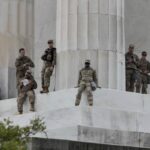
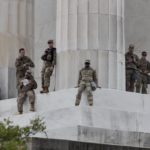
An additional 1,500 national guardsmen will join the D.C. National Guard on Tuesday in response to protests in the District against the killing of George Floyd in Minneapolis.
The chief of the National Guard bureau confirmed this morning on a call with reporters that national guardsmen from Indiana, South Carolina, Tennessee, and now Maryland will be deployed to the District.
Close to 1,300 soldiers and airmen in the D.C. national guard were already deployed to the District on Monday night, augmented by national guard troops from Utah and New Jersey to assist civilian law enforcement efforts in the ongoing protests of police brutality.
On Tuesday afternoon, a number of Humvees were already seen driving through D.C. as additional troops made their way to the city.
K street NW #wtf pic.twitter.com/nWpHBKp4Hv
— Former Petworthian™ (blue checkmark) (@petworthnewvie) June 2, 2020
Gen. Joseph Lengyel said that between National Guard troops activated for the COVID-19 response and the recent civil unrest mission, there are 67,000 active guardsmen in the country right now — the largest national guard deployment since Hurricane Katrina.
Unlike the active-duty military, the guard is made up of civilians. That difference can be indistinguishable to the public because they wear the same uniform as active-duty military.
Guardsmen are trained to provide domestic help in times of national emergency. When they’re activated under Title 32 of the United States Code, they leave their regular day jobs to complete their mission.
Federal law prohibits the active-duty military from directly participating in law enforcement activities like conducting surveillance, searches, or making arrests on behalf of civilian law enforcement. That work is reserved for the guard.
Guardsmen are often called into duty for natural disasters like hurricanes and floods. But large demonstrations and protests are also under their purview. That includes this week’s protests.
“The civil unrest mission is in our domestic portfolio,” Lengyel told reporters. “But it is one of our most difficult missions and the mission we like doing the least.”
So far three states have rejected the Secretary of Defense’s request to governors for additional national guard troops in D.C., including New York, Virginia, and Delaware, according to the Washington Post. The outlet reported that Virginia Gov. Ralph Northam rejected a personal appeal from Secretary of Defense Mark Esper for thousands of Virginia national guard members.
“I am not going to send our men and women in uniform — a very proud National Guard — to Washington for a photo op,” Northam told the outlet, referencing the president’s appearance in front of St. John’s Church on Monday night as federal police dispersed protesters with canisters of smoke and rubber bullets.
Senior defense officials said that members of the D.C. National Guard on Monday were not carrying “non-lethal” weapons including tear gas, smoke canisters, or rubber bullets. Their typical uniform for these types of missions includes a shield and club where appropriate. Soldiers on the “front line” had pepper spray that was not deployed, according to the Pentagon.
D.C. Mayor Muriel Bowser came out against the use of firearms to quell protests during a press conference Tuesday morning. In a tweet on Monday night she called the use of munitions to move peaceful protesters from in front of the White House “shameful.”
Bowser also said the presence of federal assets are appropriate at the monuments and memorials, but not armed on the streets. “We do not request… an armed guard for any purpose in the District,” she said about the possibility that D.C. National Guardsmen could be armed.
“The events of the last several days demonstrate that our fight for statehood is more than about getting two senators,” Bowser said.
Though all guard members are trained to respond and work with local law enforcement, they aren’t all trained police officers. Military policemen are a specific occupational specialty with unique training and qualifications and can be “deputized” as special police by local law enforcement. The D.C. National Guard military police were carrying rifles or pistols, which is always part of the civil defense mission.
Senior Master Sgt. Craig Clapper said there were discussions of arming the entire National Guard and not just the military police officers for future protests.
Though President Trump ultimately commands the D.C. National Guard, orders during this week’s “civil unrest” mission are coming from Major Gen. William Walker, who will command all national guard forces in the District regardless of which state they represent. Walker reports to the Secretary of the Army, who has given the directive to protect buildings, monuments, and general peace and order in the District.
However, the president has broad legal authority in the nation’s capital. And that starts with the D.C. National Guard.
“Unlike state guards, where there’s often a complicated interplay between the governor and the president, the D.C. Guard has a unified command,” says University of Texas Law Professor Stephen Vladeck. “The mayor can ask, but the president and Secretary of Defense are the only authorities who can formally activate the guard. So the D.C. guard is basically ‘always federal’ in ways that aren’t necessarily true for states’ guards.”
Active-duty forces arrived in the area yesterday from Fort Bragg in North Carolina and were placed on a short alert status, meaning they are ready to deploy if called upon. They are located at bases in the national capital region, but outside of the District. So far, no active-duty forces have been deployed into the District or are engaged in law enforcement.
If the president were to bring in troops from neighboring active duty bases, he would need an exemption to federal law — and one exemption is the Insurrection Act.
“The Insurrection Act remains the most likely and legally ‘clean’ method for introducing military units — whether active duty or National Guard — into the current unrest in order to reestablish order in a uniform manner,” said D.C.-based national security attorney Bradley Moss.
Senior defense officials say they want to do everything they can to keep from using the active-duty force in D.C. and across the country.