Rachel Kurzius
 Rachel Sadon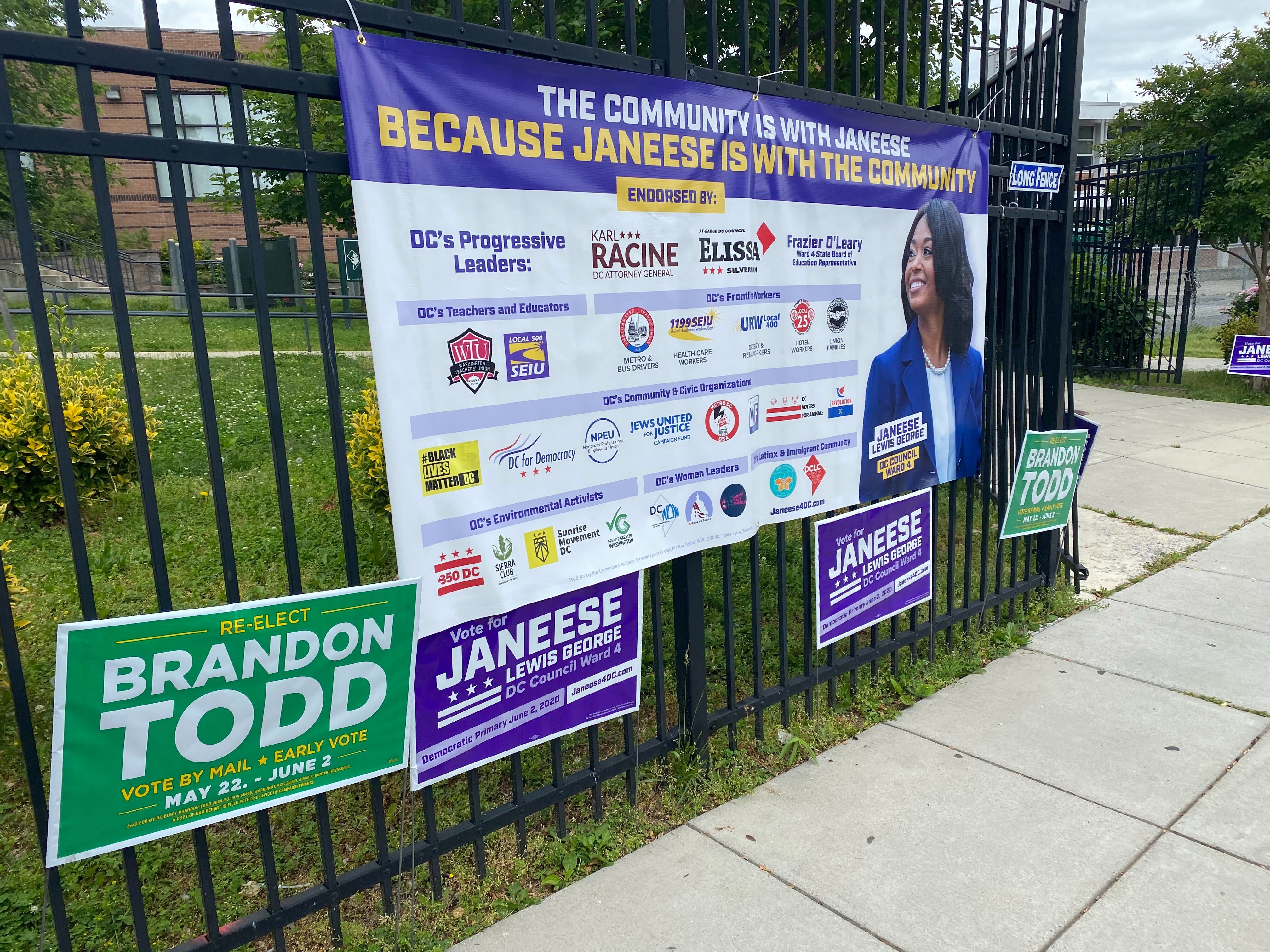
This story was updated at 3:20 p.m. on June 4.
After an election night marked by wait times stretching past four or five hours at polling sites, Janeese Lewis George appears to have bested incumbent Brandon Todd in Ward 4 in the Democratic primary, while Brooke Pinto holds an extremely narrow lead in Ward 2, according to unofficial election results that don’t include special and some absentee ballots.
Incumbents Vincent Gray and Trayon White, in wards 7 and 8, appear to be handily holding on to their seats. Both lead by margins of around 2,000 votes.
All 144 precincts are reporting, including both early votes and ballots cast on Election Day. But the totals don’t include special ballots or nearly half of the absentee ballots that were requested. Just over 50,000 absentee ballots had been counted by Wednesday, while some 90,000 were requested.
While Democrats, Republicans, Libertarians, Statehood Greens, and independents all cast ballots in the primary, the Democratic primaries in deeply blue D.C. are most often more competitive than November’s general election. (An exception is an at-large race for the seat that David Grosso is vacating, which cannot be filled by a Democrat.)
Absentee and provisional ballots will continue to be counted in the coming days, and it is likely to be at least three weeks before the Board of Elections certifies the results. It’s not clear exactly how many ballots remain to be counted.
The Ward 4 race is a test of Mayor Muriel Bowser’s political machine — Todd was her handpicked successor and received an endorsement from her. He was also backed by D.C. Council Chairman Phil Mendelson, who considers the moderate councilmember an “important ally.”
But George, who described herself as a “people-first” candidate and racked up a series of progressive endorsements, is up by about 10 percent — more than 1,500 votes. George won about 75 percent of the precincts in the ward and did particularly well in gentrifying neighborhoods, as former D.C. politics reporter Cuneyt Dil noted, including the area around the Petworth Metro station.
George declared victory on Wednesday morning, saying that even with uncounted absentee ballots her campaign expects “our lead will stay stable or grow slightly.”
“Our campaign has a broad coalition, reflective of Ward 4. Ward 4 neighbors and grassroots organizations came together and together, united, we won. This is a victory for racial, environmental, social, and economic justice. Together we can make D.C. a more just and equitable place,” she said in a statement.
Bowser acknowledged her protégé’s defeat at the polls. “It looks like we have a new Democratic nominee in Ward 4,” she said at a press conference on Wednesday, adding that Todd “should be very proud of his service, and I know he’ll be able to hand off his progress well to the next councilmember.”
Todd conceded in a note on Facebook on Thursday. “The past 5 years serving as your Councilmember has truly been an honor and privilege,” he wrote. “I’ve congratulated Ms. Lewis-George, and will continue to support Ward’s 4 progress.”
In Ward 2, Pinto is beating Advisory Neighborhood Commissioner Patrick Kennedy by about 100 votes. Pinto was the latest entrant in the crowded race, whereas Kennedy was the first to declare.
Pinto isn’t quite declaring victory yet, though “we are declaring that the votes that have been counted demonstrate that we’re in the lead, and hope that the rest of the votes that come in reflect that as well,” she says. “I do feel confident that the remaining ballots left to be counted will track along that trajectory.”
Kennedy says that “it’s on a razor’s edge. We feel reasonably good about the possibility of ultimately making up our deficit and still winning this race.”
But even as the race remains a virtual tossup, one thing seems clear: the wealthy ward did not vote Jack Evans back into office. Evans, who represented the ward for almost 30 years, was hopeful this race could mark his political comeback—he announced his candidacy 10 days after resigning from his seat amid an ethics scandal, and the entire sitting D.C. Council condemned his run. But he came up with fewer than 300 votes thus far, landing him in seventh out of an eight-person pack.
Evans says he has no regrets about throwing his hat back in the ring. “I’m glad I ran and I congratulate — we don’t have a winner yet, but I congratulate the ultimate winner,” he tells DCist. “I thank the residents from Ward 2 who supported me and … I respect the voters. I enjoyed serving and now look forward to the next chapter of my life.”
Jordan Grossman, the candidate favored by many of the city’s progressive groups, is currently in third, with 20 percent — about 600 votes shy of Pinto. Grossman said in a note to supporters that “the results look very promising for us … most of the outstanding votes are likely to come from my strongest precincts.”
Kennedy, meanwhile, looks at his deficit and says, “it would be very difficult for him to have the votes to overcome that,” and instead, sees the race at this point as one between him and Pinto.
While Kennedy early on amassed the support of a plurality of Advisory Neighborhood Commissioners in the ward and notched endorsements from Mendelson and At-large Councilmember Anita Bonds, Pinto was a sleeper candidate who scored a nod from the Washington Post editorial board and a mixture of citywide and federal elected officials.
The final results of this tight race aren’t expected from the Board of Elections before Ward 2’s special election on June 16 to determine who will serve the rest of the term vacated by Evans. All of the Democratic candidates, aside from Evans, will run in that race, as will Republican Katherine Venice.
Amid the pandemic, the Board of Elections decreased the number of polling centers from 144 to just 20 and heavily encouraged Washingtonians to vote by absentee ballot.
But the board struggled to meet the demand, with Washingtonians reporting difficulties at multiple stages of the process. Low numbers of absentee ballot requests in communities east of the Anacostia River also raised concerns about access and turnout. Indeed, Ward 8 saw three quarters of voters come to cast ballots in person, and Ward 7 had slightly more Election Day votes than absentee votes.
At-large Councilmember Elissa Silverman told DCist that a quarter of people still waiting to cast their votes at the Emery Heights Recreation Center in Ward 4 around 12:45 p.m. had requested an absentee ballot and never received it. Silverman, one of the council’s two independent members, supported George over her colleague, Todd.
Earlier in the day, chairman of the Board of Elections Michael Bennett told the Washington Post that the elections systems struggled to balance a more than 10-fold increase in the number of absentee ballots, while also seeming to blame election day voters for not taking advantage of early voting.
“The good news is I’m really, really glad we had so many people interested and willing to vote,” Bennett told the outlet. “The bad news is everyone decided to vote on the last day that vote centers are open and they decided to do it in person, and that just created an incredible logjam when you consider the fact we are in the middle of a pandemic.”
Ward 8 saw the lowest turnout reported so far. After picking up nearly 60 percent of the vote and easily trouncing competitors that included his former campaign manager, Trayon White wrote on Instagram that he is “humbled and blessed,” calling his first term on the D.C. Council “one of the hardest things I ever did in my life.”
As expected, At-large Councilmember Robert White won the uncontested Democratic primary for the citywide seat. Two at-large seats are on the ballot in 2020—one of them must be filled with a non-Democrat. The non-majority seat is an open race and currently has more than a dozen candidates, including independents and the uncontested winners from the other parties’ primaries.
Notably, George and Pinto used to work in the D.C. Attorney General’s office, and both scored an endorsement from their former boss, Karl Racine. If they win their races, they would join fellow D.C. AG office alums Trayon White and Robert White on the council.
George and both frontrunners in the Ward 2 election would also bring more millennials to the D.C. Council — George is in her early thirties, while Pinto and Kennedy are in their late twenties.
Meanwhile, nearly 18,000 Washingtonians cast a protest vote in the Democratic nomination for president, with 9,600 votes going to Elizabeth Warren and 8,000 for Bernie Sanders (Biden took 62,000). Both earned more than Donald Trump, who pulled in 1,200 votes.
The story has been updated throughout, including comment from Muriel Bowser, Janeese Lewis George, Patrick Kennedy, Jack Evans, Brooke Pinto, and Jordan Grossman. Martin Austermuhle contributed reporting.