Matt Blitz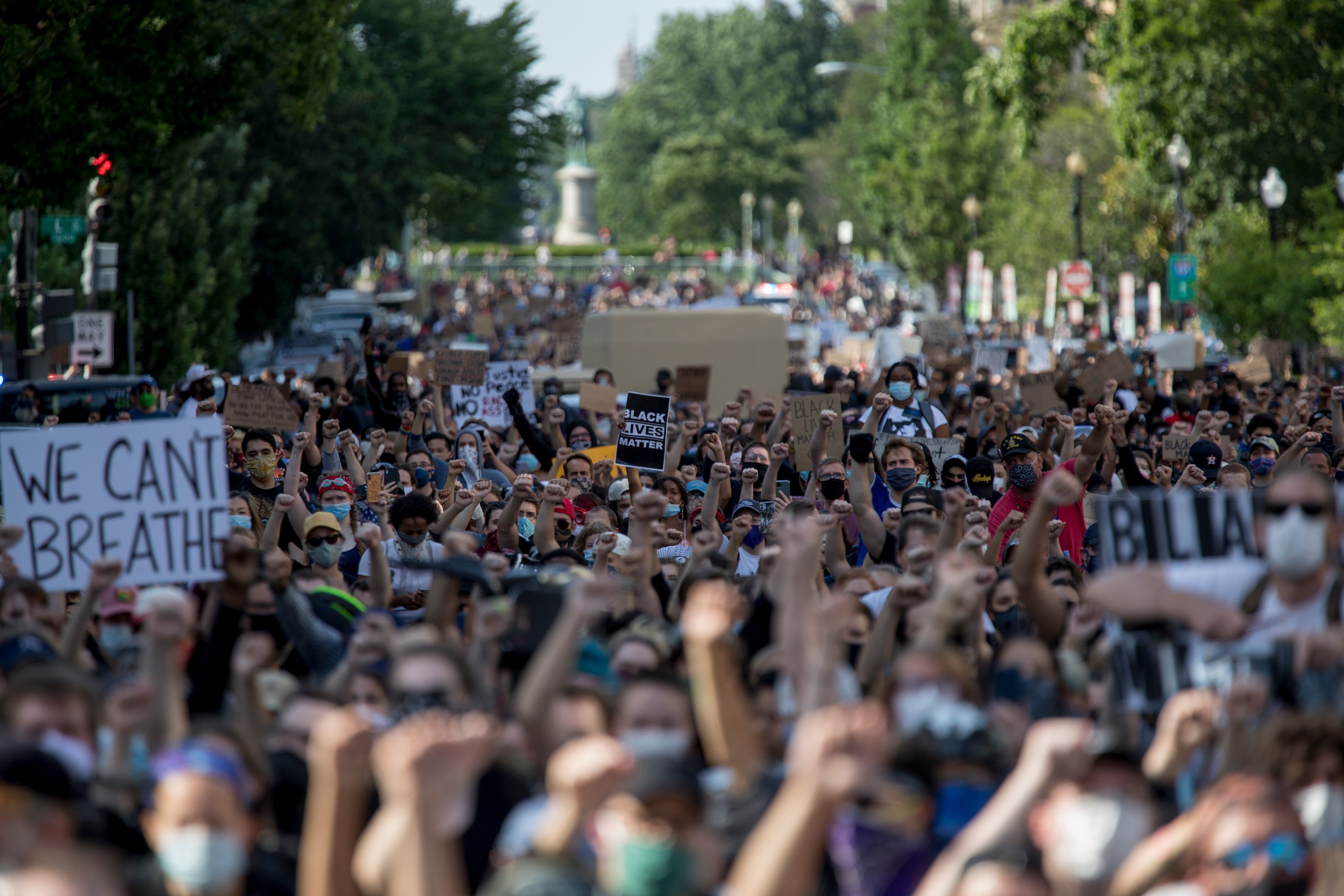
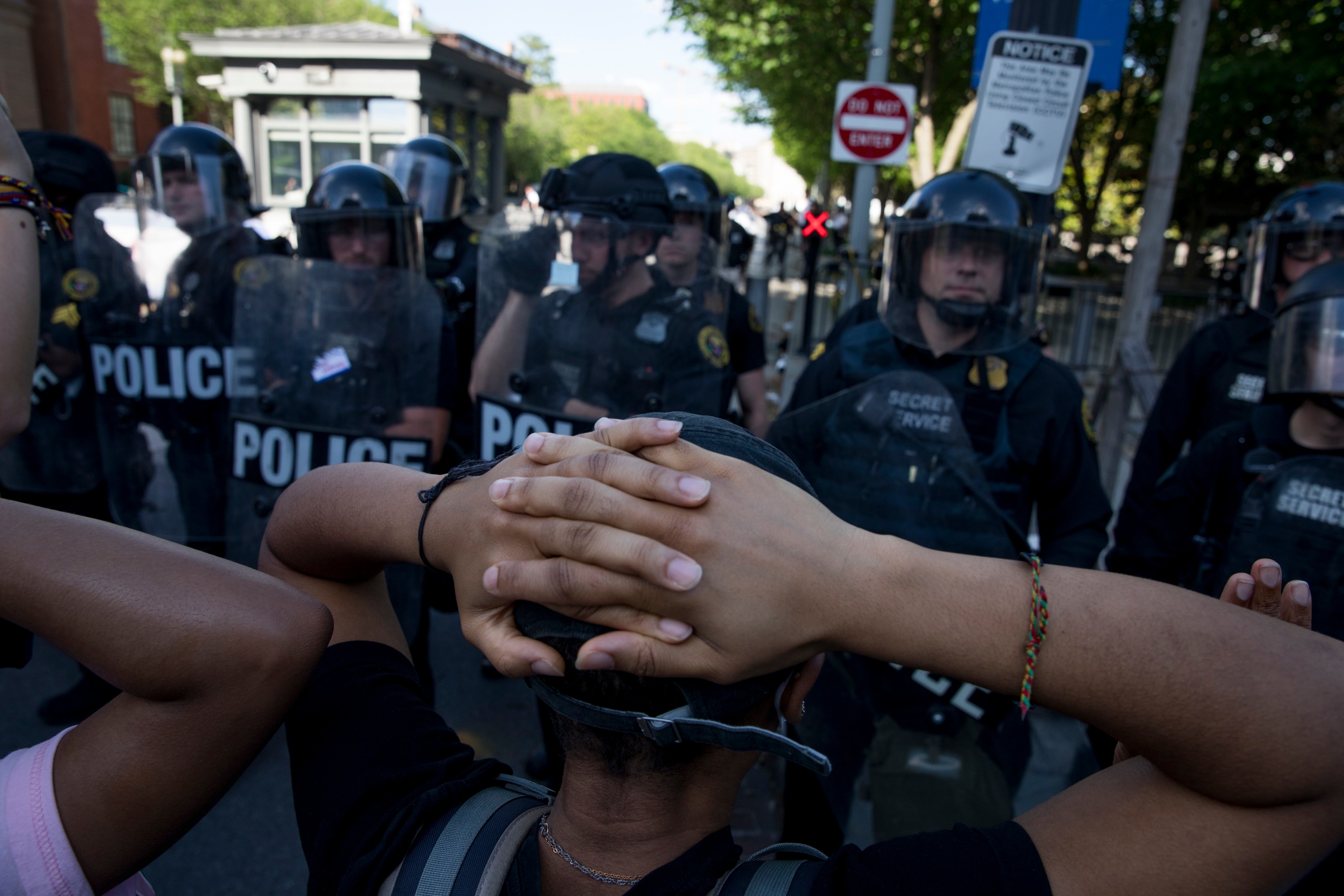
On her eighth day of protesting the killing of George Floyd, Lamarr was tired, hot, and sweaty. The 49-year-old mother and educator who lives in Silver Spring, has been out here all day Wednesday. She also has a welt on her leg from where she says she got hit by a rubber bullet over the weekend.
The mask that she’s wearing to help protect herself against COVID-19 isn’t helping any of that either.
But as the sun was setting at about 7:30 p.m. and standing on Connecticut Avenue NW across from Lafayette Park, none of that matters.
Everything — the heat, the pain from the welt, the coronavirus fears — takes a back seat to making sure her voice is added to a chorus that’s been calling out for centuries.
“I’m a black woman. … This affects me all the times I’ve been ignored and discriminated against,” says Lamarr. “We are just so tired and exhausted.”
To Lamarr, the country is ill — and not just with COVID-19. “We have two pandemics going on: racial injustice and a disease that’s in the air and could possibly kill you,” she says. “But there’s no vaccination for white supremacy.”
There’s understandable concern from public health experts and local officials that the D.C. protests over the killing of Floyd, which is bringing together thousands of people in mass gatherings, could lead to a spike in COVID-19 infections.
Earlier this week, D.C. Mayor Muriel Bowser said she was “very concerned” about a COVID-19 spike related to the protests and highly recommended those who protest get tested. On Wednesday, she noted that the numbers of those being tested in the District had dipped as well.
With a large protest also being planned for Saturday — which D.C. Police Chief Peter Newsham says “may be one of the largest that we’ve had in the city” — these anxieties continue to grow.
This also comes only a week after the city and the majority of the region enacted phase one of their gradual reopenings.
Bowser, who visited the protest front line earlier this week, has repeatedly expressed her own dismay, sadness, and anger at the killing of George Floyd. She has also said that “I absolutely emphasize with the public” in regards to wanting to protest and that “we applaud the American spirit of protest.”
It’s a fine line that officials and public health experts are trying to walk, reiterating their concerns over the spread of COVID-19 but also emphasizing their understanding that systemic injustices in America are also a major threat to public health.
The mass gatherings seen locally and across the country certainly increase the potential of contracting COVID-19, according to Dr. Amanda Castel, an epidemiologist at George Washington University’s Milken Institute School of Public Health.
“Some of the risks associated with protesting like shouting, being in large groups of people, and not being able to socially distance … [can] all potentially increase someone’s risk for infection.” she says. She adds some tactics used recently by law enforcement agencies to disperse crowds, including pepper spray and tear gas, can cause people to cough and disperse respiratory droplets.
But her own experiences make her realize that it is easier said than done. “As a native Washingtonian, an African-American woman, and somebody who has black children, it’s hard to stay home,” Castel says. “[I’ve] watched this kind of institutionalized racism throughout my life. It’s tough.”
She and her family have made the decision to contribute to the movement in other ways — such as candlelight vigils and donating to worthwhile organizations—than protesting in a large crowd. But she understands the urge. “I fully recognize, honor, and respect people’s decision to go out and protest. … They are justified and necessary,” says Castel, who grew up in the 16th Street Heights neighborhood. “What complicates it is that it’s happening now in the midst of this COVID-19 pandemic.”
For anyone considering going to the protests, Castel says to wear a mask, try to social distance, and have goggles or some sort of eye protection. “There’s a potential for people to get infected through their eyes, as well as noses and mouth.” Also, this provides protection against the potential of tear gas, she says.
And indeed many protesters have been taking such protections, with most wearing masks and constant offerings of hand sanitizer. The city also has a number of free public sites where demonstrators (and anyone else) can be tested.
But that trade-off remains a complicated one.
“It may mean we may take a step backward in terms of our ability to reopen our communities,” says Castel, who notes that the same communities are hit hardest by both two crises. “We really are in the midst of two public health crises here. … We need to reduce the disparities in the way African Americans and people of color are treated in the United States. But these are also the same communities that are hardest hit by COVID-19.”
The racial disparities of the impact of COVID-19 are stark. As of June 4, according to city data, black Washingtonians make up 75 percent of the 479 COVID-19 deaths in the city while making up just under half of the city’s population. Ward 8 has had 97 deaths, the largest death total in any of the District’s wards. Ward 8 is 92 percent black. This tracks with what’s happening in cities across the country.
This disparity is largely associated with underlying health conditions. As reported by DCist in May, data shared by city health officials at the time show that 71 percent of those who died from COVID-19 also had hypertension, or high blood pressure. Nearly half had diabetes.
These conditions closely correlate with income and race. One-fifth of D.C. residents who did not graduate from high school have diabetes. Those who make less than $15,000 a year in D.C. are about three times more likely to have the disease than those who make more than $50,000.
Thirteen percent of black D.C. residents have type 2 diabetes. Only 2.5 percent of the city’s white residents have it. As of 2017, hypertension, affected about 41 percent of D.C. black population. That’s more than double than that of non-Hispanic white residents.
Public health experts agree that a huge reason behind these health disparities are due to social factors, including the lack of housing, employment, and food access that impacts D.C.’s black community.
“We’re seeing the most vulnerable … get sickest the quickest, because they can’t take care of themselves,” Dr. Randi Abramson, medical director for Bread for the City, told DCist last month. “They have no place to rest. They have no place to have somebody else help provide some services, like bringing them food and water and making sure they’ve got some Tylenol and that they’re feeling safe and supported.”
But these are also among the reasons that Tricia Glaser has also gone out to protest. She understands her own risk of getting COVID-19, but it’s one she also says is worth taking.
Glaser was always supportive of the Black Lives Matter movement but says being Asian-American during the COVID-19 pandemic has put it in sharper focus. “The hate crimes and harassment that Asian-Americans have been seeing with this pandemic probably helped motivate me a little more to take more direct action,” she says.
Glaser, who works at a D.C. museum, came downtown to the protests on Saturday from her Hyattsville, Maryland, home, arriving at 2 p.m. and leaving around 6 p.m. Or, as she put it, “shortly after they charged at us to get us to move back.”
Yes, she’s concerned about getting COVID-19. Glaser wore her mask, kept sunglasses on the whole time, and tried to social distance, though she admits that was basically impossible. She heard what the mayor said about recommending folks who went to the protests to get tested and is looking into how to get one herself.
But her own physical health, she says, takes a backseat to the systemic issues in her country. “What’s happening right now with these protests and the police brutality is a greater concern for me,” Glaser says.
Back downtown on Wednesday evening, Lamarr says not everyone agrees with her protesting in large crowds — particularly her adult daughter, who lives in Seattle.
Lamarr says her daughter is mad at her for being out here amongst large groups of people in the midst of a pandemic. She could get sick and die, Lamarr’s daughter argues, and that she’s not going to make much of a difference anyway with being just one person of thousands protesting.
But Lamarr is undeterred. “If I don’t fight for our justice … who’s going to do it? Who’s going to do it? I have to do it. For my family.”