 Daniella Cheslow
This story was updated on June 8 at 10:36 a.m.
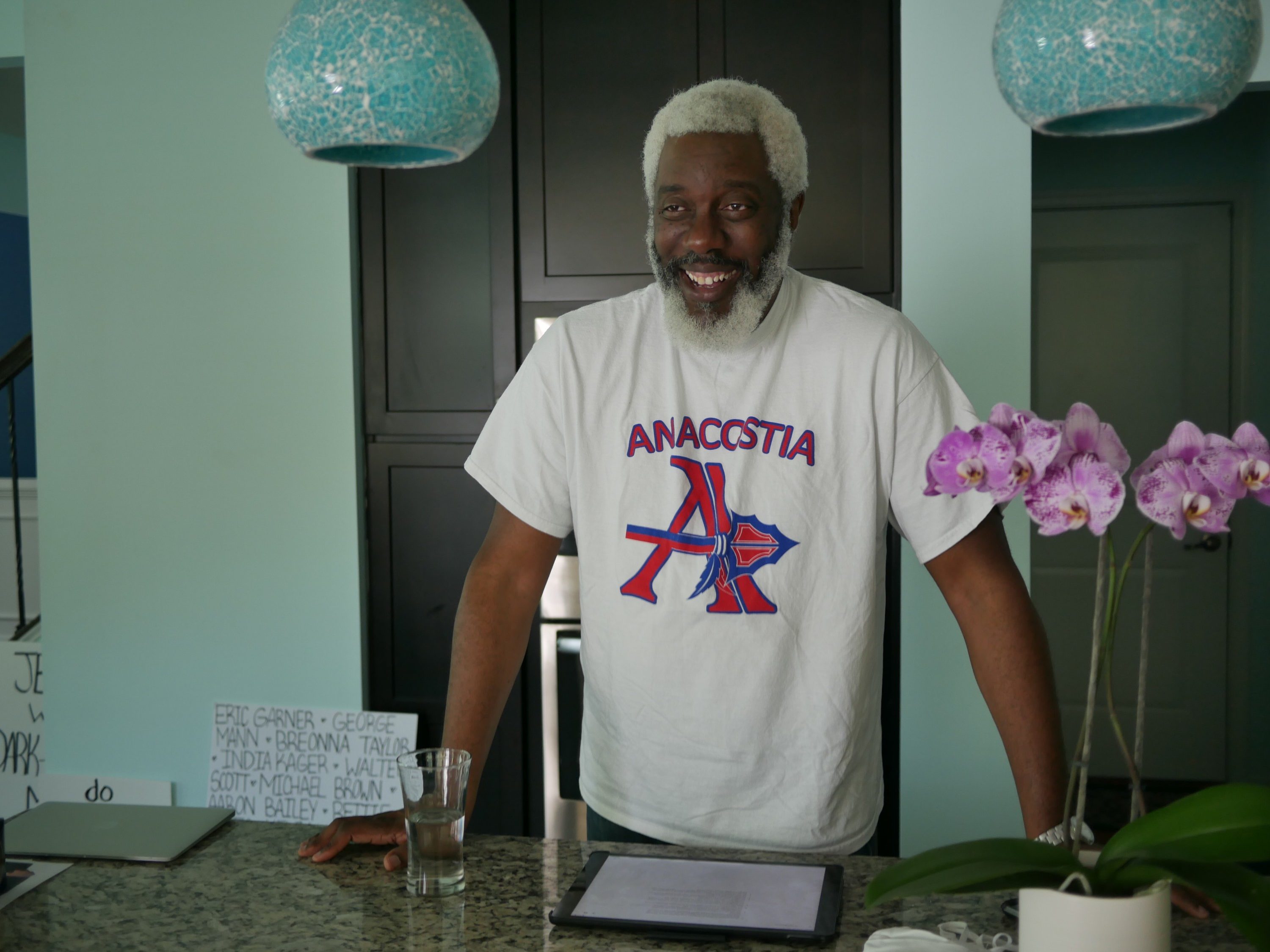
A day that culminated in a prayer session outside the U.S. Capitol and with a cameo by Republican Sen. Mitt Romney of Utah began quietly for pastor Thabiti Anyabwile of the Anacostia River Church. In his basement in Anacostia, Anyabwile sat with his wife and their three children, watching his pre-recorded Sunday prayer service that was being broadcast to a remote audience. The theme was the Biblical story of Cain and Abel.
“That story still speaks today, as brother kills brother,” Anyabwile said. “Whether that’s police in uniform killing an unarmed black person, or whether that’s the kind of violence we see in our communities, we’re all siblings because we’re all descended from Adam and Eve.”
At the end of the sermon, Anyabwile urged his members to join him for a walk to the U.S. Capitol and the White House, “to march and to sing and to pray in the cause of justice.” The event was to be a march from Wards 7 and 8 that would be part of citywide protests of the killing of George Floyd in Minneapolis.
But privately, he feared he’d have trouble gathering a group. Whereas protesters stream out of neighborhoods like Adams Morgan and Dupont Circle, Anyabwile noticed that his part of town had been far more subdued.
Anyabwile explained that for some in his congregation, protesting is a luxury.
“Most of the folks in our community are at or below the poverty level. We live in a city with tremendous housing insecurity, food insecurity, so the ability, if they are working, to miss a day’s work to go and join the protest, that’s not something that people can readily afford,” said Anyabwile. “And so people are [contending] with a lot of things that are in their own right important that might make it more or less possible for them to participate.”
He, too, had found the last week difficult, as he tried to reconcile his feelings following Floyd’s killing.
“The grief piles up and the anger piles up and I think I spent the better part of the week feeling kind of numb,” he said.
The idea for a march from the two predominantly black wards east of the river came from a white resident of Ward 7: Stephanie Municchi, an administrator in a law firm who has lived in the neighborhood for about seven years and attends a different church, the mostly African American Mercy of Christ Fellowship Church.
“I called some friends to see if there were any Christians going out to the protests. We didn’t see any events in any of our networks,” said Municchi, 30. “And we live in wards 7 and 8 where these policies that folks are protesting downtown really affects, and so we want to give voice to our neighbors.”
Attorney Patrice Wedderburn knows Municchi from church and said she was inspired to help organize it. Wedderburn said she was not surprised her neighborhood in Ward 7 had until now little presence with the citywide protest. She spoke to DCist/WAMU in Marvin Gaye Park, an expanse of green that she said often was a backdrop for drug deals. Nearby was a public housing project. Some of her neighbors are feeling alienated, she said.
“I think this community, like many neighborhoods in D.C., has experienced a kind of pushing-out of people to the margins, where they’re further away from resources and haven’t benefited from the bigger development downtown,” said Wedderburn, 38.
Her fellow church member Tiara Peterson, 30, grew up in Ward 7 and described a sense of resignation in her community.
“A lot of people are mad at the police brutality but they also believe that nothing is going to change,” Peterson said. “They believe that if we do go down there, we’re just going to waste our time.”
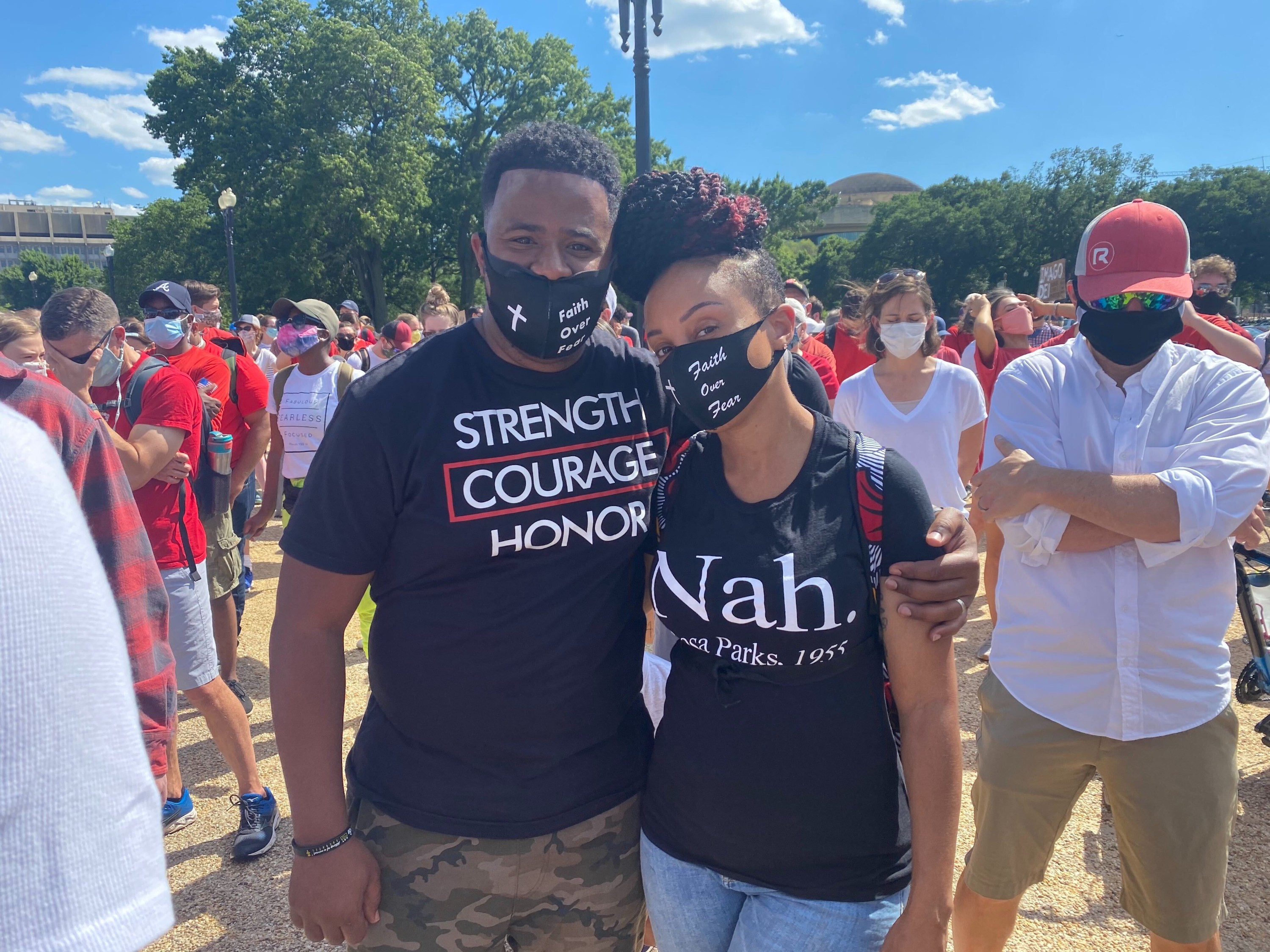
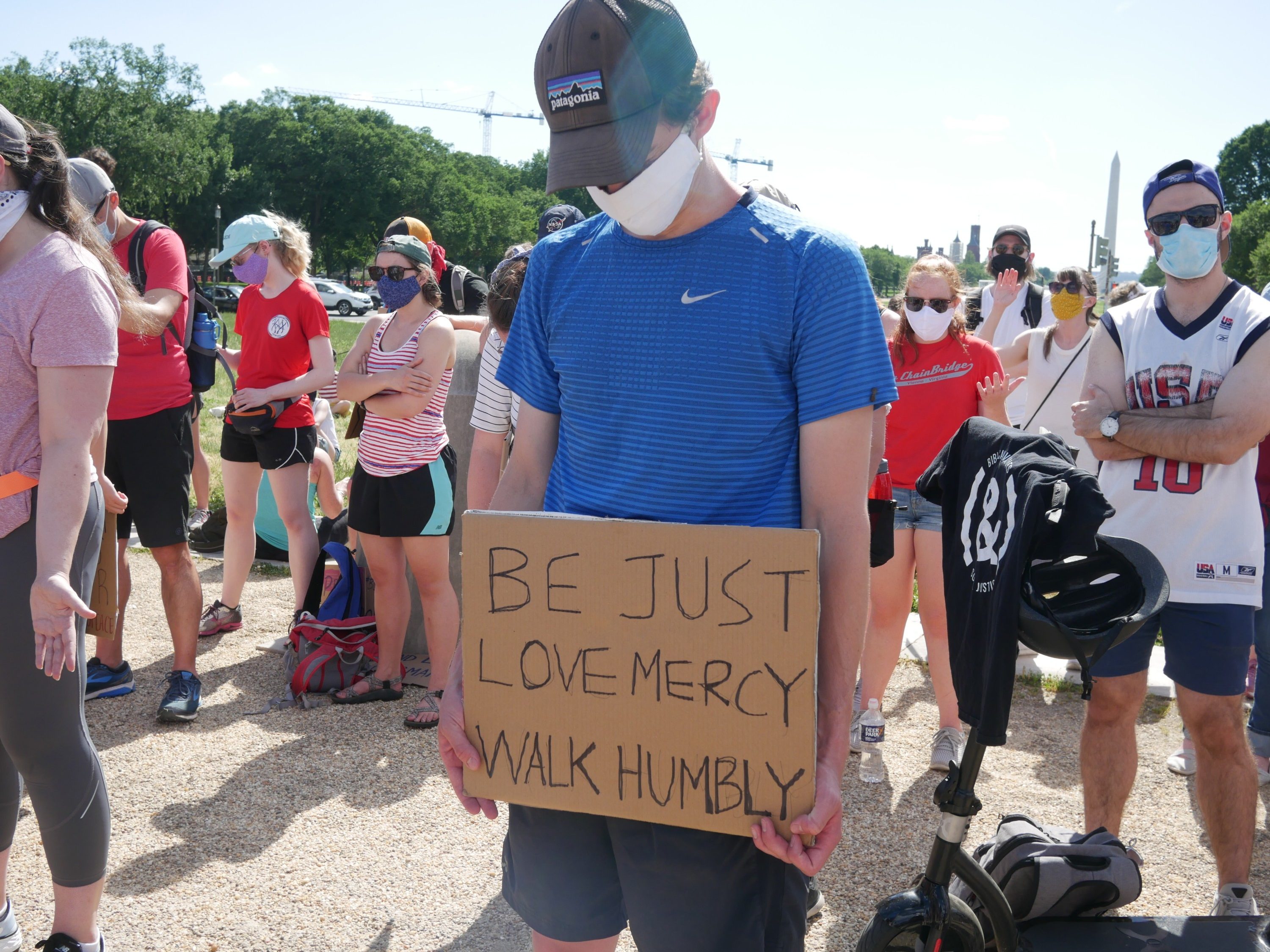
At 2 p.m., Wedderburn stood in the center of a green lawn outside the Benning Stoddert Recreation Center, surrounded by a wide ring of roughly 200 marchers. She and and Municchi gripped each side of a white banner painted with LOVE MERCY and led the procession over the Whitney Young Bridge as they sang “Amazing Grace.”
Peterson briefly attended but returned home to care for her family.
The group continued into the Capitol Hill neighborhood. Bystanders cheered; some shouted “Jesus Loves You”; and in one front garden, a musician played the violin.
Katie Heidengren, 26, joined as the group passed Lincoln Park and held a small sign she drew with the words “Black Lives Matter.” She said she was drawn to the chance to march under black leadership.
“We need to listen to our black brothers and sisters who know so much more of this experience, and who have been silenced by the church, by the white church in particular,” said Heidengren, who is white. “They need to be leading us and we need to be listening.”
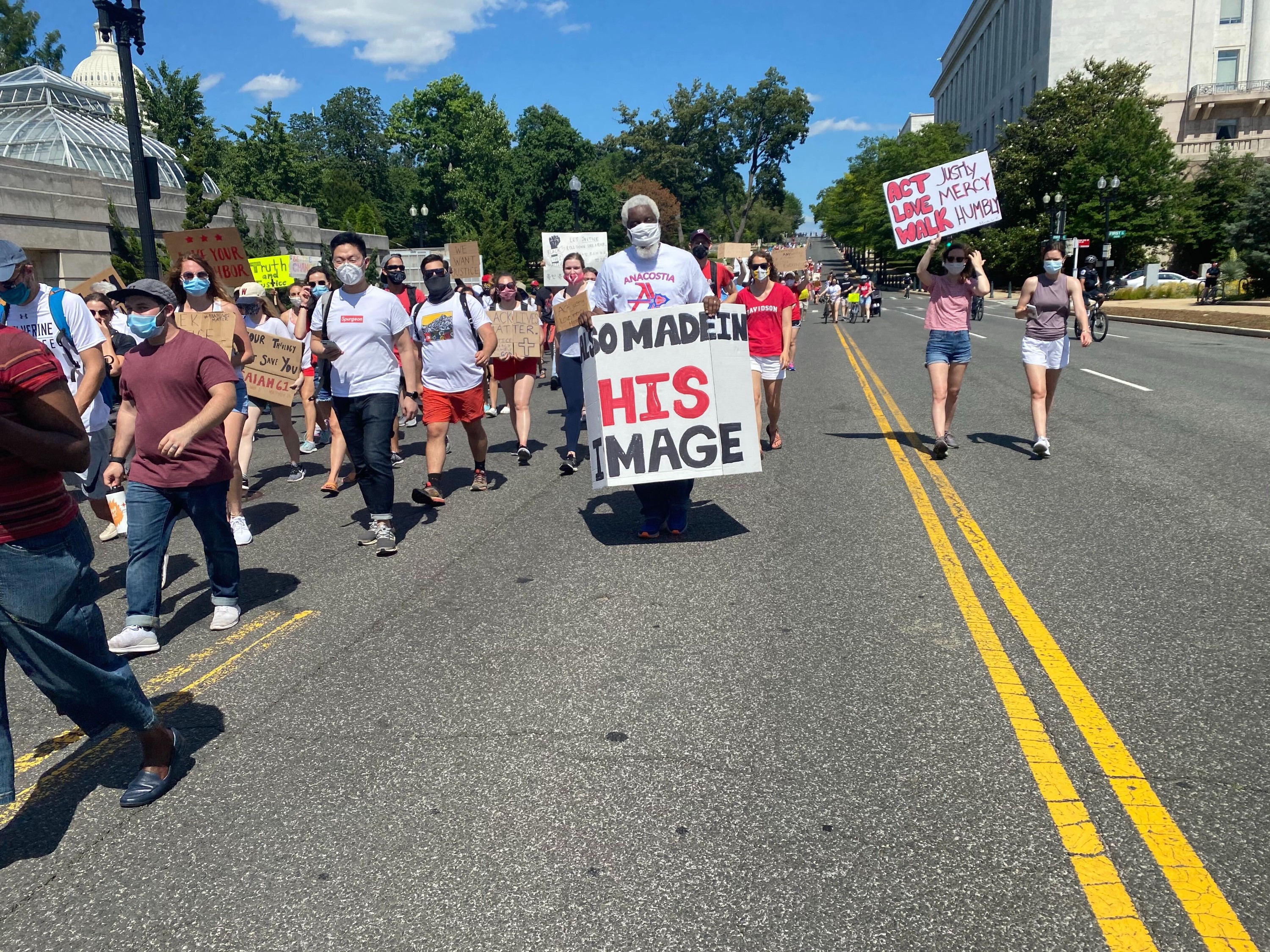
Meanwhile Pastor Anyabwile walked in a second procession from the Anacostia Metro Station. His wife and children joined him. Anyabwile walked carrying a large poster his daughter made that read, “ALSO MADE IN HIS IMAGE.”
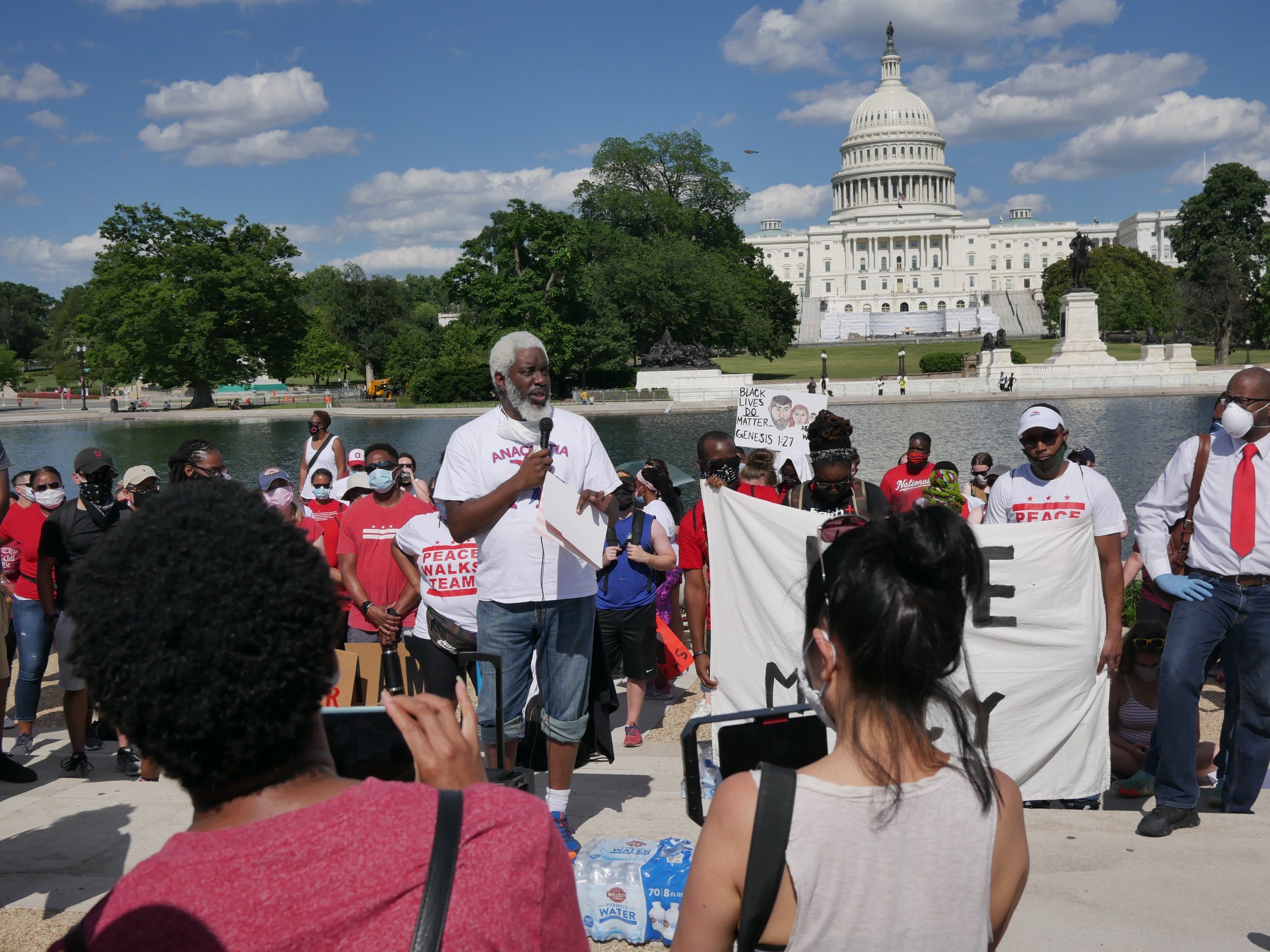
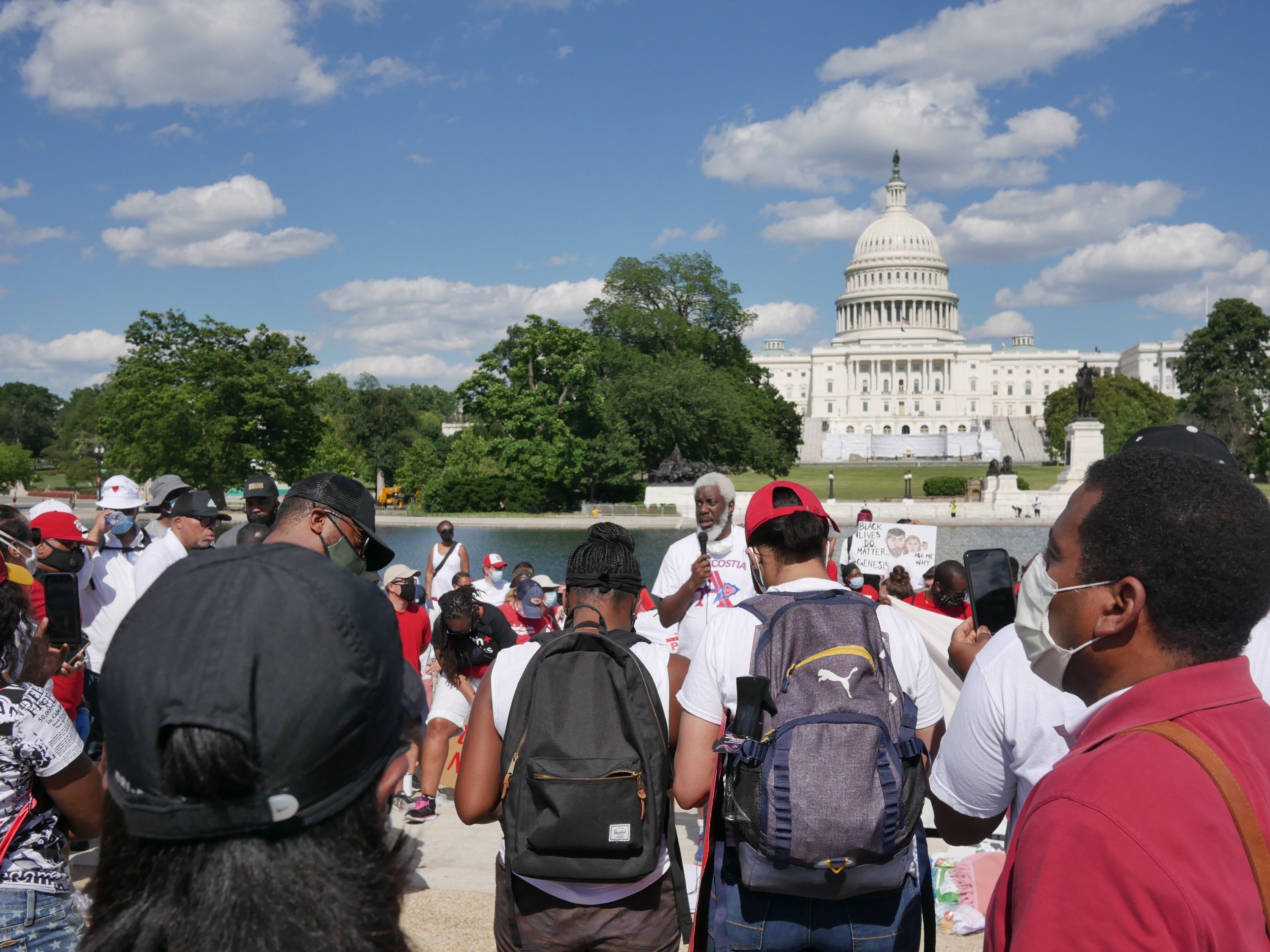
The two groups from Ward 7 and Ward 8 merged on Independence Avenue, as more participants joined in the flow. Pastor Anyabwile looked as the line of protesters stretched out in the shadow of the National Museum of the American Indian and behind him, toward the U.S. Capitol.
“I’m blown away by what I’m seeing,” he said. “I’m seeing God’s people come out to pray and come out to fight for justice.”
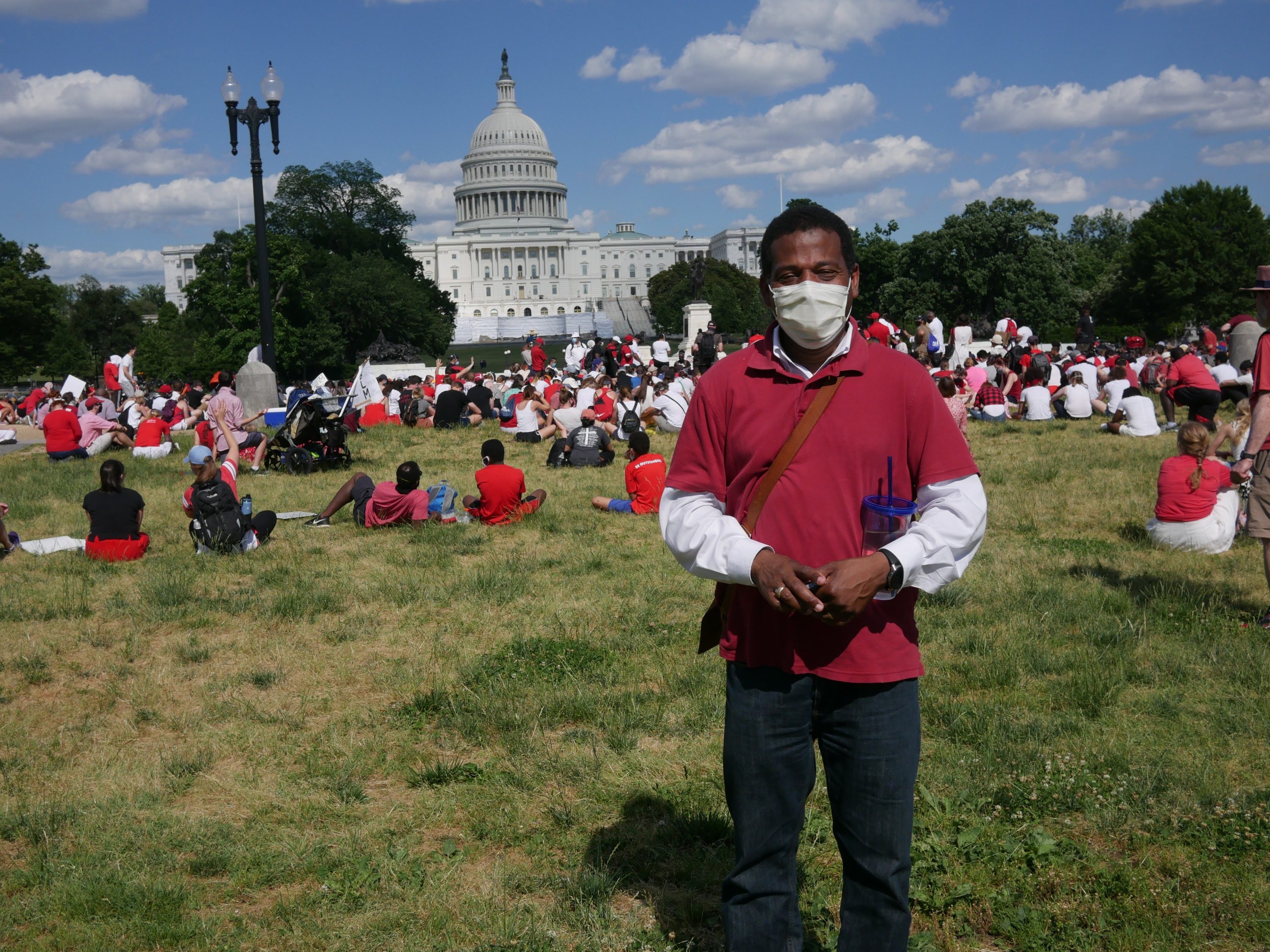
The walk culminated in a prayer session at the U.S. Capitol. Pastor Anyabwile emceed, and a church volunteer used white plastic bags to cover the microphone and avoid spreading the coronavirus.
Christopher Butters, 59, of Fairfax, Va. was among those listening to the prayers. Butters, an engineer, said he had been wary of joining the large protests over the past week because he did not want to be associated with unruly crowds or looting which “frankly I am sometimes, as a black man, embarrassed by.” A Christian march felt like a place to send a clearer message, he said, and he was heartened by the support shown by people who offered water and encouragement from along the road.
“That moved me to tears to see little children with their little signs saying, ‘we support you, we care,’” he said.
After their prayer session, the group continued to the White House, where they were joined by Republican Sen. Mitt Romney. He tweeted a selfie showing his eyes, the tip of his white face mask and a crowd behind him. His caption bore three words: Black Lives Matter.
Both Anabwile and Wedderburn said they had no idea Romney would be there.
“Praise God!!!” Wedderburn wrote DCist/WAMU in a text message. “Prayerfully he will use his voice+platform to advance the cause of justice.”
But more than Romney, Wedderburn said she was struck by an observation from her partner, who teaches at a high school in her neighborhood. Many children in wards 7 and 8 have little reason to go into the center of Washington, D.C., she said. However her partner thought now, his students would see the newly named Black Lives Matter Plaza on 16th Street as a statement that they belong.
“In the center of the city, right by the White House, there’s a statement that affirms the value of his students,” she said. “They’ll be comfortable being downtown.”
Pastor Anyabwile reflected on the march as he recalled protests following police killings of Tamir Rice and Michael Brown in 2014.
“There was great division in the church,” he remembered. “Many white brothers and sisters at that time instinctively sided with the police and the state and maybe reinforced the narrative of assumed black criminality. Now, I think the consensus feels like it’s on the other side.”
This article has been updated to correct Stephanie Municchi’s profession and clarify a comment from Patrice Wedderburn.