 Victoria Chamberlin
The Department of Defense is reviewing the National Guard’s controversial role in nationwide racial justice protests over the past few weeks.
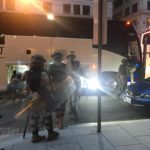
Secretary of Defense Mark Esper has ordered an after-action review of the National Guard’s support of law enforcement in 30 states and D.C. during demonstrations following the police killing of George Floyd in Minneapolis. More than 5,000 troops were deployed to the District from a dozen states and D.C.’s National Guard to assist local and federal law enforcement, an overwhelming show of force for a city used to peaceful protests.
After-action reviews are standard procedure in the military for large-scale missions. Esper directed Army Secretary Ryan McCarthy to evaluate a range of issues including training, equipment, and the use of National Guard forces. Esper gave the National Guard until July 30 to complete the review.
“In recent weeks, the National Guard has performed professionally and capably in support of law enforcement in cities across the United States,” said Secretary of Defense Mark Esper in a statement. “I have full confidence in Secretary of the Army McCarthy to lead a robust review.”
Some soldiers and airmen in the National Guard who participated in the civil unrest mission felt conflicted about their roles during the demonstrations. The New York Times reported the first-hand accounts of service members who were rushed to the city to fortify police lines in response to mostly peaceful protests.
“Typically, as the D.C. National Guard, we are viewed as the heroes,” First Lt. Malik Jenkins-Bey told the Times. Bey, who is black, was serving as the acting commander of a military police company early in the week. “It’s a very tough conversation to have when a soldier turns to me and they’re saying, ‘Hey sir, you know my cousin was up there yelling at me, that was my neighbor, my best friend from high school,’” he said.
The National Guard wasn’t the only part of the Pentagon’s response to the demonstrations that drew disapproval.
As the first few days of the protest gave way to some violence and property damage of federal monuments, active-duty troops were brought to the area on alert status, a move widely criticized by retired senior officers according to the New York Times. Major Gen. William Walker, who commands the D.C. National Guard, said on a call with reporters that he wasn’t sure if National Guard troops could be pulled in quickly enough. “Your only other options to develop more reserves in the event for another violent evening would require you to activate units … and that’s what we did,” said Walker.
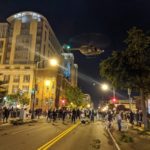
A dangerously low-flying Army helicopter usually reserved for medical evacuations aggressively hovered over protesters on the street on June 1, DCist / WAMU reported, just hours after federal law enforcement violently cleared Lafayette Park so President Donald Trump and senior aides could walk to St. John’s Episcopal Church for a photo-op. National Guard officials confirmed in a call to reporters that the helicopter incident is under a separate investigation by the Army and the crew has been grounded.
Gen. Mark Milley, the top military official in the United States, publicly apologized for walking with the president to the church in an address to graduates of the National Defense University on Thursday in Washington, D.C.
“I should not have been there,” Milley said in the prerecorded video commencement message. “My presence in that moment and in that environment created a perception of the military involved in domestic politics.”
For many, the involvement of the military in domestic politics is more than a perception. The vast majority of state governors who agreed to send their National Guard to D.C. at the request of Secretary Esper are Republicans, including Maryland Governor Larry Hogan. Unlike states’ governors, Mayor Muriel Bowser does not have the power to deploy D.C.’s National Guard. Notably, Virginia Governor Ralph Northam refused to send his troops into the District.
“I am not going to send our men and women in uniform — a very proud National Guard — to Washington for a photo op,” Northam told the Washington Post.