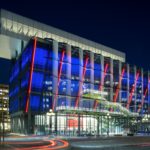
Before closing its doors in March due to the coronavirus, the International Spy Museum in L’Enfant Plaza encouraged visitors to test their stealth skills by crawling as quietly as possible through an air duct in the ceiling.
But when the pandemic reached the D.C. region, museum officials knew this activity would no longer be prudent. That remains the case even after the museum began welcoming visitors again June 22, under the city’s phase two reopening.
“We couldn’t have people in a small space, crawling, touching everything,” says Jackie Eyl, the Spy Museum’s youth education director. “So we went back to what our goals were, and it’s to test stealth.”
Adapting to the challenge, the museum took a sound meter inside the air duct and placed it under the floor beneath a display about ninjas. “Now, we encourage people to practice their ninja walks,” Eyl says. “While it’s not climbing through a ceiling, you still get to practice your stealth.”
Phase two allows D.C. museums to reopen with capacity limits and social distancing rules in place, but guided tours and large tour groups remain prohibited. The Spy Museum and the Museum of the Bible, both of which are private institutions, were among the city’s first museums to reopen.
Other local museums, including those within the Smithsonian’s vast portfolio, have been slower in their approaches, continuing to weigh safety measures and long-term plans. The District still must lay out the specific metrics it will use in determining whether to advance to the third phase of its reopening, which would let museums resume limited tours and larger events, according to the recommendations of D.C.’s official reopening advisory group.
The Smithsonian’s nearly 20 museums have yet to announce their reopening dates, although Lonnie Bunch, the secretary of the institution, has convened two task forces to explore options, says Smithsonian spokesperson Alise Fisher. One task force is focused on a gradual, staged reopening, while the other is focused on how the Smithsonian will generally navigate the future. Two of the Smithsonian’s most popular attractions—the National Zoo and the National Air and Space Museum’s Steven F. Udvar-Hazy Center, which is located in Fairfax County near Dulles International Airport—are actively planning for their reopenings, Fisher adds.
At the Spy Museum, Eyl says officials have incorporated COVID-19 precautions into the visitor experience, which begins with being assigned a unique spy identity. “We look at masks as potentially a fun way to disguise yourself,” she says.
Some parts of the museum have required total revamps because of coronavirus concerns. For example, each visitor now receives their own stylus to use for interactive screens and buttons, so they don’t have to touch them directly. Eyl says digital displays and other interactive features had to be modified to respond to the styluses.
The Spy Museum isn’t alone in making changes. Susan Fisher Sterling, the executive director of the National Museum of Women in the Arts, says she doesn’t think tours at her museum will be possible until the fall, noting that the museum plans on using technology so docents can guide small groups remotely. The museum also wants to implement a timed-entry ticketing system to make visits go more smoothly. But, Sterling points out, other museums apparently want one too.
“We had to wait in line,” she says of procuring the technology needed for the system. “Even though we’re working with a great company and [receiving] great service, there’s just only so many hours in the day.”
Even before the pandemic, some D.C. art spaces restricted the number of guests they allowed at a time. ARTECHOUSE, an interactive gallery set in the basement of a building in Southwest, is one such space, and plans to reopen July 9, bringing back its cherry blossom-themed spring installation. The gallery will time-limit visits to facilitate cleaning between sessions, and require visitors to wear face masks, according to managing director Tatiana Pastukhova.
Pastukhova also says ARTECHOUSE is used to touchless technology: For the cherry blossom exhibit, guests wave their arms in front of large, glowing screens to make virtual blossoms burst open and virtual snowflakes freeze and melt. She says the gallery intends to “keep harnessing” that technology, but that it will remove the beanbags patrons popularly lounge on while looking up at the screens.
ARTECHOUSE’s decision to stick with the previous exhibit is both thematically and financially motivated, per Pastukhova. The gallery invested significant resources in the exhibit before the city’s spring shutdown forced it to close two days after the debut, and the pandemic disrupted the 2020 cherry blossom season. (City officials even barred traffic around the Tidal Basin to curb the number of people visiting the cherry trees.) “When it comes to bringing healing and hope, this is a really beautiful installation,” Pastukhova says.
In March, with events grinding to a halt, ARTECHOUSE furloughed 90 of its employees in D.C., Miami, and New York City, where it also has spaces. The gallery now hopes to slowly bring back its D.C. employees, according to the managing director.
Other D.C. art institutions have also made staff cuts amid the pandemic. The National Building Museum laid off 42 employees in May, citing lost revenue due to the coronavirus crisis as well as broader financial challenges.
Meanwhile, the Smithsonian lost $22 million in revenue between March 14 and May 31, says Fisher, the institution’s spokesperson, with some employees taking salary cuts and managers implementing a hiring freeze for certain positions. In April, Bunch told the Washington Post that if museum closures stretched to the fall, the Smithsonian could lose an additional $20 million to $50 million. (Since general admission for Smithsonian properties is free, much of the loss stems from Smithsonian Enterprises, the institution’s revenue-generating division.)
Sterling of the National Museum of Women in the Arts counts her institution as comparatively lucky. While the museum has stopped generating revenue through admission fees during the pandemic, it’s been able to make ends meet thanks to existing funds from grants and various programs. It also reeled in donations from a virtual gala in April, which was moved up from its originally scheduled date in August.
But even when D.C. museums physically reopen, it’s possible that coronavirus infections could spike and trigger closures again, especially if a second wave of cases hits the region in the fall. Some states that are now seeing rapid growth in COVID-19 cases, including Texas and Florida, recently reversed course and shuttered businesses after they had reopened.
Sterling says her museum’s reopening task force has been mindful of that possibility and is closely monitoring health guidance from the District government. Accordingly, the National Museum of Women in the Arts is increasingly promoting digital content, just like the other museums DCist spoke to for this story.
In late March, the museum shifted 80% of its employees’ time to producing virtual offerings, including on its Instagram page, which has seen a surge in new followers and won a Webby award in May. “That was really successful for us,” says Sterling.
The Spy Museum has also expanded its digital programming, particularly for adults. It now runs at least 10 virtual programs a week, and has conducted more adult programming in the last few months than it had previously done in an entire year. Eyl, the youth education director, says the digital programming has enabled the museum to reach people across the U.S. and in more than 40 countries worldwide.
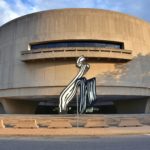
The Smithsonian American Art Museum moved much of a planned exhibit on Prussian naturalist Alexander von Humbolt online by deploying in-gallery videos, including a tour led by the curator. And the Hirshhorn Museum started an artist-diary video series, while the Anacostia Community Museum launched an online initiative to share the stories of everyday people living through the pandemic as well as the movement for racial justice fueled by George Floyd’s killing at the hands of police in Minneapolis.
Across the board, D.C. museums are looking ahead to a post-pandemic world and figuring out how their programming could change over the long term.
“The pandemic is a temporary situation, but there are some creative things we are doing that helps us think about the visitor experience in a different way,” says Eyl with the Spy Museum, citing hand sanitizer stations, social distancing guidelines, and virtual offerings.
ARTECHOUSE has had to reconsider all its 2020-2021 programming and delay some exhibits, since current travel restrictions are preventing international artists from coming to the U.S. And the National Museum of the Women in the Arts, which usually plans exhibits two to three years in advance, has pushed back some of its exhibits as well.
Sterling, the museum’s executive director, says she believes visitors will return eventually, albeit in limited numbers at first. “Setting the precedent that people can feel comfortable and confident to come back to us is important,” she says.
Besides, “we were never closed,” she adds, referencing her museum’s shift to digital offerings. “We were always open, just in a different way.”