Jacob Fenston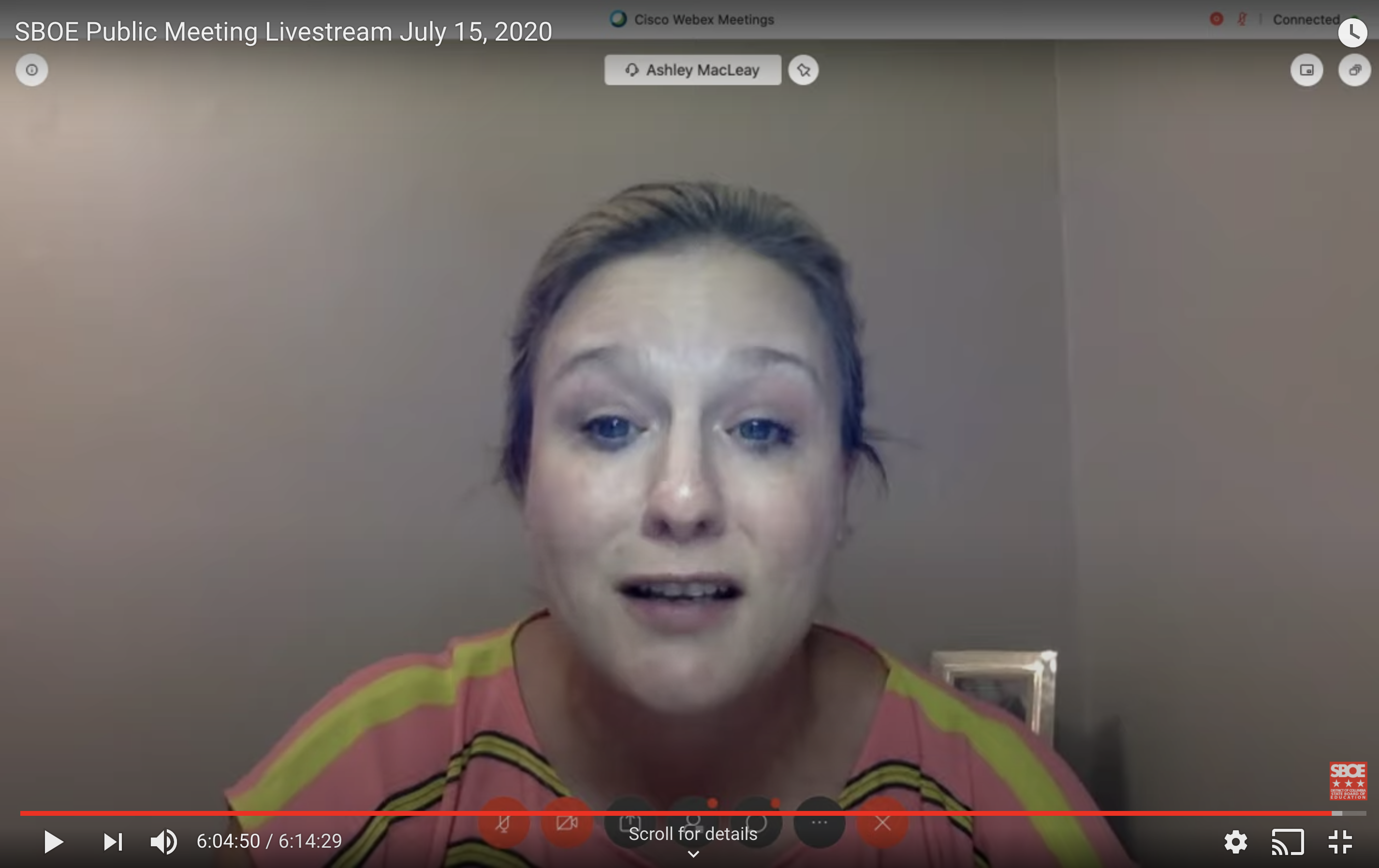
This story was updated at 2:25 p.m. on July 21.
The D.C. State Board of Education spent hours discussing a resolution calling for the removal of police from D.C. Public Schools and public charter schools. Toward the end of the marathon meeting on Wednesday evening, board member Ashley MacLeay spoke up against the measure.
“As the granddaughter of a former Metropolitan Police Department officer who spent over 30 years in the force defending this city, I find it highly offensive how members of the board have disparaged police officers through this resolution,” MacLeay said. “Members of this board have tried to capitalize on an incident that took place half a nation away,” she said, referring to the killing of George Floyd by a Minneapolis police officer.
Then, she defended the use of D.C. police in public schools, using what some of her colleagues on the board, as well as activists, say is racist and dehumanizing language.
“Since I started on this board, we’ve had children bring knives, guns and other deadly weapons to schools. In fact, just a couple months into my term, a Black 3-year-old brought a gun into a school and it was found none other, but than by an SRO,” or school resource officer, she said.
MacLeay said the board of education downplayed violence in schools and pointed a finger at schools in the city’s poorest neighborhoods.
“It’s well-known that at least one school east of the river, that known gang members and human traffickers, a.k.a. pimps, hang out during school because members of this board have chose to ignore [it],” MacLeay said.
MacLeay’s colleagues on the board reacted with outrage, and several have called for her to apologize, be censured or resign.
Board member Markus Batchelor, who introduced the resolution and who represents residents east of the river in Ward 8, said MacLeay was using racist and dehumanizing tropes. “When schools that I represent were categorized as havens for weapons trafficking and pimps, they’re pulled out of a deep, age-old book that, quite frankly, has allowed the state and decision makers to dehumanize and attack the lives and humanity and freedom of Black people for 400 years.”
Batchelor said that in using the example of a pre-school age child bringing a gun to school, and emphasizing the child’s race, MacLeay was “weaponizing a Black 3-year-old.”
“I found that rhetoric so painful to listen to,” said Alex O’Sullivan, a high school junior and student member of the board of education. “I was listening to the meeting with my with my parents, and that was, quite frankly, one of the most disgusting things I’ve ever heard,” O’Sullivan said.
“She made a comment about George Floyd’s killing being half a nation away. But this is not half a nation away to Black people everywhere in the United States. This is personal,” O’Sullivan said.
MacLeay is no stranger to controversy — a rare conservative elected official in Democrat-dominated D.C., a Trump supporter in a progressive city where only 4% of residents voted for the president. In 2018, she drew criticism for tweets questioning one of the accusers of Supreme Court nominee Brett Kavanaugh, and downplaying the accusations against him.
MacLeay declined an interview but defended her words in an email to WAMU/DCist:
“I stand behind everything I said and believe removing SROs will lead to a marked increase in violence. An increase in violence will mean families will speak with their feet. Those who can will move out of the city. Those who can’t will, unfortunately, pay the price,” MacLeay wrote.
MacLeay mentioned the race of the 3-year-old, she said, because the debate all evening had been about race. “It was made very clear that race was an important issue by other members of the Board and that this resolution was to support only people of color,” she wrote. “I used real, concrete, and true examples of actual incidences that have occurred in the schools in our city and showed multiple examples of how having SROs are helpful and not hurtful.”
Activists with BlackLivesMatter DC posted a video excerpt of MacLeay’s comments on YouTube, with the description: “UNBELIEVABLE: Ashley MacLeay’s racist rant before the vote on the Police Free Schools Resolution July 15, 2020.” Numerous people watching the virtual meeting live reacted with disgust on the meeting’s live chat.
“This is blatant violence & racism,” wrote Hannah Minkoff.
“Absolute racist,” wrote April Goggans. “SHE NEEDS TO BE REMOVED.”
Members of the board of education also said there should be consequences for MacLeay. “My hope is that she apologizes for it, but in my mind is demonstrated to me that she’s unfit to represent all of the families of the District of Columbia,” said Batchelor.
Karen Williams, who represents Ward 7 on the board, called for MacLeay to resign, in a letter to her colleagues on July 21. “We all come from different backgrounds and are entitled to have different opinions on public policy matters,” Williams wrote. “However, that is
not a license to spew hate, opportunistic political divisiveness, and further marginalize an entire group of people.”
Zachary Parker, the Ward 5 board member said there is movement toward censuring MacLeay, though it would not be a simple task.
“We are prohibited from censuring state board members for problematic or racist speech,” Parker said. “I think that should change. And so at our next meeting, I do plan to advance a change to our bylaws that would allow us to censure members for problematic or racist speech.”
In her email, MacLeay dismissed suggestions that she should apologize, be censured, or step down.
“The beauty of freedom of speech is having the ability to speak your mind and speak for those who are too scared to speak up in today’s world,” she said.
At the end of the meeting, near midnight, the board approved the non-binding resolution, calling for the removal of police from schools. The vote was 9 to 1, with MacLeay the only member voting against it.
The state board of education does not have the power to remove police from schools, and serves mostly as an advisory body. Any decision regarding use of police in D.C. schools would need to come from the mayor.
This story was updated to include Karen Williams’ letter calling for Ashley MacLeay to resign.