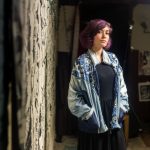
Jules Hale’s new EP, Hypnagogia, takes its title from the state between being awake and asleep, when the line between reality and dreams is especially blurry.
“It doesn’t have to be scary, but it’s just very dreamlike and bizarre,” says Hale, who performs as Den-Mate. “And it’s kind of weird because that’s how life feels right now. Everything just feels so upside down and, like, ‘Is this real? Is this happening?'”
Den-Mate started in Hale’s bedroom in rural Virginia. Known for her blend of pop, dance, and electronic music, she uploaded early tracks to SoundCloud, releasing her self-titled debut album in 2013, and soon earned a deal with local label Babe City Records. Hypnagogia is the D.C.-based artist’s first release since 2018’s Loceke.
Hale herself has experienced hypnagogia, which inspired the EP. Over six synth-drenched songs, the indie pop producer and songwriter explores the ways people cope with pain and trauma, and find strength in healing. She finished writing the songs before the COVID-19 crisis hit D.C. in March, but the lyrics have since taken on new meaning.
“I listened to it quite a bit in quarantine just through the process of trying to do the [promotional] campaign, and I was really relating to it in a totally different way,” she says.
Ahead of the EP’s release on July 24 via Babe City and Substitute Scene Records, Hale spoke with DCist about the writing and recording process, her love of soundtracks, and how it feels to release music during the crisis.
This interview has been edited for length and clarity.
What has your experience with hypnagogia been like?
It’s almost like lucid dreaming, cause you’re in this state of almost being awake, but you’re seeing things. It’s euphoric, but also kind of melancholy. The dream world is very mysterious. I’ve dreamt of very bizarre things.
The track “Hypnogia” on the EP is basically about trauma or bad things that happen to you, and almost experiencing [a] type of detachment hallucination [while it’s happening]. I’ve never personally had that happen, but I believe this is something that can also happen during the waking times. So, that’s why I made up the word, “hypnogia.” It was kind of my representation of another side of this dreamlike sense.
Do you usually record at home or are you in a studio normally?
When I recorded Loceke, that was in a studio with an engineer and this one was very much going back to the roots of my first two EPs. I did it all at home, and I actually did it pretty much all when no one was home, when I was just by myself. And I did really keep it kind of close to me, cause I think I needed almost like a self-preservation of just trying to be as creative and get this feeling and vision I had out before I went to record it.
I did record “All My Friends” and “Army On Mars” with Tommy Sherrod who also recorded Loceke. I just did my vocals with him, which was cool, but, yeah the rest of it was at home by myself. And my boyfriend, Jonah [Welt], he mixed and mastered it and added a couple flares and it was definitely a home process. But that’s my favorite way of doing it.
Yeah, that sounds nice.
Yeah, and it’s cheap [Laughs].
Compared to Loceke, this album does sound a little bit darker and heavier on the electronic elements. How did you decide on the sonic direction?
When I wrote Loceke, I was really young. I was still a teenager when I started writing those songs, and that was much more guitar-based. All the songs had guitar in it, and I think as I was evolving and experimenting as a musician, location changed it, living arrangements changed it, jobs changed it, what I was listening to changed it.
I really wanted to make almost like an experimental, electronic pop record. I think I really wanted to just have an outlet where I didn’t have to be characterized as an indie-rock or dream-pop artist, which is fine. I don’t dislike that term, but I do feel like I had so much more to show. I’ve always loved electronic music. I stopped playing guitar for maybe a solid year and a half and just did synth stuff. And it wasn’t on purpose. I think I just wanted to play with keyboards.
Were there specific records you were listening to that informed the sound?
I was listening to a lot of my friends up in New York. One who’s super influential is my friend Caroline [Sans] from Sur Back, and listening to her music was actually a great inspiration of wanting to learn more about composition. And one artist that I always discuss is Mica Levi, and she’s a really great composer.
Have you ever seen [the 2018 film] Annihilation? I love soundtracks and scores. That’s one of my favorite things to listen to, and there’s this one track at the end of Annihilation, and when I heard it, throughout the movie everything is based outdoors in the woods, and music is all acoustic. But at the end when there’s this alien that Natalie Portman encounters, and this electronic, very dark song comes on, and I just felt it so hard. I was like, “This is the best song ever in a movie,” and I was obsessed with it.
The themes of the EP seem especially relevant now. Did what’s going on in the world now inform that or were the songs done before the pandemic?
The only song that was written this year—and it was before the pandemic really hit—was the last song called, “Think Like You Should.” And I feel like maybe that song was really where my mind was starting to have a really hard time making sense of everything and I was like, “Is this right? Is this wrong? Should I be nervous? Should I be scared? How do I react in this time?” But everything was already written.
You recently donated funds from the sale of the single “All My Friends” to the National Black Women’s Justice Institute and proceeds from sales of the song on Bandcamp to the NAACP. What motivated that decision?
I really believe that focusing on educating people about what’s happening right now is the best thing I could be doing, and educating myself, and educating my other white friends. It feels awful right now to be releasing music. I’m not gonna lie, it’s super uncomfortable. [I postponed] the EP release, but right now what I can do is use my music in order to put it to something that’s way more important.
With the restrictions on touring and playing shows, how does it feel to be releasing music?
It definitely was kind of sad in a way, cause as a musician, that’s just part of what you do, just getting on the road and playing. It just feels a little surreal not planning a tour.
Grimes was talking [during a 2019 interview] about how live shows were going to be obsolete, and I was like, “Nice try, Grimes! That won’t happen.” And, you know, now it’s true. But I really hope they come back. And I’m really rooting for places like [DIY arts venue] Rhizome in D.C. I really think it’s going to be the small house communities that are going to help lift us, because until then, where are we gonna play?
You posted on Instagram that you were a little scared to put this particular project out. Why was that?
Maybe it’s because I kept this project really close to me, and I feel like maybe there’s some songs that are really personal to me, or I wrote them for people that are close to me that have gone through some really hard things, and that felt very private. It was a little nervewracking to put something out that’s very personal but also wanting to keep the privacy at the same time.