Elliot C. Williams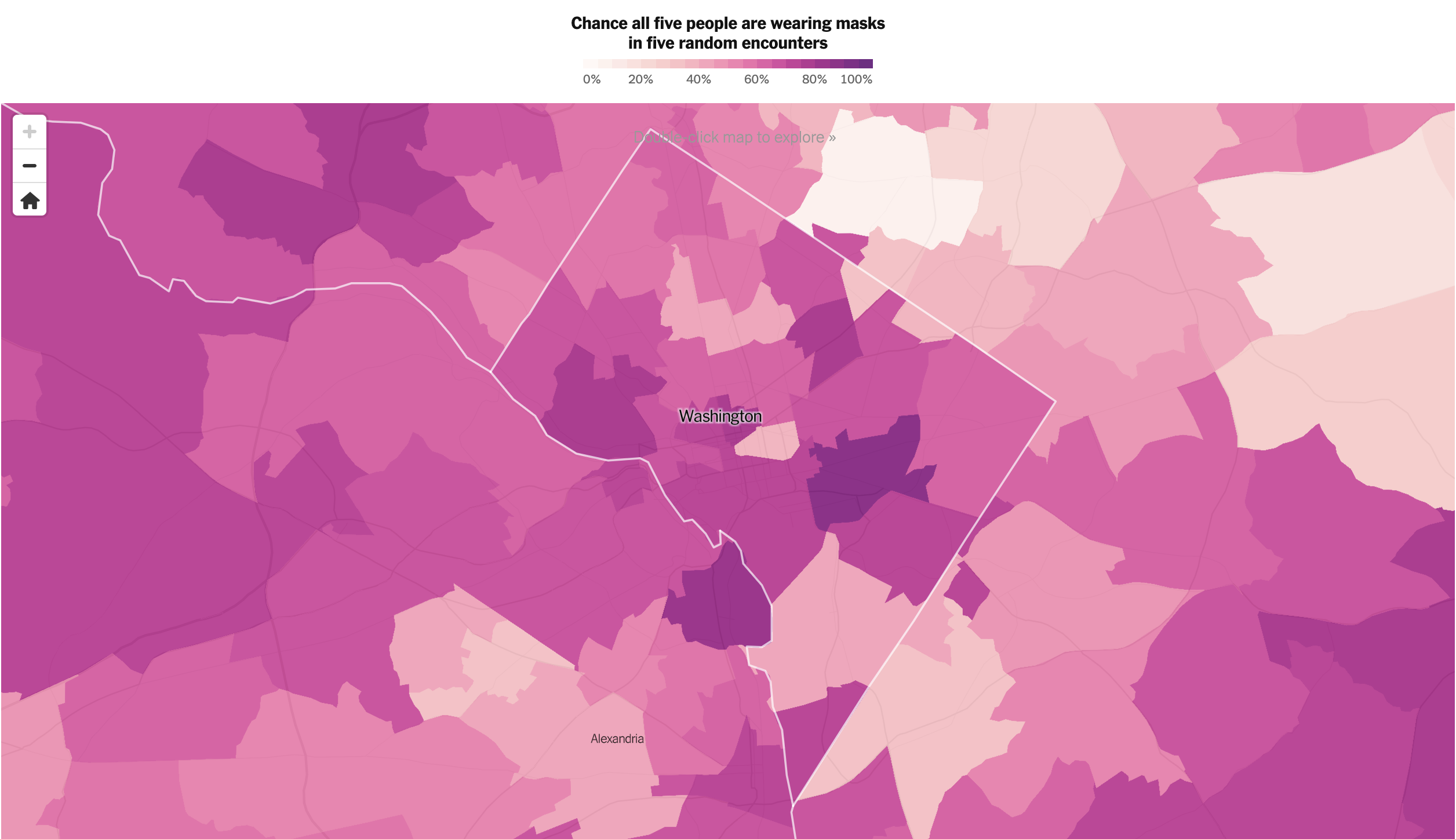
The New York Times released a detailed map on Friday that shows how common mask-wearing is depending on where you are in the U.S. The map provides some insight into the factors that lead to mask use, or lack thereof, revealing regional and hyperlocal patterns across the country.
Here in D.C., for example, the Times found that masks are quite common, but “there are sections of the suburbs in both Maryland and Virginia where norms seem to be different.”
To create the map, global research firm Dynata (on behalf of the Times) surveyed 250,000 people between July 2-14, compiling location data by ZIP codes, averaging nearby respondents’ answers to estimate mask-wearing frequency, and combining census tracts to draw up the shapes seen above.
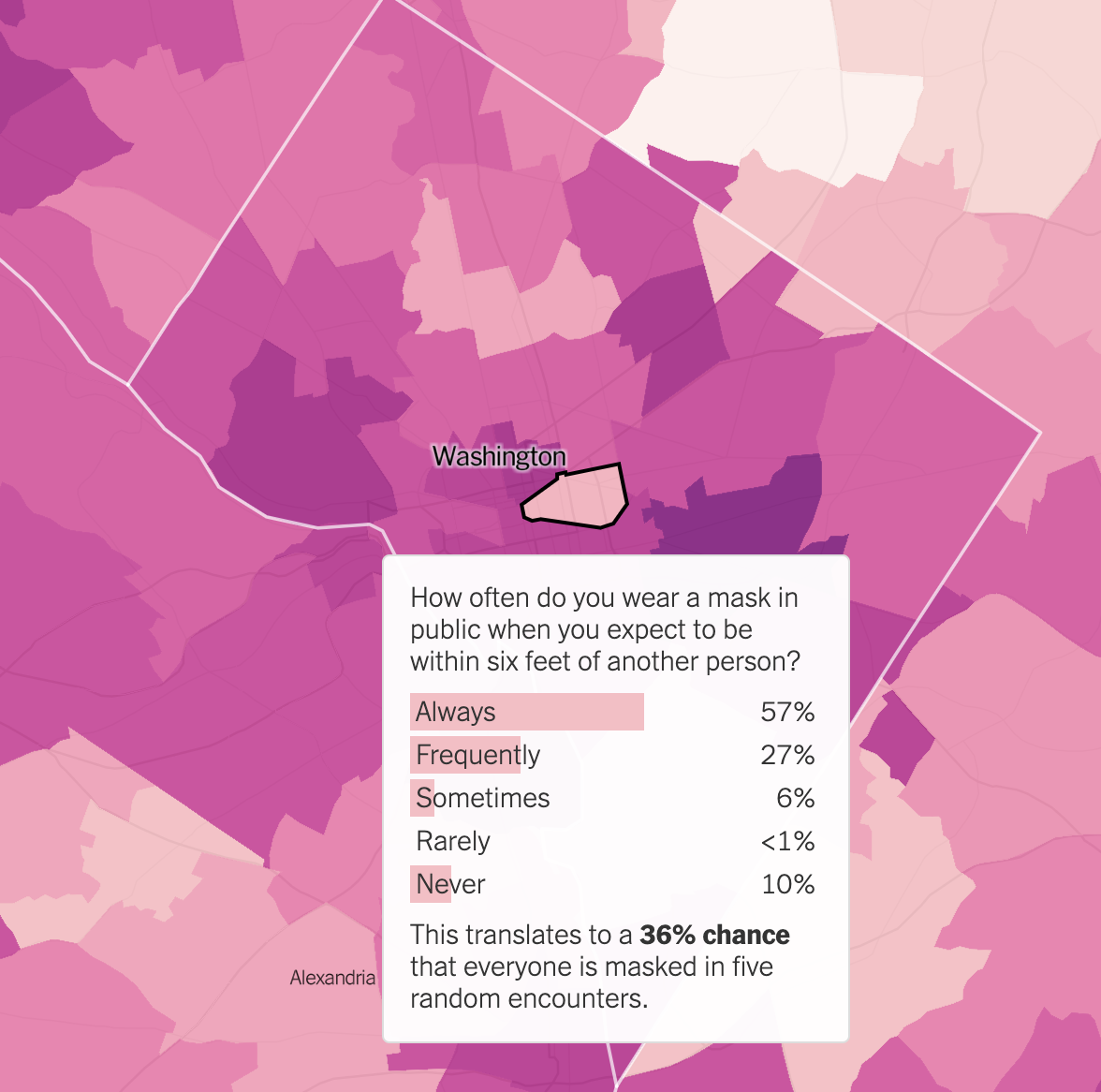
Dynata asked respondents,”How often do you wear a mask in public when you expect to be within six feet of another person?” and used that data to determine how likely it would be in five random encounters in a given location, that all five people would be masked.
For the most part, District residents have taken mask wearing pretty seriously, according to the map. In one part of Northeast, for example, there’s an 86% chance everyone is wearing a mask in five random encounters, as 97% of the respondents said they “always” or “frequently” wear masks. That’s pretty indicative of the rest of the city, where many of the — let’s call them “shapes” — reflect percentages in the high 60s and 70s on the “how likely are you to find five mask-wearers” scale.
Some pockets of D.C. and its surrounding suburbs aren’t fully sold on mask-wearing recommendations, it seems. One shape in what looks like Ward 2 shows that there’s only a 36% chance five random people are wearing a mask, even when they expect to be within 6feet of others. In an area just over the D.C./Maryland border, near what appears to be Takoma Park, masks are only seen in 5% of encounters, with 37% of the respondents saying they “never” wear a mask.
Like other cities in the Northeast and along the West Coast, the District shows higher mask use than, say, Georgia, whose governor has challenged mask restrictions, or less densely populated areas like Montana and North Dakota.
“The sample of survey respondents used by Dynata is also not entirely representative of the United States population, and not equally dense everywhere,” the Times reporters explain. “Some local numbers may reflect oddities in the survey sample, but over all the large number of responses provide rough comparisons across many areas.”
Mayor Muriel Bowser has frequently encouraged face coverings to help prevent the spread of coronavirus with tweets like this one — “Justice Ginsburg, your strength is contagious. You are #WhyIWearAMask” — in which she’s photographed wearing an RBG-themed mask. Bowser was expected to issue stricter mask mandates last week but delayed the announcement without explanation.
Some jurisdictions have intensified mask requirements in recent weeks, as the region sees spiking coronavirus numbers. Virginia officials recently announced that liquor stores in the state can deny entry to non-mask wearing customers, while leaders in local beach towns are warning that lax mask-wearing behavior is causing more cases among young people. Meanwhile, advocates have pushed for D.C. police to wear masks after spotting a number of officers who don’t. One Gaithersburg business owner shut down his restaurant after facing backlash for refusing to adhere to Montgomery County and state mask mandates.
Mask use has become a divisive political subject, as researchers have found that thoughts on masks largely fall down partisan lines. A recent Pew study showed that Democrats are about twice as likely as Republicans to say that masks should be worn always; and a writer at Philadelphia Magazine pointed out the Dynata map’s resemblance to the 2016 presidential election results by county.
“Trump supporters, many of whom may live in less-populated red states, may currently know fewer people with COVID, and may therefore minimize the threat,” Robert Klitzman, a psychiatrist at Columbia University, told the Washington Post. “They don’t want to wear masks — they may feel they are being imposed and are ‘un-American,’ perhaps something only people in the Far East do. The fact that wearing masks suggests that the virus is a real threat to them — despite what Trump has said — may further tip the balance against masks.”
The president himself was seen wearing a mask in public for the first time earlier this month, when he visited Walter Reed National Military Medical Center.
Ultimately, much of this comes down to peer pressure. The more people wear masks around you, the more likely you are to wear a mask, the Times reports.
“We definitely take our cues from our friends, and we often, almost always, already share values with our friends,” Elizabeth Dorrance Hall, a Michigan State University communications professor, told the Times. “It takes a strong person to stand up and say: This is what we’re doing and we’re all doing it.”
Explore the full map here.