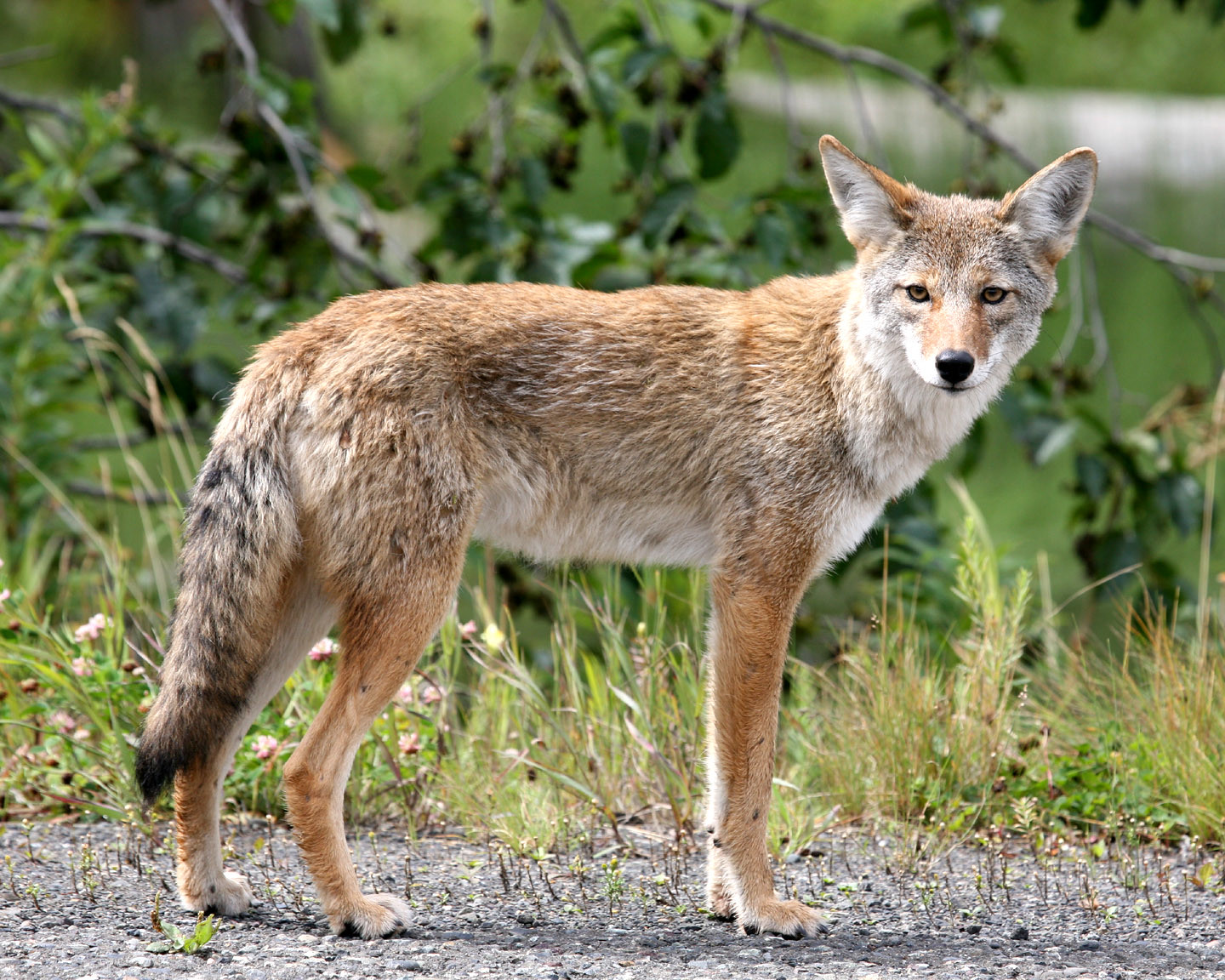
The area around the National Mall is seeing fewer tourists usual these days, and some locals are taking advantage: a coyote was spotted there on Tuesday morning.
The National Park Service tweeted a photo of the coyote on Wednesday morning, writing that its tree crew supervisor spotted it in East Potomac Park, which is located along the Potomac River near the Jefferson Memorial and the 14th Street Bridge.
The coyote was spotted around 6 a.m. near the East Potomac golf course, NPS chief of communications Mike Litterst told DCist in an email.
The agency said it is “rare” to see the animals on the National Mall, though they are known to live in nearby Rock Creek Park.
Lauren Crossed, the wildlife program manager for the Humane Rescue Alliance, says coyotes are “opportunistic,” going wherever they can to hunt and eat, and that the animal was probably just enjoying the newfound peace and quiet as a result of the pandemic.
“It’s just probably taking advantage of the fact that there’s all this space that’s probably not been explored by them very much, because there are so many people there normally,” she says.
https://twitter.com/NationalMallNPS/status/1285894268901642240
Crossed says the coyote could have been looking for a water source or finding a new home, but said she wasn’t concerned by the sighting. “It wasn’t, like, drinking out of the reflecting pool. It was sort of on the outskirts. It didn’t venture super far.”
Across the country, coyotes are found in most major metropolitan areas, and do well living close to humans, though they’re often hard to spot.
The animals are also terrified of people, Crossed says, and tend to avoid interaction with them. They are not typically aggressive towards humans, though they hunt small mammals, birds, other animals, and can pose a threat to peoples’ pets.
Crossed says she only knows of one other coyote sighting in that part of D.C., when one was found sick in a downtown parking garage two or three years ago.
One of the first coyote sightings in the District was back in 2004. They have been spotted largely in Northwest D.C. in the years since, but according to the D.C. Coyote Project, which provides information on the local coyote population, they have also been seen in Fort Dupont Park, Barnard Hill Park, and elsewhere.
Since coronavirus hit the District, as many people have been staying home, locals have noticed more wildlife than usual. Experts have said that’s no coincidence.
“Less ambient noise, less traffic, less interference … right now, life is better for them,” says Bill McShea, a wildlife ecologist with the Smithsonian’s National Zoo told DCist in May. “If there’s an upside to COVID, it’s on the wildlife.”
McShea also said he’d heard anecdotally about an increase in coyote sightings, though he attributed those reports less to an increase in the coyote population than to the fact that, with fewer people around, the animals were coming out into the open more often.
Just last week, a fox was caught stealing copies of the Washington Post off porches in Arlington, Washingtonian reported.
Even before the COVID-19 crisis, wild carnivorous mammals have been spotted in and around the city. Cameras captured a lone bobcat wandering near Georgetown in back November, and another fox, dubbed the Capitol Hill Fox, was seen on and around the U.S. Capitol grounds several times in 2014.
Crossed says HRA has not seen an uptick in reports related to coyotes specifically, though that doesn’t mean they aren’t out and about. She says there is a “strong possibility” that as people continue to stay indoors more than usual, locals could see more coyotes in unusual places.
“They’re pretty fearful of people, so if those people aren’t there, they’re gonna probably venture a little bit further than they normally would,” she says. “So, it wouldn’t be super surprising.”