Martin Austermuhle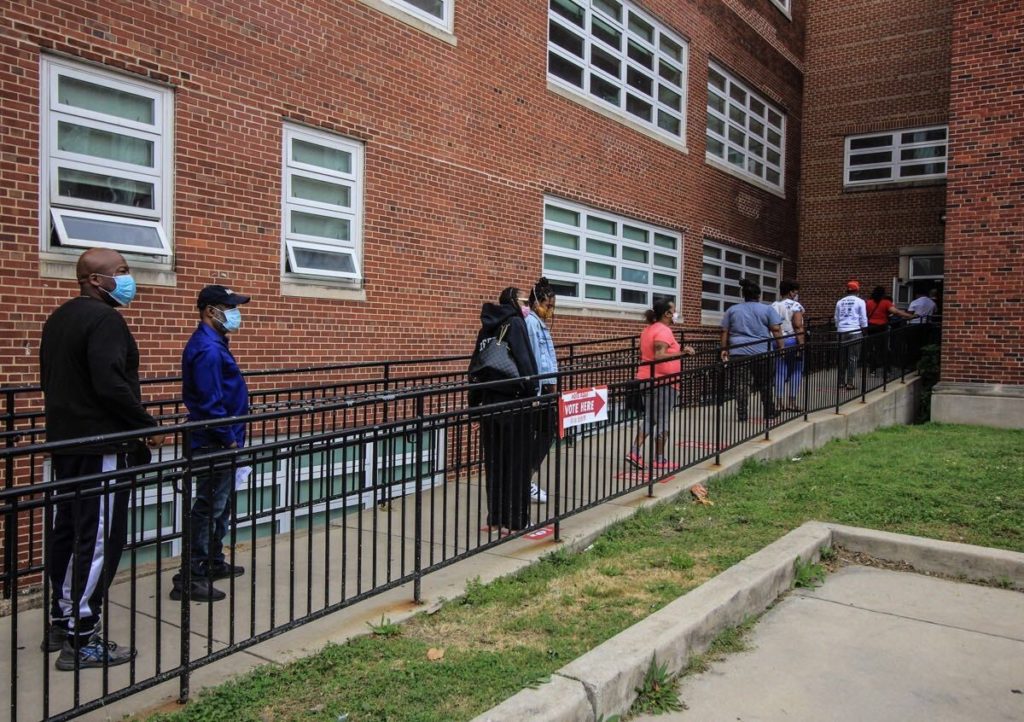
The D.C. Board of Elections says it plans on opening no fewer than 80 in-person polling places for the Nov. 3 general election, twice the number it was originally planning for. But it also warned that even with an increased number of polling places available, voters could still see long lines because of high turnout and social distancing requirements.
In a letter sent to Bowser and Ward 6 Councilmember Charles Allen on Monday, elections board chairman Michael Bennett committed to opening the 80 polling places, and putting more of them in neighborhoods east of the Anacostia River, where in-person voting was heaviest during the June 2 primary.
He explained that any D.C. voter would be able cast a ballot at any of the polling places, a change from normal elections where most voters use designated polling places — 144 in all — tied to their home address. He also said that the board would again open two early voting centers in each of the city’s eight wards, and continued working to open “super vote centers” in large-scale facilities like the Capital One Arena. (Monumental Sports & Entertainment, the arena’s owner, has offered it for use as a vote center.)
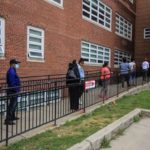
Bennett’s pledge comes amid back-and-forth demands over how to run November’s election, especially in light of the experience with the June primary, when some voters had trouble getting absentee ballots and others were forced to wait in hours-long lines at the 20 polling places that were open.
Election officials admitted after the primary that the city would need more in-person polling places for November, but said they had to balance that against the difficulties of staffing them during a pandemic and also finding appropriate locations where social distancing could best be accommodated.
An original plan approved by the board called for 40 vote centers for both early and day-of voting, but Mayor Muriel Bowser called that number insufficient during an appearance on WAMU’s “The Politics Hour” this month. Late last week she introduced a bill that would require at least 80 polling places, and even as many as 144 — the number available during normal election cycles. Allen tweeted Monday that the Council will vote on emergency legislation on Tuesday to set the requirement for 80 polling places for the November election in law.
In his letter on Monday, Bennett agreed to open the 80 polling places — but also insisted that the board was only forced to accept fewer than the usual 144 because of the ongoing pandemic.
“I feel compelled to state that, but for the current COVID-19 Health Emergency declared for the District of Columbia, the nation, and the entire world, the DCBOE would be conducting the November 2020 election as it has successfully for many election cycles. We would have approximately one week of early in-person voting and open 144 precinct-based polling places for Election Day voting,” he wrote. “These are far from normal times. Many often fail to note this fact.”
Bennett also asked Bowser and Allen for help identifying suitable locations for the 80 polling places, requested that the city take the lead on cleaning them during and after voting, and said he’ll need assistance hiring a temporary workforce of up to 4,000 volunteers and staff to help run the election. In the letter, he recommended allowing D.C. school students as young as 16 to qualify, and offering them “enhanced community service hours for working the polls.”
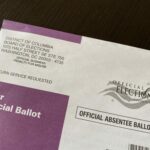
In his letter, Bennett said the board’s plan to mail every registered voter a ballot ahead of the election remains unchanged. That grew out of the June experience, when voters were asked to request a ballot. While nearly 90,000 did, per the board’s vote tallies, some voters said they never received their ballot or had trouble finding out if it had been received after they mailed it back. The board says it expects to contract with a specialized mail house to handle the logistics of sending out almost a half-million ballots, and plans on placing between 40 and 50 ballot drop boxes around the city for voters who don’t want to rely on the mail.
But he added that unless an overwhelming majority of voters cast ballots by mail, lines at the polling places would be inevitable.
“The truth is that unless 85% of D.C. voters cast their ballots by mail or take full advantage of early voting, there will be long lines at every Election Day polling place on November 3,” he wrote. “This will be due in part to the limited capacity of the typical polling place (and the responsibility to respect social distancing and other recommended health emergency guidelines) and the inventory of election equipment that is available for deployment to process voters at the polling places on Election Day.”
In Maryland, Gov. Larry Hogan has also ordered that all normal polling places be open to voters, and says that residents who want to vote by mail need to request a ballot. Ahead of the state’s June 2 primary, every Marylander was sent a ballot directly. Hogan’s decision has drawn criticism from some election officials and activists, who worry that he’d be putting voters at risk by giving them them the sense that voting in person will be safe in November.