 Daniella Cheslow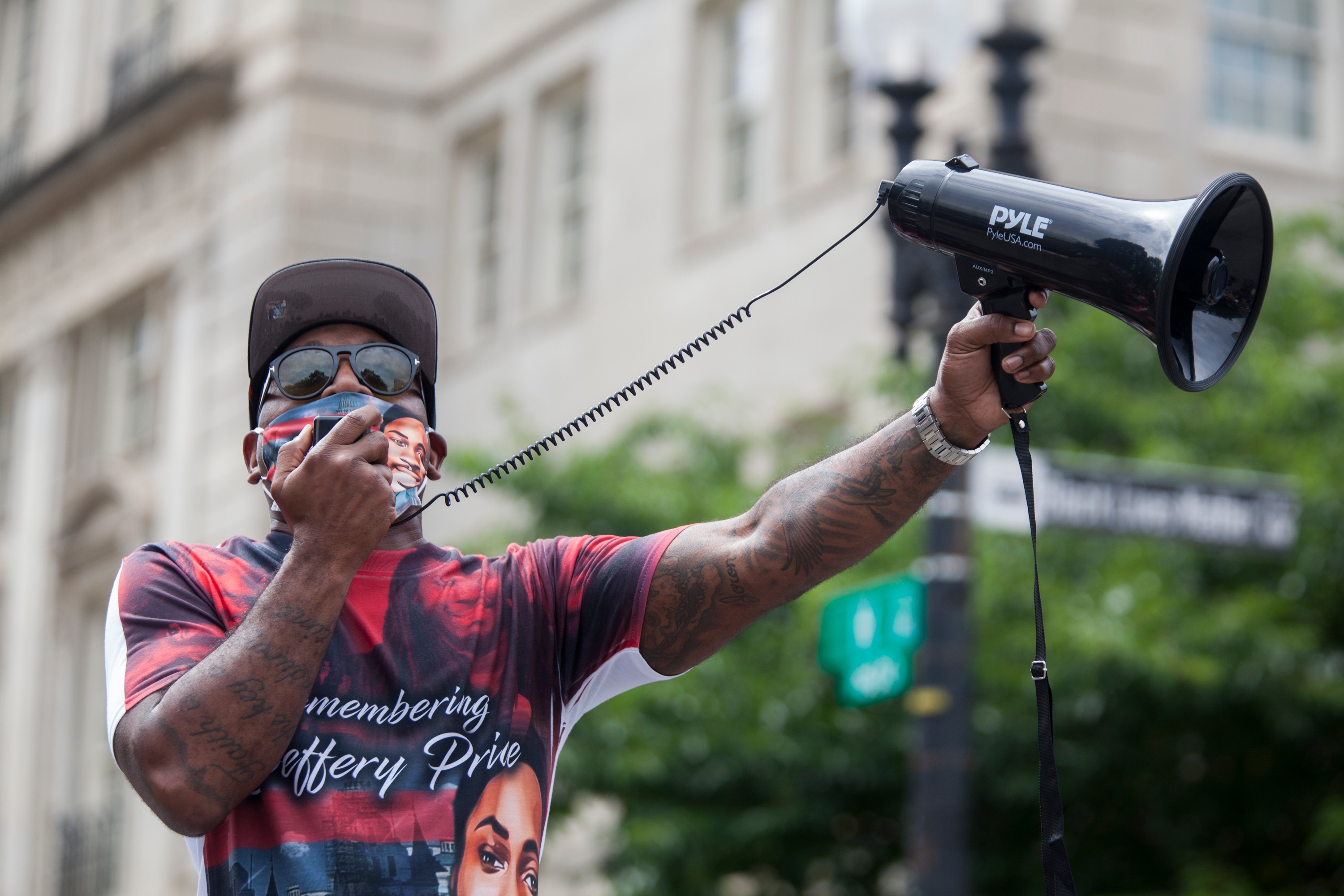
The families of three men killed by D.C. police in 2018 say the city only partially followed new emergency protocols when it released footage from officers’ body-worn cameras to the public in late July. At least one family says the video provides further proof of wrongful death, and all three families say the process of releasing the footage left them further traumatized.
“We were not prepared,” says Jay Brown, whose nephew Jeffrey Price died on May 4, 2018, within weeks of the fatal shootings of Marqueese Alston and D’Quan Young. Footage from those incidents was also released.
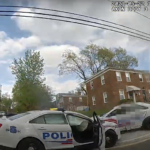
Police say Price was driving a dirt bike, which is illegal in D.C., against traffic at high speed when he slammed into a police vehicle. But the family says police chased Price and blocked him at an intersection, causing the fatal incident. After two years of waiting for the footage to be released, Brown says he was driving when friends called him to say they saw Price’s last moments on TV.
“That’s not how we wanted to learn,” Brown says. “I pulled over, I got out of the car and I just screamed until my lungs got raw.”
Mayor Muriel Bowser authorized the release of the footage on July 31 to comply with an emergency police reform bill passed by the D.C. Council in July. The law requires the release of body-worn camera footage and the names of officers responsible for a death or serious use of force within five days of an incident. It also applies retroactively, and gives the mayor until August 15 to release footage and officer names from deaths since the camera program began six years ago.
The law gives families the chance to opt out of the release of footage, and D.C. officials say four did late last month. For those three families who D.C. says did not opt out, the law requires that MPD notify them that the footage will be published — “including the date when it will be released” — and offer them a chance to view the footage in advance.
Attorneys for the three families say the police and mayor’s office ignored some of those terms.
Attorney David Shurtz, who is representing the Price family in its $100 million lawsuit against the city, says he was still negotiating with MPD over releasing more than 50 videos he says were related to Price’s death when police released one three-minute compilation and a longer, hour-long video. Shurtz says he was startled.
“I had no clue,” he said.
Kevin Donahue, D.C.’s Deputy Mayor for Public Safety, says the release of video from all three incidents was guided by public interest.
“There was an attempt at negotiating something that is not in our power to negotiate, which is how many videos get released. And given the history of wanting to have the video released, we moved forward,” Donahue says.
A Long Fight Over Footage
After D.C. started outfitting officers with body-worn cameras in 2014, the council passed a law allowing for footage to be made public — but only under specific circumstances. It also gave Bowser the right to make footage public if she deemed it in the public interest; she did just that in Jan. 2017, releasing video from the killing of Gerald Hall two weeks prior.
Civil liberties groups pushed the council to require that more footage be released more consistently, saying it would increase accountability and transparency. A first version of the council’s emergency police reform bill would have required that footage be released within 72 hours of an incident, but was negotiated up to five days after Bowser raised concerns.
Attorney Joseph Caleb represents the mother of D’Quan Young, who died on May 9, 2018 after police said he pulled a gun at an off-duty officer, who fatally shot him. The officer was not in uniform and was not wearing a camera. Police released video from a camera on a nearby recreation center along with footage from body-worn cameras of three officers who arrived to give first aid after the shooting.
Caleb says Young’s family saw that footage on July 28, but “because the video, we thought, was incomplete and it resembled a TV production, we weren’t comfortable with the video being released,” he says. “We informed them that we did not consent at that point.”
Nevertheless, Caleb says, “At some point on Friday morning, an officer with MPD did reach out to the family. By the time I returned the phone call, the footage had already been released.”
Donahue says that account is “not consistent with the briefing that I got,” after the family viewed the video. He added that when he asked if the family had asserted its privacy verbally or in writing, “that bar hadn’t been clearly met.”
A lawyer for Kenithia Alston, says she, too was not satisfied with the way footage of her son Marqueese Alston was released. Alston died on June 12, 2018; police say Alston fired first and officers shot back, although his family disputes that version of events and has filed a $100 million wrongful death lawsuit.
Attorney Zina Makar says Alston saw footage last year and on July 28. Makar says Alston “never gave consent” to release the video, which she said is “edited, curated and heavily narrated version of what happened. It’s not designed to demonstrate the truth.” Nevertheless, Makar says, the police swiftly moved to publish the video and only notified Alston 90 minutes before it was released.
“Everything moved extremely quickly and she was not made fully aware about what was going to happen or that the information was going to be produced publicly so quickly,” Makar says.
Makar says the release of the video would not dissuade her suit. She says Alston also seeks the internal investigation reports and the records of the police officers involved in her son’s death.
Donahue did not dispute that Alston received final notification 90 minutes before the release, but he claimed the process for it “started almost two weeks prior.” He noted that MPD also released two longer videos from the incident.
Councilmember Charles Allen (D-Ward 6), who crafted the legislation, said he aimed to reduce trauma for the families of the dead. He said he would follow up with the mayor and deputy mayor’s office.
“The legislation was informed by hearings that we held where Ms. Alston testified, where Mr. Brown testified,” he said. “If the law was not followed with the intent with which it was spelled out, then we’ve got a problem.”
Price’s family also saw in the video further evidence of what they believe is police wrongdoing. In the hour-long video released by police, Officer Michael Pearson clearly runs a stop sign and drives into the intersection where he collided with Price.
“Clearly, it showed that not only was the officer negligent in blowing through the stop sign, he did it on purpose,” attorney Shurtz said. “That was [Price’s] cause of death.”
He said he expected this finding to bolster his civil case.
Moreover, Price’s uncle Jay Brown said he believed the video shows officers coordinated a cover story. In the footage, Pearson, who collided with Price, says, “‘I saw him coming down speeding.” Another officer says, “I can see you were trying to clear the road.” Pearson answers, “That’s right. I was trying to get out of his way.”
Donahue said he could not comment on the litigation.
Concerns From Police
The new law, which was passed in the wake of George Floyd’s killing by a police officer in Minneapolis, has already drawn criticism from police. This week the D.C. Police Union filed a lawsuit to block Bowser from releasing footage and officer names. Union president Greggory Pemberton said he took issue with the five-day window, which would make officers’ names public before any internal or external reviews could be done.
“The concern is that if you release a video of an officer using force in that manner, without any other context other than the video itself, there’s an opportunity there for activists and anti-police rhetoric to sort of point the finger at this officer,” Pemberton said. “It’s going to be very difficult for that officer to get past that even when they’re cleared of any misconduct.”
The union has also sued the city over a provision that prohibits it from addressing disciplinary procedures during contract negotiations.
Deputy Mayor Donahue said he intended to “follow the law with fidelity.”
The emergency law will remain in effect for 90 days; the council passed a parallel, identical temporary law that applies for 225 days. Allen said passing a permanent version of the law was a top priority for the council, and he said he would seek to learn from the three families’ experiences over the course of hearings in the fall.