Elliot C. Williams
 Margaret Barthel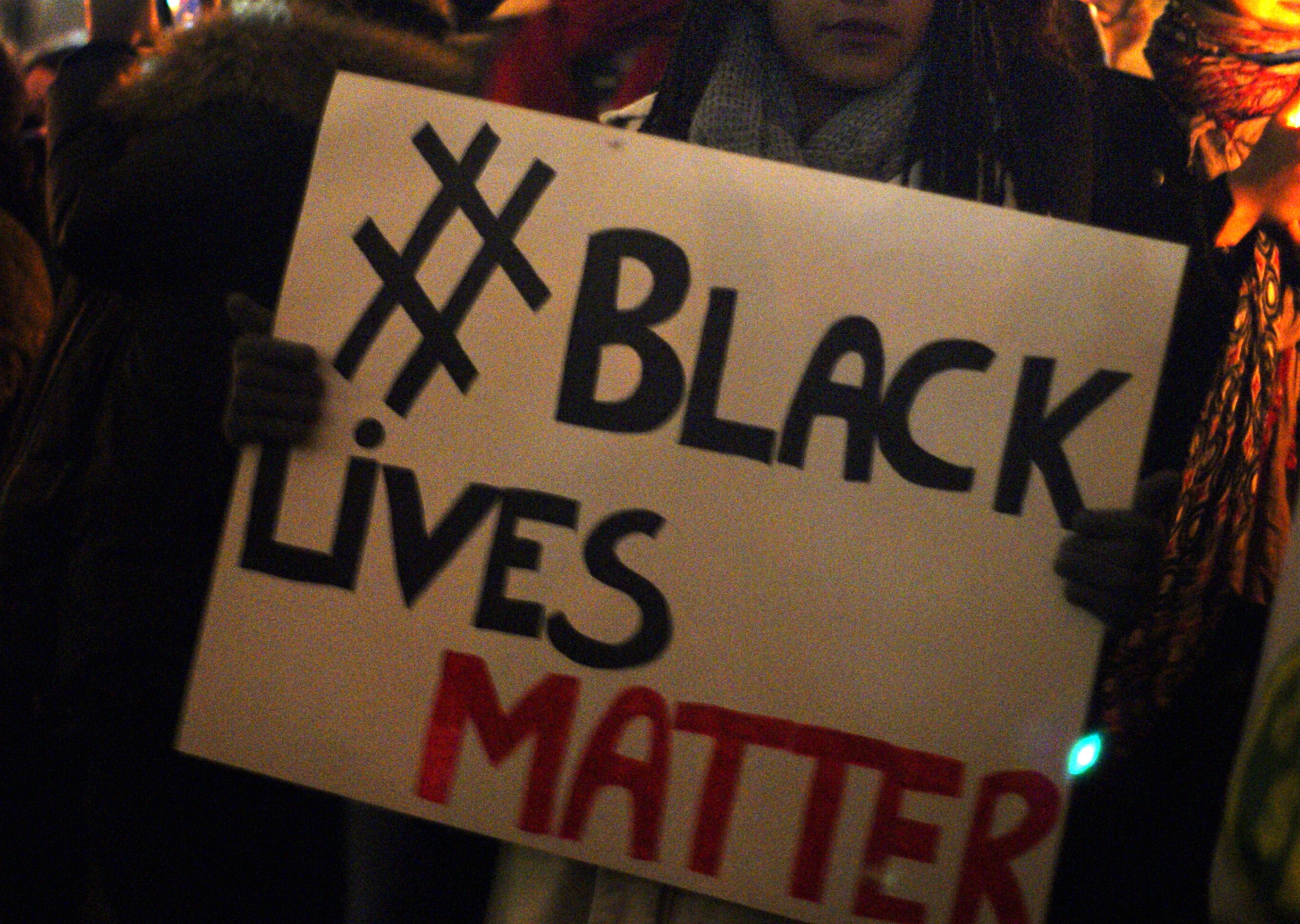
This post was last updated on Aug. 17 at 12:40 p.m.
Update: A city official confirmed Monday that D.C. police used pepper spray to control protesters in Adams Morgan last week.
Kevin Donahue, the city’s Interim City Administrator and the Deputy Mayor for Public Safety and Justice, said police “effectively, tactically” contained the protesters, some of whom set at least five fires, he said.
D.C.’s Metropolitan Police Department is prohibited from using “chemical irritants” to disperse First Amendment activities, per an emergency police reform bill signed by D.C. Mayor Muriel Bowser in late July. Under the legislation, chemical irritants are defined as “tear gas or any chemical that can rapidly produce sensory irritation or disabling physical effects in humans.”
Original story: A group of Black Lives Matter protesters marched through the Adams Morgan neighborhood Thursday night, and were met with a massive police presence, multiple media outlets reported.
D.C. Police said in a statement that officers arrested 41 protesters on offenses related to felony rioting and assault on a police officer. Two officers sustained non-life threatening injuries, police said.
Multiple reports on social media indicated that the majority of the arrested protesters were released on Friday evening, some with charges dropped.
Kian Kelley-Chung, a 23-year-old filmmaker and photographer from Columbia, Md., was one of the 41 people arrested. He told WAMU/DCist that he was held at the 7th District police precinct overnight, and then detained at Superior Court before being released on Friday evening. It was the first time he’d ever been arrested.
“I was thinking that I know that John Lewis was arrested, he has a mug shot too. MLK Jr, he also has a mugshot too — Malcolm X, some of my greatest inspirations when it comes to the civil rights movement,” he said. “It’s almost like a badge of honor.”
Kelley-Chung and fellow independent filmmaker Andrew Jasiura have been filming protests in D.C. for a documentary. Kelley-Chung said he had his camera out during his arrest, and said MPD officers ignored him when he identified himself as a journalist. Jasiura was detained by the police but not arrested.
On Friday during the day, about fifty people gathered outside of D.C. Superior Court, waiting for the release of arrested protesters. Jay Brown, who has been attending protests throughout the summer, said the mood of the gathering was determined.
“We’re not going anywhere. We’re not going anywhere. We are not going anywhere,” he told WAMU/ DCist.
Brown said he had seen “one or two” arrested protesters released by about 3 p.m.
Brown is also the uncle of Jeffrey Price, who was killed in a collision with an MPD vehicle in 2018. Body camera footage of Price’s death was released in July, which Price’s family said provides further evidence of wrongful death.
Standing outside the courthouse to support arrested protesters, Brown said, was personal to him.
“When I come to these events, I kinda have to find myself stepping away from the crowd because I break down, as any human being would, you know, knowing that the individuals who took the oath to protect and serve intentionally murdered your loved one,” Brown said.
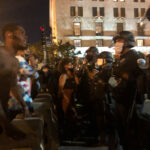
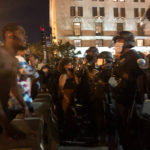
On Thursday night, at least 50 people marched through Adams Morgan starting around 10:00 p.m., and about an hour later, MPD officers shut down the block near 18th and Willard streets NW and were corralling protesters into a confined area (a tactic known as “kettling”), according to reports from Boston Globe staff writer Abdallah Fayyad.
This all started with only about 50 protesters marching through the streets. By my count, there are now over 40 cop cars at the intersection of Florida and U NW. https://t.co/NjiP7qkyg4
— Abdallah Fayyad (@abdallah_fayyad) August 14, 2020
Kelley-Chung said police surrounded the group of protesters after what appeared to be an altercation between police and a protester.
“I just saw the police had just tackled someone, and then a bunch of people went to go in, rush in, see if that person was okay, see if they could help, and then the police just circled everyone,” he recalled.
He ran over with his camera to see what had happened, and got caught in the circle, where he was arrested.
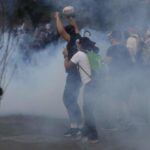
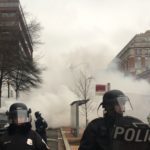
Witnesses say police officers used pepper spray to disperse the crowd. D.C. Fire and EMS were seen removing one protester, who appeared to be in a medical emergency, away from the area on a stretcher. Some later recounted a chaotic scene of violent clashes between protesters and police, people burning newspaper vending boxes, and a low-flying helicopter.
Under an emergency police-reform act passed by the D.C. Council and signed by Mayor Muriel Bowser, MPD is prohibited from using “chemical irritants” to disperse First Amendment activities. The legislation defines chemical irritants as “tear gas or any chemical that can rapidly produce sensory irritation or disabling physical effects in humans.” The bill also has limits on use of less-lethal projectiles, like rubber bullets, as well as riot gear.
Multiple social media posts and outlets showed MPD officers clashing with and detaining protesters and putting them in vans, while bystanders shouted at officers. It wasn’t immediately clear what led police who had been monitoring the demonstration to move in on the group.
Protesters were later seen marching to the Third District police station, shouting “no justice, no peace!”
One witness told the Washington Post that the protesters turned over at least one garbage container and lit fireworks, but said that otherwise, they were peaceful. By early Friday morning, the area was quiet and police had moved out of the area.
“We facilitate daily peaceful demonstrations in DC,” MPD wrote in Twitter post. “Overnight, intentional fires were set & property destroyed. When this occurs, our members have a responsibility to take action.”
This story has been updated with comments from Jay Brown and Kian Kelley-Chung.