 Jenny Gathright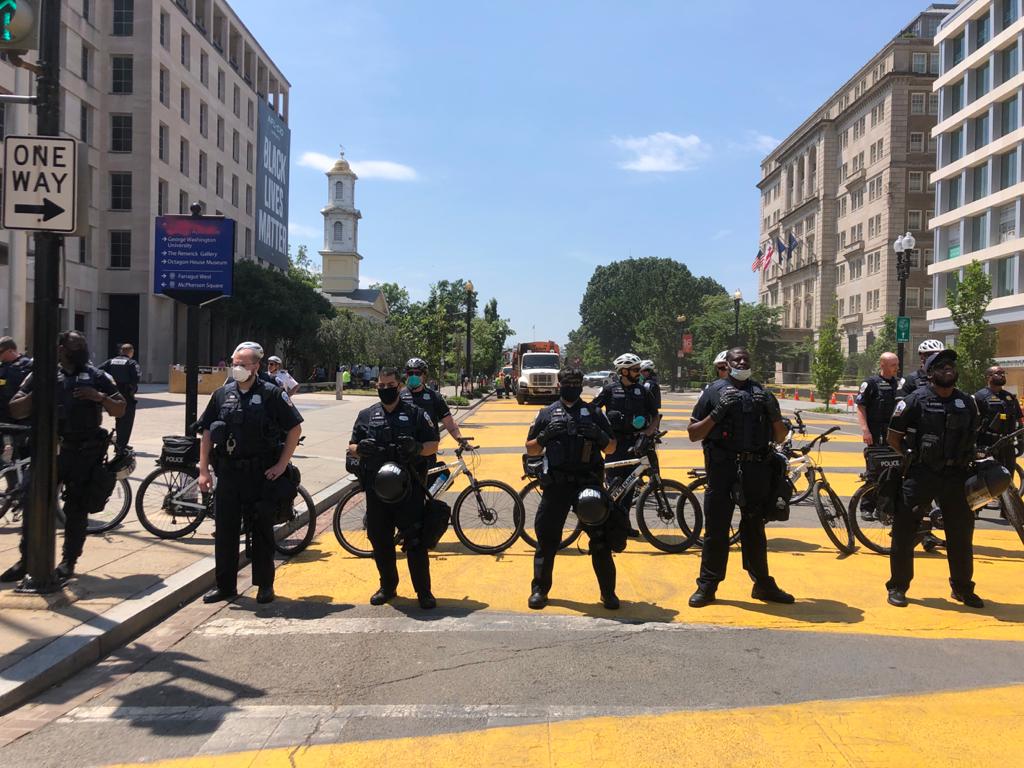
Dionte Coley was waiting for the bus near Black Lives Matter Plaza on Tuesday, June 23, when he says police approached him. Without warning, Coley says, the officers started aggressively pushing him and others who were nearby, clearing them from the area where they were standing.
Coley says police and Department of Public Works employees then took his backpack — which contained personal documents and nearly all his money — and threw it in the trash.
The incident was part of a series of police actions that day to clear protesters against police brutality who had been camping downtown. Officials say the encampment was a risk to public safety.
Coley has now filed a lawsuit against Mayor Muriel Bowser, Police Chief Peter Newsham, and several other city leaders and employees. It alleges officials, acting under pressure from the federal government, violated protocols for clearing encampments. Coley is seeking compensation for the loss of his belongings and the resulting stress and hardship he has experienced (the suit does not specify how much Coley is seeking). Without the documents and money in his backpack, Coley says he has been unable to find work or stable housing, and is now homeless.
“It’s crazy how just one incident can change the direction of what someone has going on in life that fast, that easy,” Coley says. “Everything—it’s just been completely derailed in every way I could think of: monetarily, socially. I can’t even access my belongings. I have belongings in a storage bin that I no longer have the keys to…it’s just completely disrupted my life in every way.”
A spokesperson for D.C. Mayor Muriel Bowser declined to comment for this story, citing the administration’s policy of not commenting on ongoing litigation.
Coley is not the only person who says they lost valuables in the chaos that day. A street medic told DCist/WAMU that she lost “thousands of dollars” worth of medical supplies that morning and was bruised and pepper-sprayed by police. Other activists who experienced police enforcement that day say the tactics from the Metropolitan Police Department were overly aggressive, leaving them injured and without valuable items.
Coley’s lawsuit, filed by his attorney Jonathan Gitlen in U.S. District Court, alleges the city did not adhere its own rules for clearing encampments, which say the city will provide those camping with a certain amount of notice and allow them to collect their personal belongings before the area is cleared. The Office of the Deputy Mayor for Health and Human Services, which oversees encampment cleanups, did not respond to a request for comment as to whether city employees followed encampment protocols on June 23.
Unlike many others who allege they were aggressed and lost belongings that day, Coley says he was not involved with protests. When he was at the bus stop at 16th and K streets Northwest, he says he had just gotten back from a stay with relatives in North Carolina, where he went to ride out the most intense phase of D.C.’s lockdown in a less densely-packed area. He didn’t know much about the plaza or what had been going on there.
“I didn’t even know that that’s where they wrote the Black Lives Matter on the street,” Coley says. “I saw it on the news, but I wasn’t aware of even what location that was until I was right there, present.”
Coley says he was not participating in protests, and “wasn’t being unruly or disruptive” when police forced him out of the space and separated him from his backpack. “I was doing what normal people do, waiting for public transportation to get regular things accomplished,” he says.
Coley says his backpack contained his phone, his birth certificate, spare changes of clothes, toiletries, medications, keys to a locker where he was keeping personal possessions, and $800. Coley planned to use that money to rent a room, but says he was not able to connect with his potential landlords after he lost the money and his phone. Since it was taken, he has been staying in the city’s emergency shelter system. Since he lost his phone, he lost contact information for doctors, work contacts, family, and friends that he has been working to piece back together over the last two months.
Coley says the backpack also contained his ServSafe certificate, which he says he needs to secure work as he looks for jobs in the food and beverage industry. He says he’s locked out of the email account he needs to log in to obtain a new certificate; He stored important passwords in notes on his phone, which he alleges was in the backpack taken by police.
Replacing his documents, Coley says, has also been a labyrinthine process, made worse by the fact that many offices and government agencies have adjusted their operations during the pandemic.
“I’m not really used to just always being on hold, waiting for the help of the next person,” Coley says. He describes the process of trying to put his life back together as a “waiting game,” where he’s always dependent on action from an agency or organization so that he can take his next step.
And as he remains caught in bureaucratic limbo, his financial resources have dwindled.
“By the end of June 23, 2020, Mr. Coley had approximately $230 to his name,” the lawsuit says, noting that Coley had some money on his person that day. As of August 11, the day the suit was filed, Coley said all the money had run out.
While Coley was not protesting, his lawsuit makes larger claims about the city’s motivation for clearing encampments at Black Lives Matter Plaza.
The day before the incident, protesters had attempted to topple the Andrew Jackson statue in Lafayette Park, and spray-painted “BHAZ,” which stand for Black House Autonomous Zone, on the pillars of St. John’s Church. President Trump responded to these events and threatened “serious force” on protesters in a tweet that violated the platform’s rules against abusive behavior.
“The message to the District was clear. Take control of the protestors, or we will,” the lawsuit says. The suit alleges that the District’s clearing of encampments on June 23 was a direct response to threats of a strong federal response to protests in the city.
District officials have said their actions on June 23 were an attempt to quell public health and safety concerns about encampments in the areas in front of the White House. Gitlen says he’s only representing Coley, since it would be difficult to find and identify other plaintiffs, and he has not seen the District Court grant class action status in similar cases.
More than anything, Coley says he wants the city to acknowledge that the incident was about more than just a backpack: It has deeply affected his trust in law enforcement, and deeply hindered his attempts to move forward with his life and seek stability in D.C.
“It took me a very long time to start to gain trust in police — and it’s gone, that fast, all over again,” says Coley. “I need them to at least acknowledge and recognize that this wasn’t a simple matter. It wasn’t something that just made that day difficult. Like, the rest of this year is difficult because of that one situation. I don’t know, for all I know, it might affect me the rest of my life.”