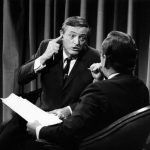
In August 1968, as the Republican and Democratic national conventions unfolded amid that year’s protest and unrest, ABC News broadcast what it called “unconventional convention coverage,” featuring analysis from two of the most high-profile political commentators of the time. The contentious on-air debates between conservative National Review founder William F. Buckley and leftist author Gore Vidal—in which Vidal called Buckley a “crypto-Nazi” and Buckey called Vidal “queer” before threatening, “I’ll sock you in your goddamn face”—foreshadowed the contemporary era of no-holds-barred political wrestling on television.
More than half a century later—in another August, in another “unconventional convention” season, in another year whose protest and unrest has drawn comparisons to ‘68—the confrontation between the two erudite public intellectuals is the inspiration for a forthcoming theatrical production from one of D.C.’s most celebrated humorists.
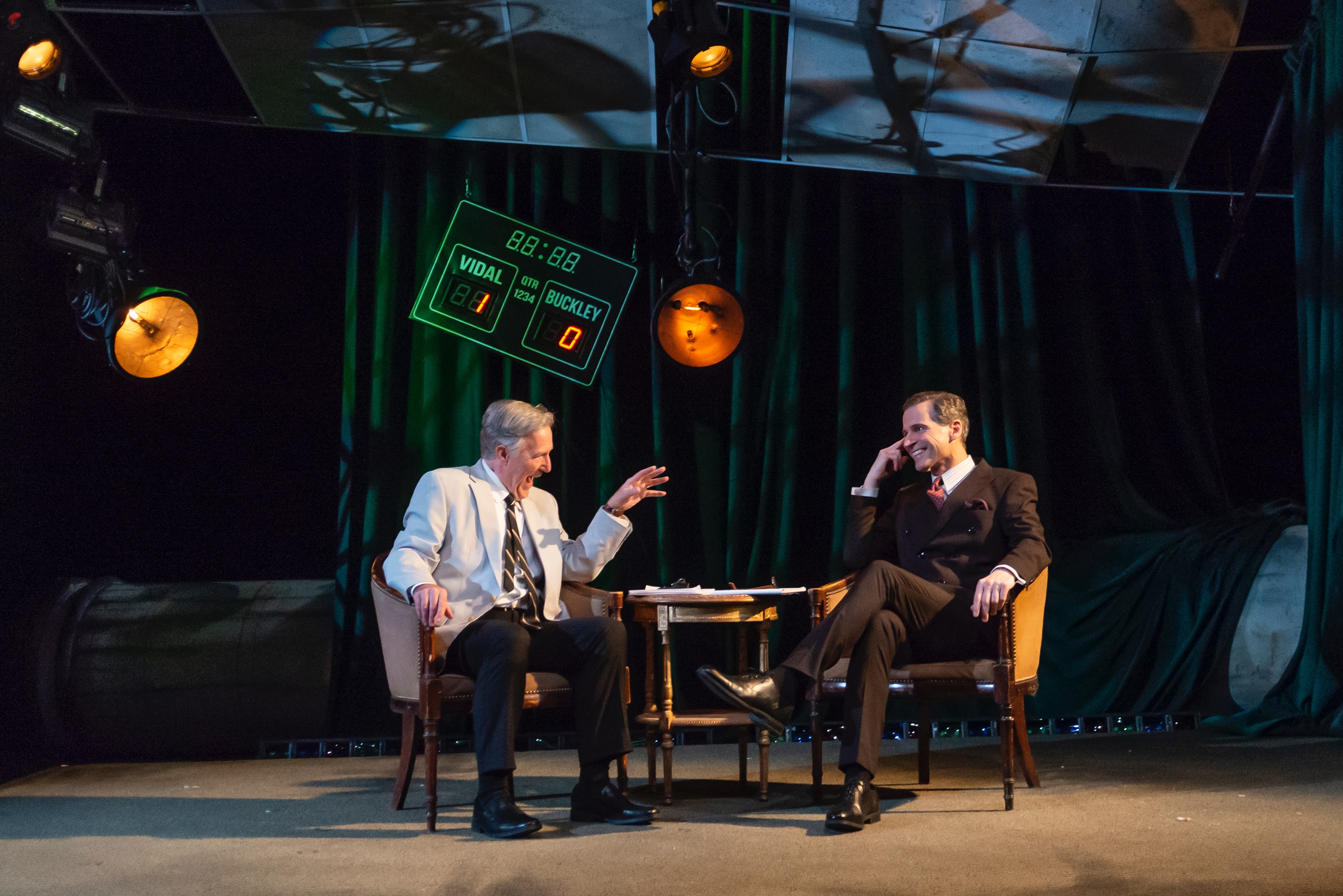
Alexandra Petri, the 32-year-old Washington Post columnist and author of this summer’s essay collection Nothing Is Wrong and Here Is Why, is the playwright behind Mosaic Theater Co.’s Inherit the Windbag, which was set to premiere at the Atlas Performing Arts Center in March before the pandemic dashed those plans. Her show finds Buckley and Vidal meeting again in the afterlife—perhaps in heaven, hell, or some kind of pundit purgatory. The two men then revisit their debates in an effort to adjudicate who won.
Mosaic still hopes to present a stage version of the show next spring, but in the meantime Petri and her creative team are working on a video adaptation—what director Lee Mikeska Gardner calls “a fancy Zoom production”—to be released later this year on a date yet to be determined. The cast includes Paul Morella as Vidal and John Lescault as Buckley, along with Tamieka Chavis and Stephen Kime as “demons” who bring back to life other famous dead writers of the era. The actors are finishing recording their performances this week in front of green screens in their homes and post-production in September will layer on special effects.
“Worst case scenario: It’ll be as good as a beautiful audio play, but also you’ll have visuals,” a cheerful Petri told DCist over the phone last week, taking a break from a jigsaw puzzle in her Georgetown home. “It’s certainly new territory, but I’m excited to see what it becomes.” She believes the themes of the Buckley-Vidal debates retain a striking relevance in this election year: culture war, polarization, and the ways political discourse can conceal as much as it reveals.
Petri’s original inspiration for Inherit the Windbag came when she happened to see Best of Enemies, a 2015 documentary about the debates, at Landmark’s E Street Cinema. The film chronicles how ABC, behind in the ratings, hired Buckley and Vidal as a ploy for a bigger audience, putting the two men on air for 10 debates spanning both major party conventions. The pair sparred bitterly over subjects ranging from freedom and inequality to protests and police brutality. But what made their confrontations memorable was their personal nastiness.
In a swipe at Vidal’s bisexuality, Buckley told him, “We know your tendency is to be feline.” He later whipped out a letter allegedly from Robert F. Kennedy in which the New York senator jokes, “I have changed my platform for 1968 from ‘Let’s give blood to the Vietcong’ to ‘Let’s give Gore Vidal to the Vietcong.’”
Vidal, meanwhile, refused out of pettiness to say the name of Buckley’s magazine. He ridiculed his opponent as “the Marie Antoinette of the right wing … always to the right and almost always in the wrong.”
ABC executives were stunned by this display. (As comedian Dick Cavett put it in the documentary, “the network nearly shat.”) But Buckley and Vidal accomplished their task, vaulting ABC back to the top of the ratings heap and birthing a new genre of televised punditry.
“The moment when you discover that something awful makes for good television is always the beginning of the end,” Petri wrote in a column about Best of Enemies. Nonetheless, she was captivated by the debaters, watching clips of them obsessively on YouTube and devouring their writings. She took Buckley’s God and Man at Yale to the beach and spent her honeymoon consuming Vidal’s memoirs, bombarding her husband with details that fascinated her. (“He’d be like, ‘It’s the honeymoon, Petri,’” she recalls in one of Mosaic’s promotional videos, “He’s been a real trooper throughout this.”)
Part of what intrigued Petri—if also troubled her—was the nostalgia she discovered for Buckley and Vidal, and specifically the lament that no one debates like them anymore. She recalls coming across this sentiment in YouTube comments, but it also appeared in the press: In New York Magazine, Jim Holt noted that, notwithstanding their vitriol, “Buckley and Vidal managed to articulate sharply opposing views on the issues: race and poverty, ‘law and order,’ containment versus rollback in the Cold War, the morality of intervention abroad, the limits of empire, and the toleration of dissent. And they did this with a degree of eloquence and intellectual sophistication—marked by casual references to the Monroe Doctrine, Oliver Wendell Holmes, and the Congress of Vienna—not seen on TV today.”
But Petri isn’t pining for the past. She argues our world is “poisoned by nostalgia” and, as much as her fascination with Buckley and Vidal endures, she has no great desire to return to the discourse of the ‘60s. “The whole idea of ‘the discourse,'” she says, “sounds like you’re in some sort of fancy room eating off fine china and able to discourse on all subjects. But then the question is, ‘Who gets to discourse on all subjects?’ and ‘Is it an absolute value that anything can be talked about, or are some people being talked about rather than getting to talk?'”
Petri says an ideal debate should include as many voices as possible—especially those directly affected by the subject being debated. In Inherit the Windbag, she takes care to include cameos from the likes of Ayn Rand and James Baldwin, who challenge Buckley and Vidal on their ideological suppositions and white, male perspectives.
“Both Vidal and Buckley had enormous blind spots they were able to conceal using their elevated verbiage,” Petri explained during a recent Facebook livestream Mosaic hosted. “They never used a two-syllable word when a 14-syllable word would do. … Sometimes it helps clarify your thinking and sometimes it muddles your thinking. Sometimes you’re hiding from your own thoughts.”
But whatever their blindspots, Gardner believes audiences will fall for the debaters in Inherit the Windbag. “It’s whimsical and absurd and funny and ultimately very touching,” she says. “I ended up just really loving both these guys.”
Maybe it’s fitting, too, that this dramatization of iconic television moments would be forced back onto a screen, with cameras and microphones and rigged-up lighting to illuminate the theatricality. “The whole thing has been taken over by this camera,” Vidal grouses at one point in Best of Enemies. “These are the cards with which we play.”