Colleen Grablick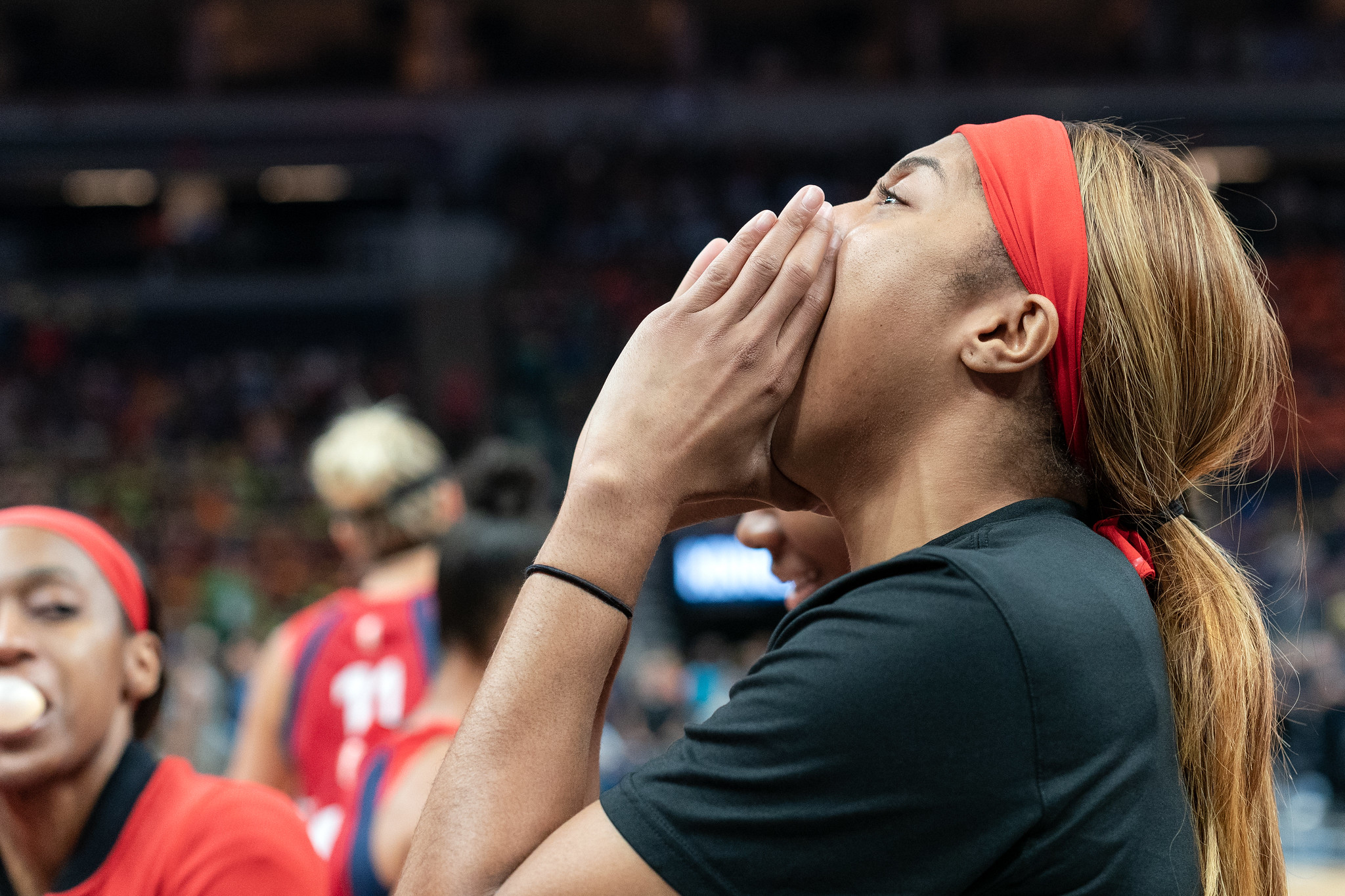
As marches for police accountability and racial justice continue in D.C, Washington Mystics player Tianna Hawkins plans to return to the court tonight with a new focus and heavy emotions.
“All I’m thinking about, I wish I could be [at the march],” says Hawkins, who is currently with the team in Florida. “Basketball is there, I’m here to do a job. But my mindset is on social justice.”
The Mystics are slated to take on the Phoenix Mercury at 10:00 p.m., days after the team went on strike earlier in the week. The Mystics — along with all WNBA, NBA, and other professional sports teams — refused to play their games on Wednesday in protest of the recent shooting of Jacob Blake by police in Wisconsin.
Instead, the Mystics team kneeled, each member wearing a t-shirt with a single letter, spelling out Blake’s name. Seven red dots – the number of shots fired by an officer into Blake’s back— were painted the backs of their shirts.
Mystics players. Seven shots in the back. All WNBA games are canceled tonight. pic.twitter.com/mxrdbZ3Phj
— Matt Blitz (@WhyBlitz) August 26, 2020
Hawkins, a mother of a young son, says that putting on the shirt on Wednesday was “emotionally overwhelming.” During interviews on Friday, Hawkins recounted a memory of walking up to a grocery store in a predominantly white Maryland neighborhood with her son. She says they saw a white boy wearing a ski-mask and holding a nerf gun, and her son said “Mommy, I want one of those.”
“I had to tell him told him ‘no, we can’t play with guns, guns isn’t something you should be proud of,'” Hawkins recalls. “Of course he didn’t understand that, of course he got mad because he just wanted a toy gun, but now I have to have that conversation with him.”
Hawkins says that having her son, Emmanuel, with her in the “Wubble” (the enclosed bubble in Florida for the league to safely play during the pandemic), has shaped how she and her teammates convey their messages about justice and police accountability. When the team spoke about about their decision to protest Wednesday night’s game, Hawkins’ son stood with the players.
"We're not just basketball players. We're so much more than that."
Ariel Atkins with a powerful statement on the unified decision to not play tonight. #BlackLivesMatter pic.twitter.com/Eg96KMqsFh
— Washington Mystics (@WashMystics) August 26, 2020
“I think my feelings are the same feelings that my grandparents had when they were raising my parents, the same feeling my parents had when they were raising me. You always want to be in a position where you’re able to protect your child. It’s my job as his mom to protect him,” Hawkins tells reporters. “When he gets older, he’s going to look back and see all of the marching, all of the statements being made, that he’s a part of that. He’s a part of that fight. And we’re fighting for his future.”
This week’s protests follow a series of actions taken by the Mystics and other teams throughout the summer. Before returning to play in July, the WNBA and the Women’s National Basketball Player’s Association announced the launch of a new platform, The Justice Movement, and a new social justice council. The league dedicated the 2020 season to Breonna Taylor, an EMT who was killed by police in Kentucky this March, as a part of the #SayHerName campaign.
On Juneteenth, Mystics players Natasha Cloud and Myisha Hines-Allen organized a march with Wizards player Bradley Beal. Cloud later chose to forego the 2020 season to continue focusing on activism.
On Thursday, Hawkins says the team discussed their next steps of collective action and seeking justice, like spreading information about voting and the census.
“We have to figure out what to do next and not just talk about it, not just put the names on our shirt, not just put the names on our shoes,” Hawkins said. “What can we actually physically do being here in the bubble, whether it’s reaching out to our fans, reaching out on different platforms to get more people involved and to use their voice and to continue to use our voice.”
According to Hawkins, the Mystics are discussing ways to honor victims of police brutality in tonight’s game, and the same motivations that pushed them to protest on Wednesday will be present as they continue through the season.
“The common theme is we’re tired,” Hawkins says. “We’re frustrated, we’re pissed off. Us standing up was a way to say we’re here, we feel the pain, we are human, we are African American, we are tired. We want that justice.”