Colleen Grablick
Several Montgomery County websites — including the police department’s — do not fully comply with state public information laws, according to the county’s Office of Inspector General.
As a result, the public may be prevented from getting information it’s legally entitled to, says Inspector General Megan Davey Limarzi.
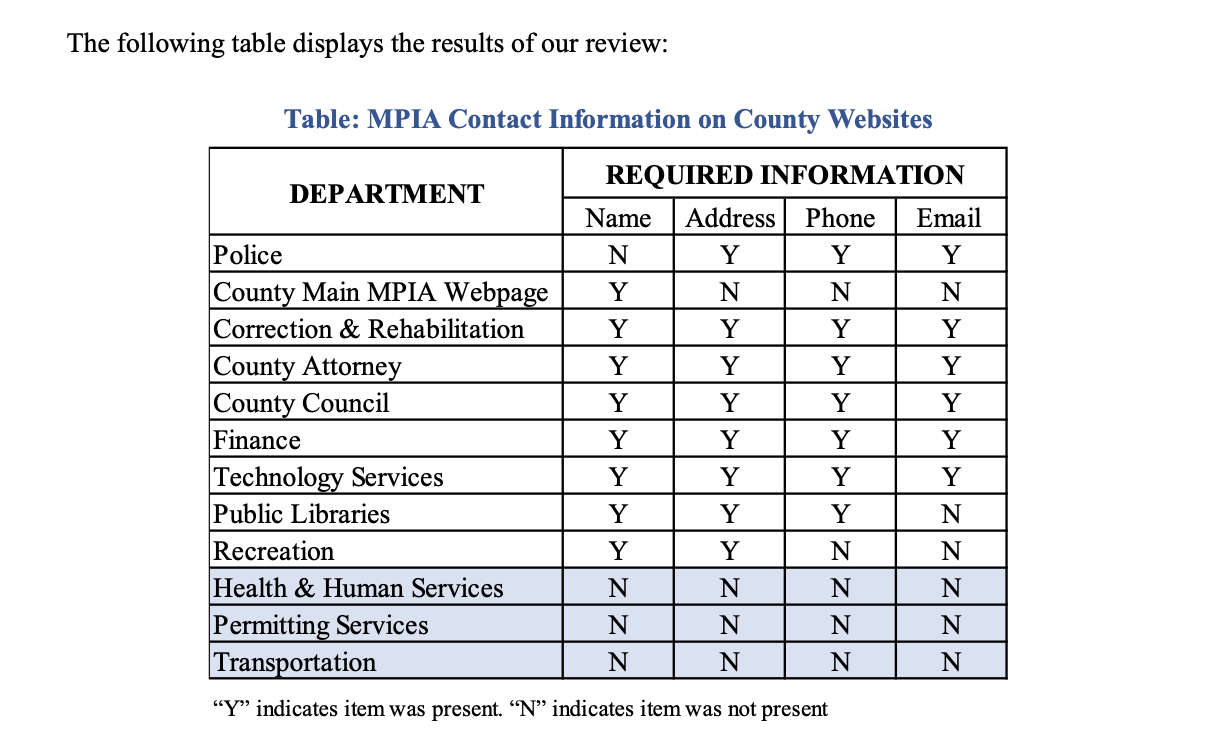
In a press release issued Wednesday, Limarzi states that an investigation of 12 county websites revealed that 7 did not provide the adequate public information required under the Maryland Public Information Act.
The findings come after the office conducted an inquiry into a complaint and noticed that information on the police department’s website did not align with state public information laws. The OIG then expanded the inquiry into other county web pages and noticed similar issues.
According to the report, the police department’s web page titled “MPIA or FOIA Records Request” lacks a contact name for an MPIA official, and instead directs requests to the Police Records Division. The page also states that a request can be denied unless the requestor is either a “person of interest” or representing a person of interest. While this applies in some cases, the report claims it contradicts general state law, which requires that local government agencies “grant a broad right to public records to any person, regardless of whether they are aggrieved parties or classified persons of interest.”
The report adds that the county’s police department website contained “ambiguous language” that “could prevent and discourage those seeking information from obtaining what they are lawfully entitled to.”
In inspecting other agency websites, the OIG noted that the Health and Human Services, Permitting Services, and Transportation departments all lacked the contact information required by state law on their sites. While it was available elsewhere on government websites, the report says that “the data is not always clear, complete, or consistent.”
“Aside from not being compliant with law, the lack of information and ambiguous language, particularly on the Department of Police page, could prevent and discourage those seeking information from obtaining what they are lawfully entitled to,” the report reads. “Such ambiguity is also inconsistent with the County’s commitment to transparency.”
Throughout the COVID-19 pandemic, many state and local jurisdictions across the country have delayed the release of Freedom of Information Act requests and other open information measures — sparking pushback from journalists, lawyers, and advocates. In D.C., the organization DC Kincare Alliance launched a petition calling for council members to repeal the emergency measures placed on FOIA requests during the pandemic.
The OIG has sent a list of recommendations to the agencies involved, encouraging officials to bring the websites into compliance with the state public information laws.