Rachel Kurzius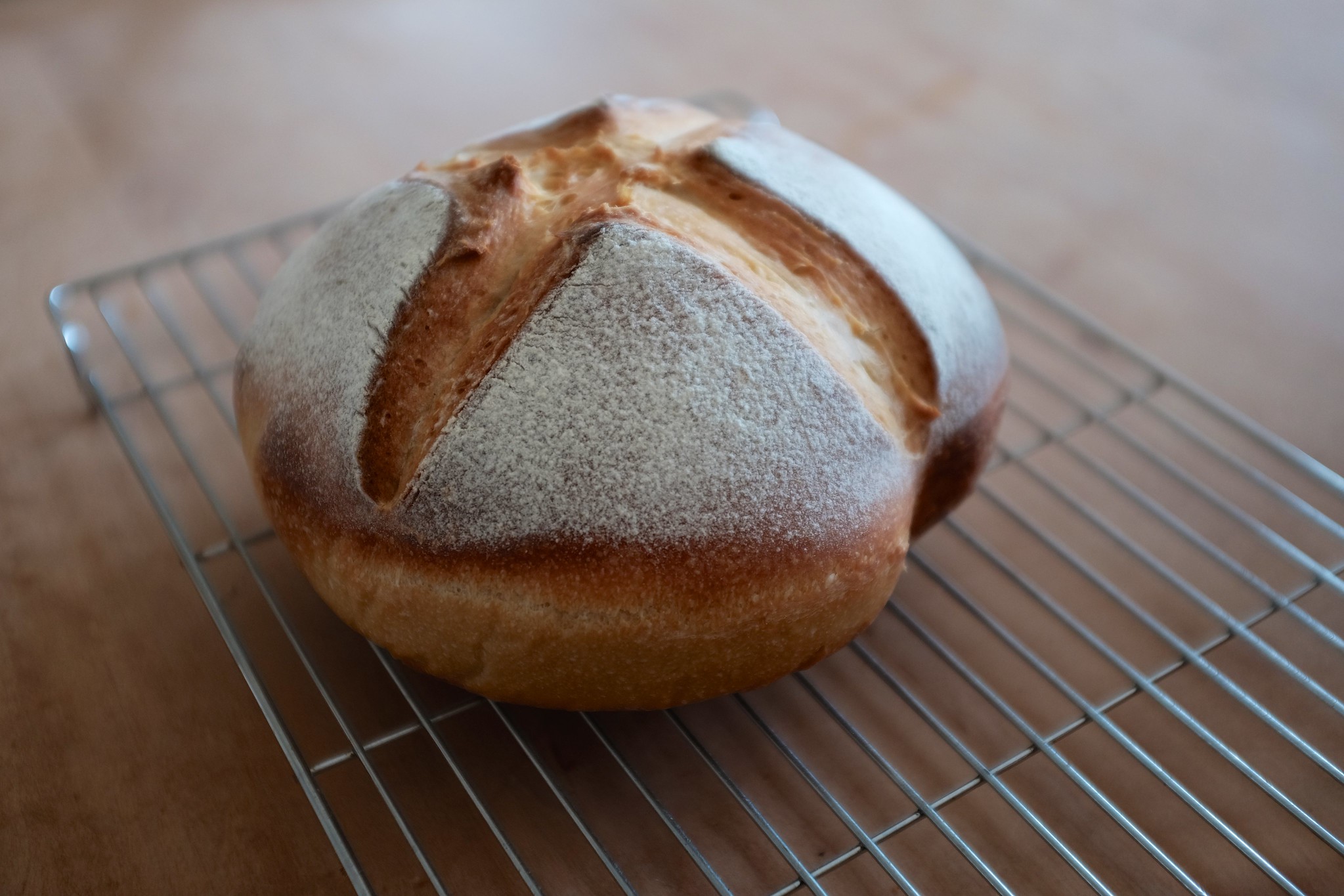
The D.C. region has been in a state of social isolation, more or less, for about six months. Through a series of stories, DCist/WAMU is examining life at this point in the pandemic — and what we’ve learned along the way.
Like many people at the start of quarantine, Alexis Thom made a sourdough starter. There was only one problem.
“I tried making an actual loaf a few times. And every time I was like, ‘Wow, this didn’t turn out well. This isn’t good,’ ” says Thom, who works for the D.C. government. “And my husband would be like, ‘What are you talking about? This tastes like sourdough.’ Turns out, I just don’t like sourdough.”
Thom was one of the people we talked to when the pandemic first hit the D.C. region in March. In a matter of days, life as we knew it had rapidly changed. The region was under stay-at-home orders. Reports of COVID-related deaths had already begun. Companies were laying off workers. There was so much we didn’t know.
During this frightening time, we wondered if anyone fortunate enough to be able to stay home was fulfilling long-held goals or using their spare moments in a new way that allowed them to carve out a measure of joy.
It turns out, some people were. Folks shared their intentions to plant a garden that would feed their family or otherwise develop a green thumb, design a board game, write a memoir, learn to make pizza from scratch, and, of course, give sourdough a try. So, more than six months into the pandemic, how were these ventures going?
Shane Boswell lives in Clarke County, Virginia, with his wife and three sons. When we spoke in March, he had planted a 20-foot-by-20-foot garden with all kinds of fruits and vegetables, part of an effort to produce all the food his family would need on their land. He works for a large technology company, and because he was working from home every day, he could tend to the garden in between conference calls: “I have the time, so we’re going to live our dreams,” he said at the time.
“We did get a pretty good crop of tomatoes. We ate lots of cabbage, lots of herbs,” says Boswell when reached in late September. But he says his interest in tending to the garden has waned.
“I’m ADHD, so I get bored of things. I tend to pick up a pick up a hobby and I do it for 30 days and then I get bored of it and move on to the next thing,” says Boswell. “Gardening is a thing that works really well when I’m excited and it’s new.”
His new hobby is carpentry, as well as changing up furniture in the family home. “Instead of going and doing things, we’ve been doing a lot of rearranging,” he says. “How do we make this more ‘us’ since we can’t leave? You know, how do we nest a little bit better?”
Boswell isn’t the only one spending time fixing up his house. Thom and her husband have also put a lot of time into reorganizing their 650-square-foot apartment, which currently serves as both of their offices while they telework. “We had to find a way to constructively be able to both be on meetings and not yelling over each other,” she says.
When they rearrange, they often create new shelving, which gives Thom new homes for what has become one of her favorite pastimes in quarantine: house plants.
Back in March, she had planted an herb garden, but she pivoted when “I realized how sad it was to grow these little things just so I could cut them up.” Now, she has nearly 40 house plants (up from a handful before the pandemic), many of which live in terra cotta pots she has painted.
“I’ve been really trying to come to terms with what it means to be bored, and that that’s okay,” she says. “Because otherwise, I’m one step away from starting to make my own kombucha over here.”
It’s not necessarily that Thom has more free time than she did before the pandemic — it’s that she’s spending so much more of it in one location. (Indeed, at least one study found that remote working has meant longer days and more meetings.) Still, she feels lucky, especially thinking about all of the people trying to juggle their work responsibilities with parenthood. “I just don’t understand how society is expecting people to still have a job and to educate their children now,” she says.
Boswell says that “it’s been trying at times” for the family, and he and his wife have reoriented their expectations for the kids’ schoolwork.
“I’m not asking for As by any means. I’m asking for them to just do everything that’s asked — turn in something and we’ll get through it together,” he says. “And it’s really changed our outlook as far as how hard we’re willing to push our kids. Because they absolutely need some time to just be kids and they’re gonna be dumped out into this world that I have no idea what it’s going to look like.”
He knows multiple people who have gotten COVID-19, and still have issues breathing months later.
That’s been the case for Anya Olsen, a lawyer we spoke to in March when she was in self-quarantine due to chest tightness and a cough. The fact that her presumed case of COVID-19 has lingering symptoms has led to her picking up yoga, even though it never interested her before.
“I couldn’t do the type of exercise I normally would have done,” says Olsen. “With yoga, there’s gentle versions of it that you can do, and so I ended up on this totally, completely different craze that I never, ever would have thought to do.”
That’s in addition to the hobby Olsen picked up while self-quarantined: baking loaves of bread. And after learning that people could make their own sourdough starters, she gave that a try, too. Unlike Thom, Olsen is “still very much enjoying it” and has used it in recipes like pancakes, pizza dough, and more.
She’s not the only person we caught up with who mastered the art of pizza making over the past six months. That was the goal of Petar Dimtchev, a lawyer, DJ, and former D.C. Council candidate. While he says he tried to “jump right into the pizza game” in March, he faced an immediate challenge: the flour shortages that ensued when so many Americans decided to give baking a try at the same time.
While it took him some time to figure out the right ratios of ingredients and learn how to knead the dough, he ultimately became the victim of his own success: “I found myself eating way too much pizza,” he says.
So he’s turning to another goal — crafting his own beats from scratch. “With DJing, you’re playing other people’s music, essentially, and something I’ve always wanted to do is make my own music. But that’s such a big undertaking,” he says. “And I said to myself, ‘You know what, you have all this time. Just jump into it.’ So I start taking music production classes and start working on my own beats.” Just like with pizza making, he’s found the tutelage he needs online.
Even though he’s been pleased with the progress he’s made, “I would much rather be in normal times. Especially considering what’s happening to our restaurant industry and all the workers that are laid off,” says Dimtchev. But learning this new skill “helps me keep my sanity, just something to break up the monotony of every day.”
Jason Biehl, a teacher and anti-racism activist, says he experienced “two different pandemics.” Back in March, “there was a moment of loss for me, a moment of unemployment, and a little bit of a moment of financial stress,” he says. So he decided to dedicate himself to working on a memoir.
“Where am I six months later?” he says now. “I feel like I had a daily writing schedule, and there were times where, you know, I’d write like, three or four days in a row, and then not for a week or 10 days, right, and then pick it up again and write.”
Then, the large-scale protests for racial justice began in late May. Organizations and nonprofits started looking for workshops and trainings on white privilege and bias. Biehl went from having a lot of free time to having almost none: “I felt like I got really overwhelmed and emotional and upset, and also busy,” he says.
Still, he says he’s getting back on track to finish his book proposal. “I’m glad you reached out because I’m determined to dig back in,” Biehl says.
Another person with a creative endeavor on her plate is Robin Savannah Carver. She told us back in March she was working on developing a new board game — she envisioned it as a role-playing game like Dungeons and Dragons, but easier to understand.
“I got the design point to a place where I’m really confident that it’ll be fun to play,” she says. But when she started trying to have friends test out a simple prototype, she reached a snag: “Getting people into the right imaginative space really demands art,” says Carver. “You need visual representation.”
So she’s developed a gaming-related side hustle that helps her save up the money to commission an artist. She’s now a Dungeon Master for hire, meaning that she virtually organizes and emcees games of Dungeons and Dragons, determining the adventures players go on and the challenges they face.
Because she’s immunocompromised, she can’t socialize in quarantine pods. So the regular gaming sessions have been a way to spend time with friends and meet new people.
“It’s a space where, for four or five hours, I have an excuse to not think about the pandemic. I’m not thinking about how the world is on fire, not thinking about all the different political crises that we are staring down the face of,” Carver says. “Now that I’ve been doing it professionally, it actually feels really gratifying to be like, okay, I’m taking $15 from you, but for your $15 you get five hours where you get to just have fun or you get to be someone else somewhere else. And boy, if there was not a better time for being someone else somewhere else.”
Previously:
With Lots Of Newfound Time On Their Hands, Some Washingtonians Are Fulfilling Their Long-Held Dreams