Martin Austermuhle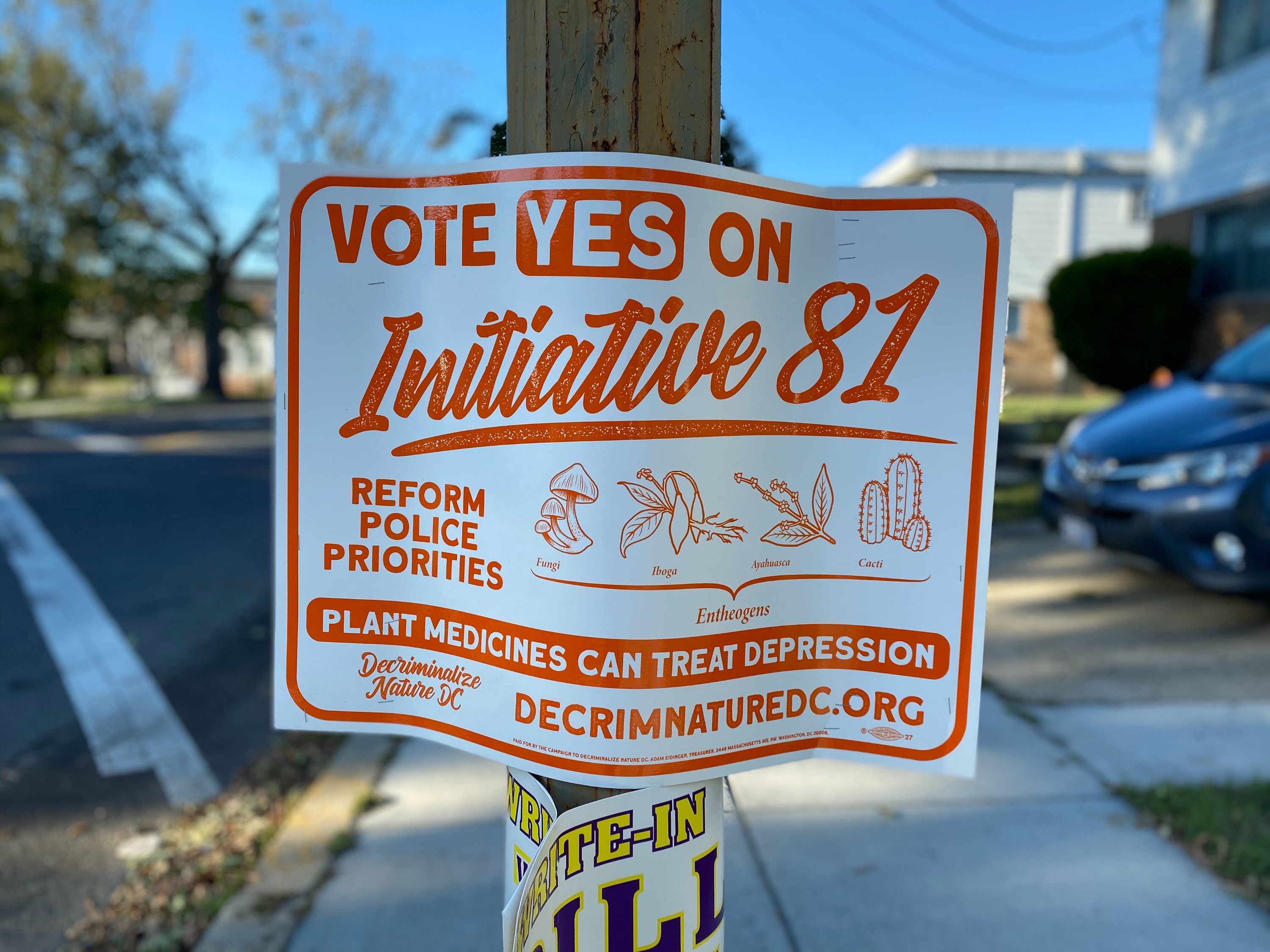
If you’re working your way through a ballot in D.C., don’t forget to turn it over: there’s a ballot initiative you get to vote for or against on the other side.
Initiative 81 is formally known as the Entheogenic Plant and Fungus Policy Act of 2020, which is a mouthful of words for a ballot measure that more colloquially has to do with magic mushrooms and psychedelic plants. Read below for everything you need to know about Initiative 81.
OK, so what is Initiative 81 proposing to do?
In short, Initiative 81 seeks to make enforcement of D.C.’s drug laws against psilocybin mushrooms and psychedelic plants like cacti, iboga and ayahuasca the police department’s lowest priority. They are currently classified as Schedule I drugs, which means they have a high likelihood of being abused and no accepted medical use. It also calls upon D.C.’s attorney general and the U.S. Attorney for D.C. to “cease prosecution of residents of the District of Columbia for these activities.” (It’s unclear how many people are prosecuted every year, but one defense attorney tweeted that he had never heard of any cases.)
So this decriminalizes or legalizes mushrooms and psychedelics?
Nope. Nothing in Initiative 81 would make it legal to use mushrooms or other psychedelics, much less pave the way for any type of legal and regulated sales. Rather, it would simply make policing and prosecution of them a low priority.
This approach was chosen because mushrooms and psychedelics are illegal under local and federal law, but also because Congress has specifically prohibited D.C. from decriminalizing or legalizing any Schedule I drugs. That happened after D.C. voters legalized the possession and personal use of small amounts of marijuana in late 2014.
Initiative 81 also mirrors similar language adopted in other cities, including in Denver, where voters approved Initiative 301 in May 2019. Oakland followed shortly thereafter. This November, voters in Oregon will have a chance to go a step further: if Measure 109 passes, doctors and healthcare providers would be able to provide mushrooms and other psychedelics to qualifying patients.
Why do this, and why now?
In the wake of the significant recent gains in nationwide fights to decriminalize or legalize marijuana, attention is slowly shifting to mushrooms and psychedelics. And just like the push for legal marijuana started with allowing medical use, proponents of psychedelics say they could offer significant new therapies for people suffering any number of conditions.
Melissa Lavasani, a D.C. government employee and the leader of the Decriminalize Nature D.C. campaign that’s pushing Initiative 81, told us earlier this year that she suffered from severe depression and anxiety after giving birth to her two kids, which she ultimately treated by micro-dosing magic mushrooms. And while that may sound outlandish to some, researchers at places like Johns Hopkins University are looking into the therapeutic and medical value of psychedelics. The federal government has even gotten in on the action; late last year it declared psilocybin as a “breakthrough therapy” to treat depression.
To get Initiative 81 on the ballot — which required getting tens of thousands of signatures from registered D.C. voters — Lavasani got a big assist from Adam Eidinger, a well-known D.C. activist who was behind the 2014 push to legalize marijuana. It also took in loads of money (the campaign raised more than $735,000) of the New Approach PAC, a political-action committee that supports efforts to decriminalize or legalize drugs. And lots of the PAC’s money came from Dr. Bronner’s Magic Soaps.
What are the reasons to vote against this?
Maybe it’s because of how quietly the initiative made its way to the ballot, but so far there is no apparent organized opposition to Initiative 81. And the most outspoken critic of the measure to date isn’t even from D.C. Over the summer, Rep. Andy Harris (R-Maryland) unsuccessfully tried to stop Initiative 81 from appearing on the ballot by prohibiting the city from spending money on it.
“This is a bald-faced attempt to just make these very serious, very potent, very dangerous — both short-term and long-term — hallucinogenic drugs broadly available,” Harris told the New York Post. “Public health has to be maintained. We know, of course, once you make it a very low enforcement level and encourage prosecutors not to prosecute it, what would prevent people from using hallucinogens, getting behind the wheel of a car and killing people?”
If Harris’s name rings a bell, it’s because he’s been one of the leading critics of D.C.’s efforts to legalize marijuana, and it was Harris who wrote the provision of law that keeps the city from moving further to legalize the sale of recreational marijuana.
“Some Democrats may say, ‘D.C. residents, if this is what they want, this is what they should get,'” Harris told the Post. “[But] I think there’s probably a lot of Democrats who draw a very distinct line between potent hallucinogens and marijuana. And whereas the majority may support recreational use of marijuana, I doubt the majority supports the broad use of these potent hallucinogens.”
The Decriminalize Nature D.C. campaign disagrees, saying that their internal polling of likely D.C. voters show more than 60% in favor of Initiative 81.
OK, I’m ready to vote on this. What next?
Turn your ballot over, and you’ll find Initiative 81. Once you’re done, you can drop your ballot in the mail, or leave it at any of the dozens of ballot drop boxes that are open starting Monday, October 5.
For more on D.C.’s election, check out our overview of the At-Large race and our full guide to voting this year.