Colleen Grablick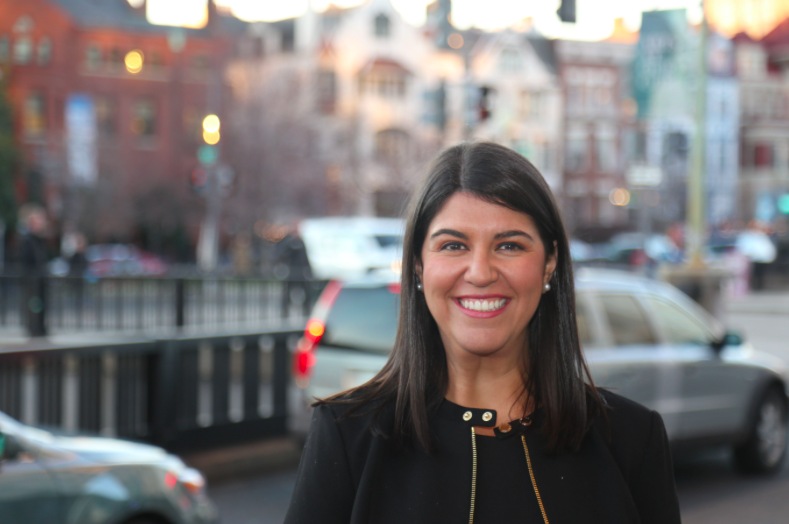
Ward 2 Councilmember Brooke Pinto – who surprised D.C. with her narrow victory in June’s packed primary — is looking to secure a four-year term on the D.C. Council this fall.
In most cases, the general election is merely a formality for the Democratic primary winner in the deeply blue District. But it’s 2020, so nothing’s typical. Pinto could be up for a decent fight this November to keep the seat long held by Jack Evans.
Since Pinto took office in June following the special election, two independent candidates — former nonprofit employee and DJ Martín Miguel Fernández and Ward 2 Advisory Neighborhood Commissioner Randy Downs — entered the race to unseat her. Statehood Green Party candidate Peter Bolton is also on the ballot. Republican nominee Katherine Venice dropped out in early September.
Pinto’s unexpected win in the first open Ward 2 primary race in decades drew speculation about her finances, private interests, and local expertise, and these concerns are now staples of her challengers’ campaigns.
It’s a big lift for an independent to beat out a Democratic candidate for council, especially during a presidential election year. A non-Democratic candidate has never won a ward seat. Still, the Ward 2 race is shaping up to be the city’s second most-watched local contest (behind the massive at-large race) as the non-Democratic challengers take aim at the incumbent’s financial and ideological positions.
And it’s not just the candidates. A group of dedicated Ward 2 residents, activists, and backers of Fernández and Downs have spent the past several months digging into Pinto’s past, jumping at any opportunity to fire off a tweet discrediting the incumbent candidate and drawing her family and wealthy upbringing into question. While some of the callouts are seemingly minor (one accused her of wearing fur after she accepted the endorsement of D.C. Voters for Animals), others attempt to draw her into allegations of illegal Russian money entanglement.
Pinto says that she is typically too preoccupied with council matters and her general election bid to notice every critical tweet. She adds that she suspects most of the criticism comes from a concentrated group of people who back a different candidate. (In this she may not be completely wrong — two vocal anti-Pinto tweeters are Eve Zhurbinskiy, a Downs supporter who calls herself a “professional receipt-haver,” and Morgan Finkelstein, who formerly worked for progressive primary candidate Jordan Grossman.)
The deep dives into Pinto’s family and finances do “concern” her, she says, but she dismisses the Russian campaign donation allegations as a “dark web conspiracy.” According to Pinto, the majority of constituents she interacts with are supportive of her bid to hold the seat.
“It’s disappointing to just see things go so negative and so personal and so kind of petty,” Pinto says.
Pinto, 28, seemingly came out of nowhere with her primary and special election wins this summer, rocketing from an unknown face in Ward 2 politics to the youngest member of the 13-person council. (The special election temporarily filled the seat vacated by former Ward 2 Councilmember Jack Evans, who resigned in January amid a swirl of ethical violations.)
A Greenwich, Connecticut native, Pinto was a rookie in D.C. local politics and still managed to rise to the top of a crowd of experienced opponents with strong Ward 2 community ties. She narrowly defeated Patrick Kennedy, an active Ward 2 ANC commissioner who had support from D.C. Council Chairman Phil Mendelson, Greater Greater Washington, and the Sierra Club. Kennedy has come out to support Downs, as has Greater Greater Washington, the Washington Teacher’s Union, and a slew of ANC commissioners.
For her part, Pinto worked in D.C. Attorney General Karl Racine’s office and secured the endorsement of her former boss early on. She also landed endorsements from the Washington Post (which she has received again this fall), and two Democratic members of Congress. She was the only Democratic primary candidate to forgo participation in D.C.’s Fair Elections Program (which matches small dollar donations and bans corporate and PAC donations) and pumped thousands of her own dollars into her campaign.
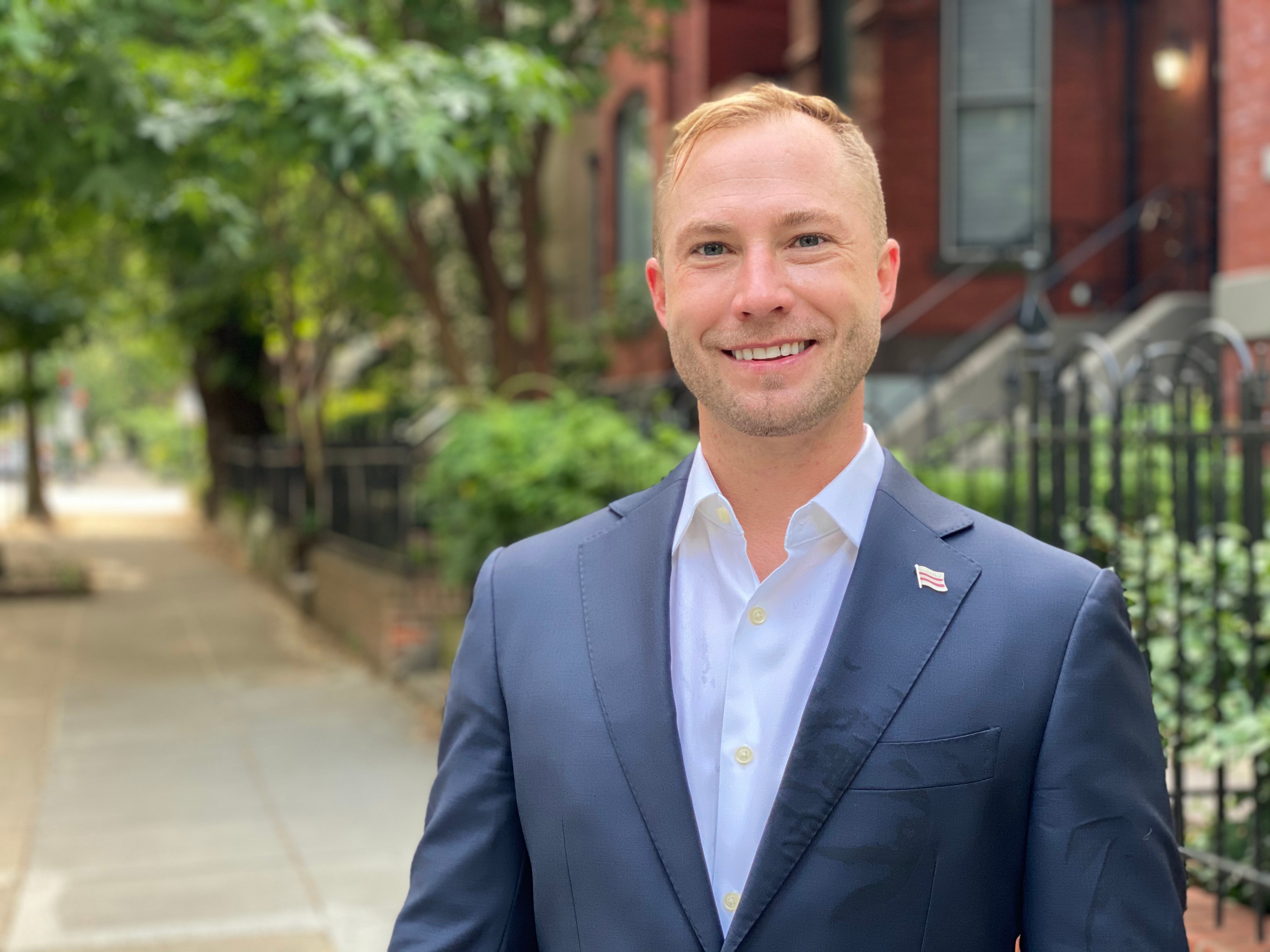
Downs, a 34-year-old commissioner and active member of D.C.’s LGBT community, sees his longstanding connections with residents as a hallmark of his campaign, compared to Pinto’s newcomer status.
Fernández, a local politics newbie like Pinto, would mark the first Latino member on the council, and positions himself as a progressive outsider compared to Downs and Pinto. And Bolton, a self-described eco-socialist, is pushing for a real third-party seat at D.C.’s long Democratically-dominated table, referring to Downs and Fernández as “so-called independents” and Pinto a “Jack Evans Part Two.”
Out of the three challengers, Downs is shaping up to be the biggest threat to Pinto’s victory. With the help of public financing, Downs has out fundraised Pinto as of Oct. 10, and he boasts more total D.C. and Ward 2 contributions.
Touting his service as a commissioner, Downs tells DCist that he entered the race when he saw Pinto’s “values” diverging from what he believed Ward 2 needed.
“There is a sense in the community, and I share this, that Councilmember Pinto is listening to a very small but vocal segment of our community, and that’s making me nervous about how we’re moving forward together as a community,” Downs says. When asked to elaborate on which residents Pinto engaged with, Downs declined to specify what he meant and referenced local listservs.
Pinto says Downs hasn’t articulated many clear policies that he would bring to the council, and instead spends his campaign firing shots at her bid.
“He is almost entirely focused on attacking me, and that’s just not the way I operate,” Pinto says. “That’s not the way I operated my campaign this spring, that’s not the way I run my office. But every day I hear from voters who tell me that these nasty, attack-based campaigns are not what they want in our local politics. And everybody is really tired of it.”
Downs tells DCist that he diverges sharply from Pinto on public safety — citing an incident in August when she called for U.S. Park Police to increase patrols in Dupont Circle after a shooting, and her support for keeping police officers in schools. Downs says he wants to divert funding from D.C.’s police department into “evidence-based solutions” like mental health care, affordable housing, and community-based violence interruption.
On policing, Pinto says she agrees with funneling resources into solutions outside of the police department, but adds that reimagining public safety in D.C. is less about reducing MPD’s budget and instead reducing the tasks police officers are assigned to cover. She also says she voted against ending a contract with D.C. Public Schools and private security guards because she felt it was irresponsible to take away unarmed security without another school safety plan in place.
“I think that the right question, respectfully, is less about the size of the [D.C. Police] budget and more about the tasks and responsibilities that we are assigning to the police department,” says Pinto, who sits on the Judiciary and Public Safety Committee.
Progressives have questioned her bona fides based on her time on the council so far. She voted against a tax increase for high-income residents, and recently characterized families with incomes of $250,000 as “struggling renters,” during a Ward 2 candidate debate.
The question is whether voters in one of the city’s least progressive wards actually want a left-leaning councilmember, especially considering how the ward kept returning business-friendly Jack Evans to the seat for nearly three decades. Home to the wealthy neighborhoods of Foggy Bottom, West End, and parts of Georgetown, among others, the ward has leaned away from progressive policy in the past. In 2018, it was one of two wards to vote against Initiative 77, a ballot measure that would have gradually eliminated the tipped minimum wage. (The D.C. Council later repealed the measure.)
When asked how Downs and Pinto saw themselves fitting into a council that could be ideologically shifting farther to the left (following the win of Janeese Lewis George in the Ward 4 primary and a potentially progressive new at-large member) both refrained from putting themselves on a spectrum. Pinto says she’s a “proud Democrat” and Downs says he’s a “progressive,” but someone “who can also back it up with accomplishments by building consensus.”

The second independent, Fernández, is a lifelong Washingtonian who says that he’s outside of the “club” of institutional politics that he thinks Pinto and Downs belong to, placing himself to the left of both of his opponents. He supports defunding MPD (and has a 14-point plan for public safety reform), expanding rent control, and increasing property taxes on wealthy residents. A former nonprofit employee who was recently laid off due to pandemic cuts, Fernández has never held local office before, but sees this as an advantage against both Pinto and Downs.
Fernández says he is equipped to represent D.C.’s Latino community and “everyday people,” while claiming Downs caters to a more moderate crowd. On Pinto, he says he witnessed the decades-long tenure of Evans, and fears that she will be more of the same.
“For almost my entire life, Ward 2 has been represented by pay-to-play politics in Jack Evans,” Fernández says. “Brooke Pinto represents a new variety of pay-to-play politics. I would say that Jack was the one being paid, and Brooke is the one paying now with her having self-financed her campaign.”
Pinto faced an Office of Campaign Finance complaint after winning the primary, focused on her family’s alleged purchase of a $975,000 home in Logan Circle and whether it was used as a campaign headquarters that went unreported on her campaign finance forms. The OCF dismissed the complaint in September, and Pinto has repeatedly denied any ethical violations in her campaign expenditures.
“I really hope that people kept up confidence that I have always operated very above board,” Pinto says. “Ethics have always been much more important to me than politics.”
But Pinto’s finances continue to be a pressure point for Downs, Fernández, and their allies. Washington City Paper recently pointed out she had posted a field director job listing with a salary of $2,400 per month — a stingy sum, according to local politicos. Critics in Downs’ camp used the listing to call out Pinto’s distance from the economic realities facing many D.C. residents, especially during a pandemic.
Downs says that Pinto’s campaign funds and her decision not to participate in public financing reflect a continuation of Evans’ drama.
“A lot of the same pay-to-play lobbyists [are] now backing Brooke, and I find that incredibly disturbing,” he says. Downs points to Pinto donors with ties to real estate and construction firms, alleging they contributed in order to gain access to the Wilson Building.
Pinto says she didn’t use public financing because she wouldn’t have met the fundraising requirement before the deadline, and a candidate cannot change their status mid-cycle. If she ran again, she says she would “absolutely” participate.
“I think it’s a great program, and it’s really important to get money out of politics and that’s why I took other steps to ensure that there were no concerns,” Pinto says. “I did not accept a single dollar from PACs, super PACs, or independent expenditure committees, and do not receive matching funds, so all of my donations come from individuals.”
Yet she’s currently facing another OCF complaint, this time filed by Zhurbinskiy. It alleges that Pinto has violated five OCF regulations, including excessive contributions and failing to report donor occupations, among other technicalities. (The OCF tells DCist that the complaint is not currently under investigation.) Zhurbinskiy has also drawn attention to some of Pinto’s out-of-state donors, like Bill Schuette, a former Michigan attorney general who supported a gay marriage ban.
Downs, a gay man, says some of Pinto’s donors draw into question her ability to lead in the ward containing Dupont Circle, an area once known as D.C.’s “gayborhood.” Pinto was also recently snubbed by the Stein Club, D.C.’s largest LGBT political organization, which opted not to endorse in the Ward 2 race. (Per the groups by-laws, they cannot endorse a non-Democratic candidate in a race with a Democratic candidate.)
“The Fair Elections Program is a program that brings transparency and weight to the residents. And so, that also concerns me that she’s taken large donor donations from well-known anti-LGBTQ Republicans,” Downs says.
In response to the barrage of criticism on social media over the past several months, Pinto says the attacks are “unsubstantiated, and the majority of constituent responses have been positive. She tells DCist she was unaware of the Schuette contribution, and that after researching his background on LGBT rights rulings, she refunded the campaign donations from Schuette and his wife. And as for the finance discrepancies, Pinto says her former compliance officer responsible for filing her reports was experiencing health issues at the time, and he recently passed away.
“I know that Randy knows I do not hold those values. He knows that those are not policies I would ever seek to advance,” Pinto says, adding that she has not highlighted Downs’ donors who she says do not align with his stances on the Black Lives Matter movement. “I do not provide the false equivalency to tell people misinformation that those are Randy’s values, because I know in my heart that’s not true, and I don’t spread misinformation like that. I think voters deserve honesty and authenticity.”
While Downs believes that Pinto caters to a small segment of the Ward 2 population, Pinto similarly affirms that her attacks come from a concentrated pool of people and do not represent Ward 2 voters as a whole. Regardless, Pinto still holds the upper hand in the race with the “D” next to her name on the ballot, and the potential of a split vote between the independents candidates.
Downs says he wouldn’t be running if he didn’t think a victory was possible.
“I know there’s a lot of people really questioning and thinking about whether or not we can do this,” Downs says. “I’m confident we can.”
Bolton, the Statehood Green candidate, perhaps said it best when DCist asked if he thought Pinto had a chance at losing: “Many a wise man has made himself look foolish by trying to predict the future.”
This story has been corrected to reflect that Pinto’s statement characterized families making $250,000 as “struggling renters.”