Margaret Barthel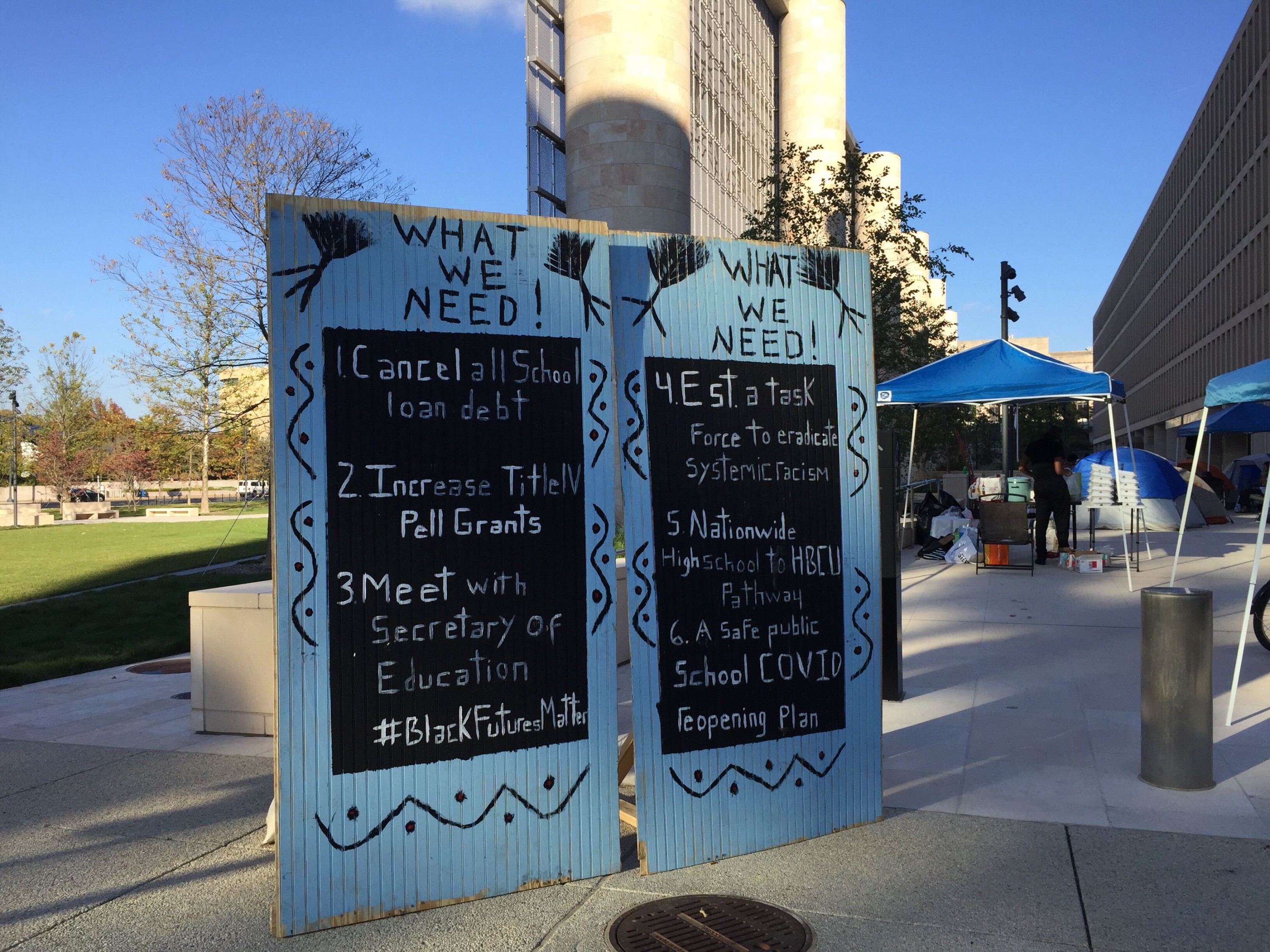
It’s October, but D.C.’s season of protest is far from over, according to the activists who have been at the center of the city’s racial justice protests, which sprang up after the police killing of George Floyd in May. As the local movement has taken root, it has also grown offshoots beyond the large-scale protests in Black Lives Matter Plaza.
The latest one this week: Tent City, an encampment outside of the U.S. Department of Education building in Southwest D.C. Activists — many of the same leaders who have been on the front lines of protests in the District since the spring — pitched tents there on Monday to draw visibility to a set of demands geared toward supporting Black and Brown students in public schools and colleges and universities.
The agenda for the week is packed: the group is hosting panels, phone-banking to make sure voters have the tools they need to vote in next month’s election, holding game nights, painting murals, meditating together, and more. On Wednesday, the Long Live GoGo truck pulled up nearby. The group is also collecting donations for winter coats and other mutual aid supplies, as well as school supplies for local students.
Aniyah Vines, a Howard University junior and the founder of the Live Movement, which organizes students at historically Black colleges and universities, came up with the idea for the protest after other attempts to contact the Department of Education about educational equity fell through.
For Vines, education is intertwined with the movement to end police brutality.
“A lot of people have the misconception that when people say Black Lives Matter, we just mean to stop murdering Black people,” Vines told DCist/WAMU. “That’s the bare minimum. We want to make sure that we invest in Black lives.”
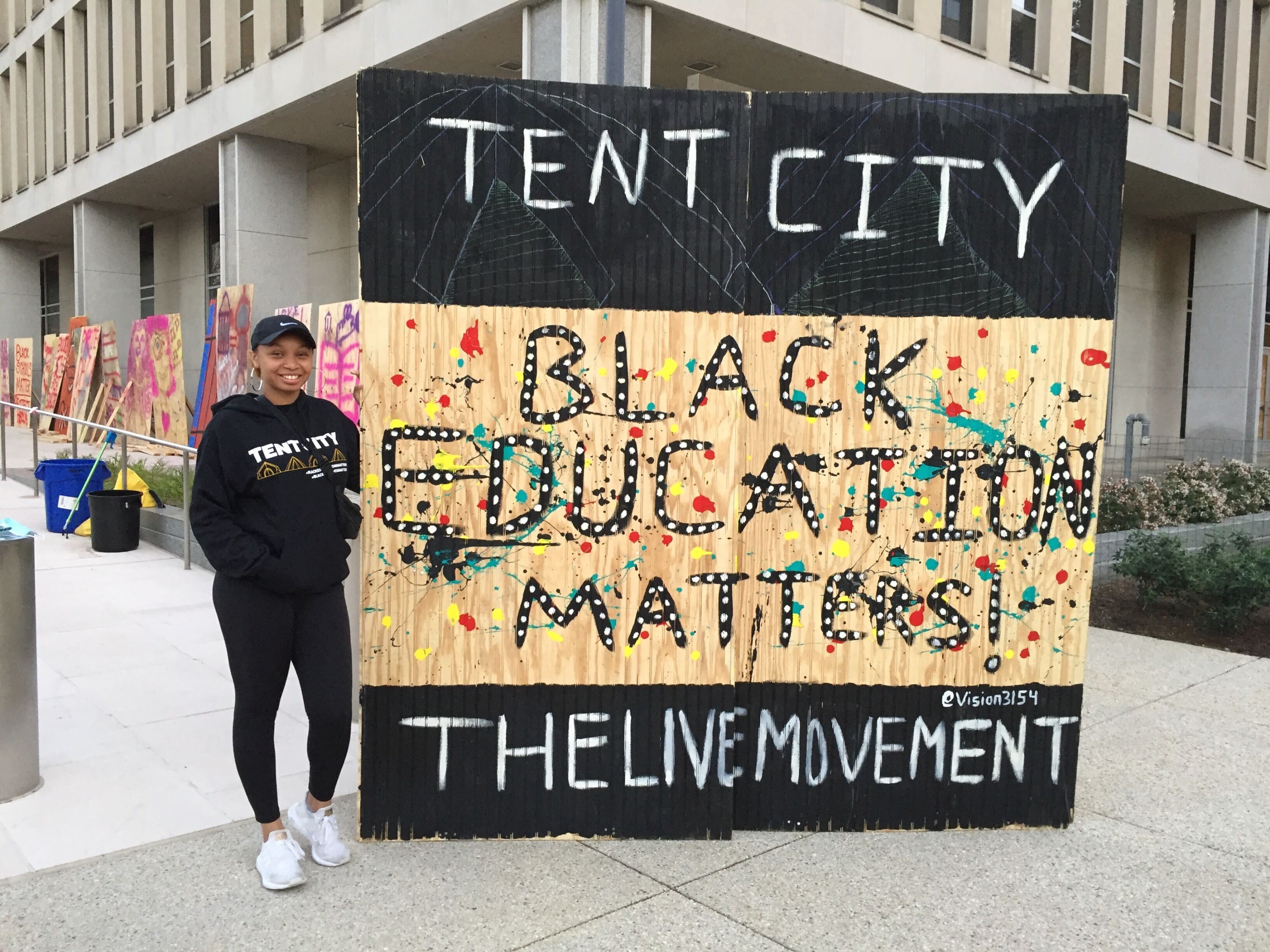
So Vines and other organizers came up with a list of six priorities to advocate for: canceling student debt, increasing funding for Pell Grants, a meeting with Education Secretary Betsy DeVos, a nationwide task force to end systemic racism in schools, a pathway for students of color to learn about and attend HBCUs, and a safe reopening plan for schools during the pandemic.
Vines says DeVos peeked out of the door to the Department of Education building with a few other staffers at one point, but there has been no real engagement.
Activists are bringing a deep well of personal experience in the education system to the action. Bethelehem Yirga, the co-founder of the Palm Collective, spent a decade as a teacher and school leader in Wilmington, Del. and D.C. In 10 years, she lost almost 30 students to drug-related violence, drug overdoses, police brutality, or other systemic injustices that disproportionately affect Black and Brown kids.
“Working with students of color has been my life’s journey and purpose,” Yirga told DCist/WAMU.
That life’s work has led her away from education to becoming a full-time organizer — which is another form of education, to her.
Her days as a teacher are never far away, though: one of her former students is now one of her fellow co-founders of the Palm Collective.
“Education is the route to how you navigate [these systems],” she says. That’s why a lot of people can come out and be like, ‘This is what I believe in. I know my history. And this is not what you’re teaching me in school.’”
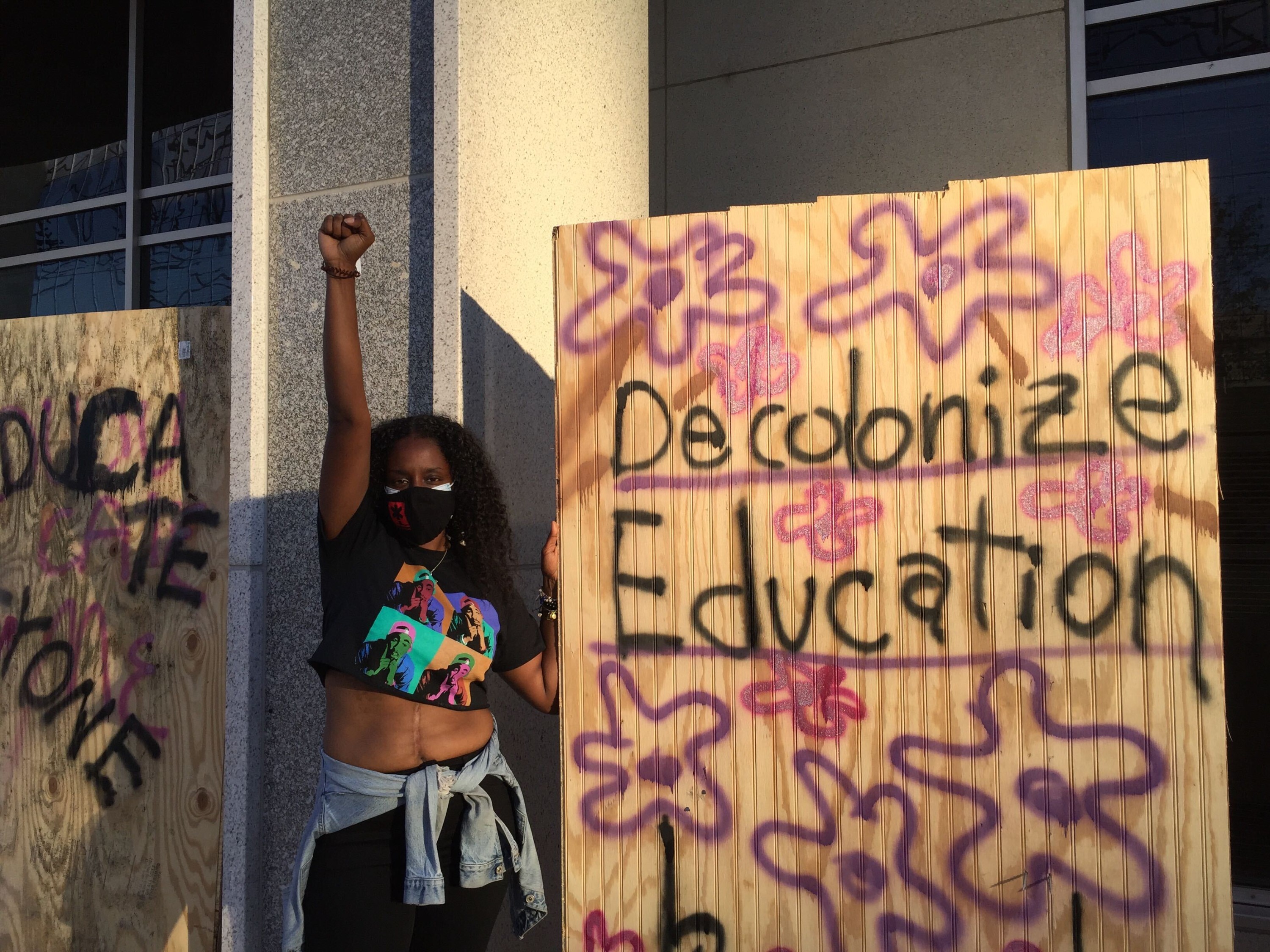
Vines also wants to prioritize teaching Black history in schools. She wants to see “that self-confidence instilled in the Black kids — they see themselves and their history in the books and then they find their value, they find their worth, they find their roots in their culture.”
Even without acknowledgment yet from DeVos or her department, the Tent City protest has been an avenue to bring together the collective power of a wide swath of the activist community in the District. The list of organizations involved is a who’s who of the leaders of D.C. protests: the Palm Collective, They/Them Collective, Concerned Citizens, Freedom Fighters DC, Black Lives Matter DC, Occupy D.C., Spaces in Action, Until Freedom D.C., BLM H Coop, and more.
“I am really proud of how so many organizations have come together to support this,” says Yirga, one of the first people Vines talked with about the idea for the protest.
“A lot of unity has taken place to make sure that this is a success,” Vines says. “And a lot of people have been coming to make sure we’re taking care of.”
Arianna Evans, a member of Freedom Fighters D.C., says success for activists isn’t necessarily always a large-scale protest.
“Mutual aid and education is the most important thing within this movement,” she says. “Mutual aid should be 80% of what every org does because it’s not just about being activists and being loud and protesting, it’s also about connecting with community and providing the resources that our government is not providing to them.”
Building that sense of community — and gathering the resources that come with it — is especially crucial, Yirga says, as the D.C. protest movement braces for the winter months and the uncertainty of the presidential election. On Wednesday, activists at Tent City also hosted a coat drive.
“We’re just trying to get the resources ready for people that want to continue [this winter],” Yirga says. “Just layer up. We’re out here, double-layered up at night.”