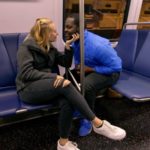
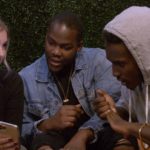
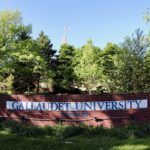
One of Netflix’s newest reality shows looks at college life in the District. Deaf U chronicles the lives of seven Gallaudet students as they navigate life, love, and lust. In episodes 3 and 4 we delve a little more into the cast’s families and the web of their personal lives, all set against a backdrop of a pre-pandemic D.C. Sean, a deaf D.C. resident, policy wonk, and education researcher, and Jonquilyn, journalist and reality show connoisseur, discussed episodes 3 and 4 of Deaf U.
For our first Deaf U recap, click here.
Sean: We open up with Rodney and Daequan visiting Rodney’s parents’ house. This family scene is wholesome AF.
Jonquilyn: Rodney’s family has a lovely home. I want to go to dinner at this family’s house. DQ has really been through it. I feel for him. It makes me wonder if he’s trying to fill a void? And makes the whole “trapping” conversation from the first two episodes sadder.
S: I love Rodney’s mom omg
J: Rodney’s dad says the quiet part out loud: Gallaudet gives Rodney a license to be an asshole. Rodney’s dad is right. Rodney needs people on campus like his parents to call him out
J: Later, Alexa and Cheyenna head to the Southwest waterfront. I rarely make it to The Wharf (it is FAR) and the last time I went was to see Lizzo and Ari Lennox at the Anthem. I AM NOSTALGIC FOR THE OUTSIDE. Remember crowds? Remember walking with friends? REMEMBER TOUCHING PEOPLE? These people are ridiculous, but will we all be rubbing up on each other in such a manner when we (hopefully) return to how things were in the Before Times?
S: Ugh yes I remember being outside and being around more than a few people at a time — I MISS MY FRIENDS
S: During the scene, Cheyenna points out a pole that Alexa may not have seen while walking. This is a common thing for deaf people — it’s related to proxemics and DeafSpace, but that was never mentioned. When you are walking and signing with someone, you are responsible for their blind spots — e.g. a curb, a pole, a sidewalk gap. This allows both people to be able to walk and talk without having to repeatedly look around. It’s a big missed opportunity to talk about the little elements of deaf culture and deaf tendencies, which often lead to how deaf people understand and use space, which is very different from hearing people.
J: What do people mean in this scene by “not deaf enough?”
S: Generally it means the perception that you “don’t fit in” in the deaf community, and it’s been weaponized in many many ways. It also goes the other way — hearing people will tell hard of hearing kids or deaf kids that they’re “not deaf enough” to join the deaf community.
J: My favorite part of reality shows are the hard conversations in public places. On another show this would be a group dinner and someone would flip a table. Cheyenna just calls out that she heard Alexa and the other girls were talking behind her back. It’s honestly a bold and mature move. I respect it. GET DOWN TO BUSINESS CHEYENNA.
S: Right? Deaf people talk so much shit in public and y’all have NO IDEA. One big thing about deaf culture is that deaf people tend to be SUPER BLUNT and that’s an example of this right here. It’s actually nice because there’s none of that compliment sandwich bullshit or that gentle conversation — get to the point y’all!
S: We get more Renate this episode! She’s doing poetry at an open mic night.
J: Open mics make me nervous because I feel secondhand embarrassment more acutely than the embarrassment I feel for myself at times. I’m hoping my girl Renate is being set up for success.
S: She does a poem about her girlfriend Tayla, and OK, wow this is hella sexual. Captions are decent actually! This is hot.
J: This poem is sexy. She talks about her hip undulating. I screamed into my laptop. I love scandal and discomfort. This is not quantifiable but do they have more sex than the average college kid? I feel like the horny levels are exponential. All I did in college was go to the occasional house party and watch Glee in my dorm room.
S: Right?? This is ridiculous
J: Another interesting thing to me is the use of music. I think of the episode of Master of None with deaf actors. The sound was completely gone. I feel like that drew me into the world of those characters more. The use of scoring makes me think … who is this series for? Is it for a hearing audience? A deaf one? How does that shape what I’m seeing?
S: Yeah — the more I watch, the more I realize that all of this is for the hearing gaze, like how porn is for the male gaze. It’s superficial and simply for the hearies.
S: In the next episode, we get a scene in the training room, with Dalton and Rodney in the cold tub! Both the worst and a lifesaver.
J: Why do athletes get in cold water? (I am not good at sports ball). Dalton and Rodney discuss the girl Dalton met at the club. Dalton avoids dating girls who can hear. Is there a hesitation among deaf people in dating hearing people typically?
S: It helps with recovery and injuries — you heal faster! As for avoiding dating girls who can hear — it really comes down to communication and empathy. If you can’t communicate in your language, and if something happens, the hearing girl is not going to be able to understand you. The other part is cultural too — generally dating someone who is in your culture is nice!
S: Rodney says Dalton flushing his hearing aid down the toilet is some “white people stuff.” I died laughing at that. I did the same thing! I think it’s interesting (if you pay attention) how the sign for Black is different for white people and Black people. When a Black person signs Black, it’s with a B handshape on their forehead, to emphasize the culture and the community. When a white person refers to Black people or Black culture, the sign is always with the pointer finger, not the full hand.
J: DQ is on a date with a new lady! They are doing a nighttime monument walk, an OG D.C. college date. Nothing like snuggling up with you boo while bathed in the light of Honest Abe.
S: Honestly — some of these dates are way more creative & cuter than the typical dates when I was in college.
J: DQ does a Martin Luther King Jr. impersonation and says “One day all the Black boys will get a white girl.” And honestly, I could probably write a dissertation or a long Twitter thread or even finagle a book deal out of this type of preoccupation with whiteness, but instead I’ll sum it up like this: -________-
S: YEPPPPP it’s yikes
S: Now it’s Alexa’s turn to meet up with her mom. They go to Coconut Club.
J: More mom content! This is a sweet scene. They talk about both their dating lives.
J: We go on to more Dalton content. PLOT TWIST: he ALSO likes Alexa.
S: Another mistranslation here: He actually says “Alexa is fucking beautiful” The more we watch, the more it is obvious that this is for the hearing gaze and is hella superficial!
Some takeaways:
Family
We liked that we got a lot of the family dynamics in these episodes. DQ’s origin story is really sad — his mom passed, he didn’t grow up with much money, and he doesn’t really have a family to fall back on financially or emotionally like the other cast members do. It was mentioned A LOT though. It’s hard to tell if that’s for the purpose of fleshing out his character, or if it will matter even more as his storyline progresses.
There were sweet family moments too. Rodney’s dad calls him out for his sometimes-jerky behavior and there are fun back-and-forths between Rodney and his mom. (“Are you hearing me?” “My ears don’t work, mom.”) Alexa is also shown having an open conversation with her mom. They talk frankly about Alexa’s abortion and both their dating lives. It’s really nice seeing that kind of intimacy play out on screen.
Missed Opportunities To Explore Deaf Things
It’s not immediately clear what Cheyenna’s issue is with the “elite group” thus far, but the scene where she talks to Alexa about not fitting in would have been a good opportunity for a quick look at some of the dynamics in the community. The phrase “not deaf enough” has been weaponized in many ways within and outside of the community. Cheyenna is just an example of this — the “elites” don’t view her as one of them, and she doesn’t view herself as one of them. Yet she still has that desire to belong, which is a common thread for people like her, and for people like Sean, who come from environments where there are only a few other deaf people, if that.
Another element that was a missed opportunity was the bluntness that Cheyenna had when she was talking with Alexa. Deaf people are often left out of conversation and often miss things so the cultural thing to do is to be direct and clear as possible. There are a lot of small details like this, but the show chooses to not even bring it up, even though it’s kind of a cool artifact.
Mistranslations
There are a few mistranslations in the closed captioning that change the meaning of certain scenes. For example, one mistranslation makes Tessa look meaner than she really is, and I feel like that’s intentional. There was another example when Rodney was referring to Cheyenna, where the closed captioning was “Cheyenna thinks,” but Rodney actually signed “Cheyenna said” which changes the meaning a bit as he is referring to her self-image. Little things like that make me suspect that the show isn’t exactly being truthful about what is actually happening!
Previously:
5 Big Takeaways From Episodes 1-2 Of ‘Deaf U,’ Netflix’s Gallaudet-Set Reality Show