 Daniella Cheslow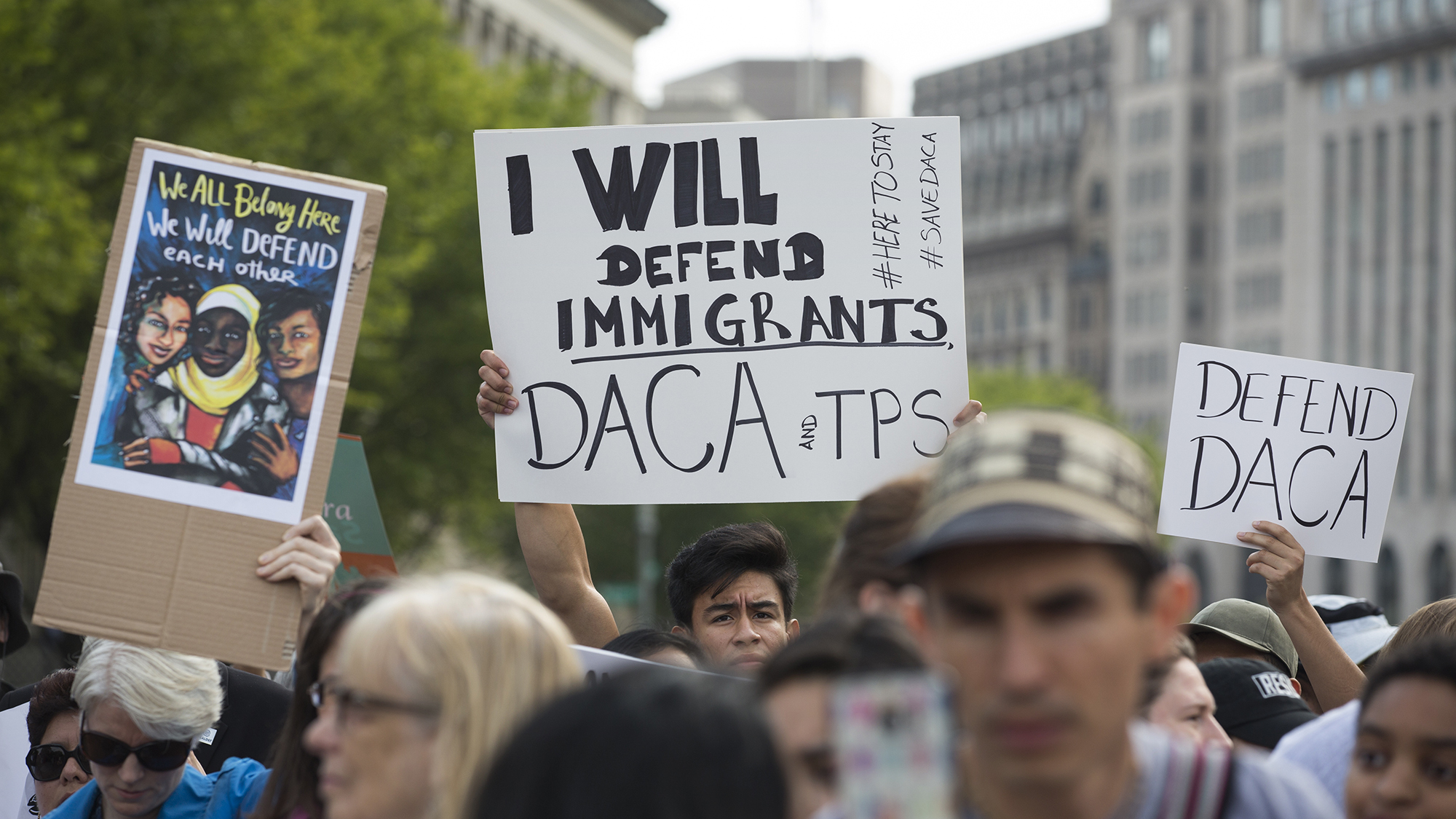
Six residents of the D.C. region are among a group of foreign nationals suing the Trump administration. They’re trying to halt a policy change that makes it harder for some immigrants to shake off old deportation orders. Immigrant advocates say the shift in policy leaves those people vulnerable as Trump pushes to end the Temporary Protected Status program next year.
Floriselda Alvarez Gomez, 48, is a mother of four and works as a manager at Burger King restaurants in Manassas and Gainesville, Virginia. She says she entered the U.S. illegally in 1995 from El Salvador and was ordered deported, but remained in the country. In 2001, she gained TPS status that shielded her from deportation and gave her the rights to work and travel abroad. TPS protects citizens of countries facing civil unrest, violence, and natural disasters, and Salvadorans make up the largest group of foreign nationals who hold the protection.
“The problem is that the situation in my country is escalating,” Alvarez said through a translator. “It’s very hard to live due to poverty, and it’s hard to get ahead.”
Many TPS holders eventually apply to be lawful permanent residents, which makes them eligible to become U.S. citizens. However, Alvarez’s old deportation order would make it much harder to get that status. But there was a longstanding workaround, said Simon Sandoval-Moshenberg, an immigration lawyer who is not involved in the case. Immigrants could apply for special permission to leave the country for urgent humanitarian reasons, and when they came back, they could apply to waive their earlier deportations.
“It enabled certain people who have TPS and who have a deportation order … to ‘fix’ that deportation order,” he explained.
Attorney Concepción De Montagut, who is representing Alvarez, said that was why she advised Alvarez to travel to El Salvador in 2018, her first visit back since she left more than two decades before. However, Alvarez found a policy change instituted by the Trump administration in December 2019 changed her course. Under the new policy, a TPS holder who left and returned to the U.S. through the legal channels “remains in the same exact immigration status and circumstances as when he or she left the United States.”
“Now with the change in policy the government, the administration is saying that the departure does not execute the order of deportation,” De Montagut said.
For Alvarez, this means she is far less likely to get lawful permanent residency, known as a Green Card, even as she has four U.S.-born children in Virginia — a 23-year-old, 19-year-old twins, and a 10-year-old who is autistic and learning from home.
De Montagut filed suit Wednesday against acting director of U.S. Citizenship and Immigration Services Ken Cuccinelli seeking to block the federal government from implementing last year’s “arbitrary and capricious” policy change. The suit came after De Montagut filed to strike down the policy change in August, saying it was unlawfully issued without notice or comment. Further, she wrote that Cuccinelli, who previously served as Virginia’s attorney general, lacked authority to order the change because his own appointment was illegal.
Immigration advocates say the policy change is more impactful because the Trump administration is trying to end the TPS program altogether. In September, a federal judge ruled the Trump Administration could end TPS for El Salvador, Nicaragua, and Sudan. The D.C. region is home to about 211,000 Salvadorans, making up the second-largest community after Los Angeles. Unless the federal court ruling is appealed, Salvadorans could lose their TPS protections by November 2021.
But proponents of restricting immigration say that TPS beneficiaries cannot expect to remain in the U.S. forever.
“TPS holders are not immigrants. As desirable as some of them might be as immigrants, that is not the legal category they are in. Indeed, they owe their presence here to the temporary nature of the program they were admitted under. Had Congress known that their stays would be as protracted as they have become, it never would have created TPS,” said Christopher Hajec, the director of litigation at the Immigration Reform Law Institute. (IRLI is the legal arm of the Federation for American Immigration Reform, and helped author hard-line immigration enforcement laws in states like Arizona.)
A judge in the U.S. District Court for the District of Columbia ordered a hearing on the motion for Friday, Oct. 30, 2020.
Sandoval-Moshenberg said it was difficult to interpret why the case was expedited. On the one hand, he said, that could indicate a sympathetic reaction from the judge toward a rule that was updated via a note on a website.
“Courts have struck down policies like this in the past when they’re not promulgated through the formal notice and comment rulemaking system, which at this point the Trump administration doesn’t have time to do within this term,” Sandoval-Moshenberg said.
On the other, he said the court could announce it was not authorized to review federal immigration policy.
Alvarez said that losing her status and being deported would shatter her family.
“I would not feel good leaving my children here by themselves,” she said. “It would be a drastic life change for my children if I were to leave them behind and return to El Salvador.”