Jacob Fenston
Before Theodore McCarrick was appointed to the prominent position of Archbishop of Washington in 2000, Catholic Church leaders all the way up to Pope John Paul II were aware of decades of allegations of sexual abuse and assault leveled against him, according to a new Vatican report.
The long-awaited report from the Vatican details years of abuse by McCarrick — who long declined the accusations — and the many times other church leaders failed to thoroughly investigate his behavior, even as he rose in the hierarchy of the Catholic Church.
Three times between 1997 and 2000, Vatican officials considered promoting and transferring McCarrick from his position as Archbishop of Newark, and three times they rejected the idea, deciding it “would be imprudent to transfer him” because of information about his conduct — including accusations of pedophilia and reports than he regularly shared beds with young seminarians.
Despite that information, in 2000 Pope John Paul II appointed McCarrick Archbishop of Washington. He held the highly visible post for five years, holding mass for Supreme Court justices and being photographed with the U.S. president.
In June 2018, allegations came to light that McCarrick had molested a teenage alter boy in the 1970s, and the church deemed the allegations “credible and substantiated.” Five months later, Pope Francis authorized a thorough investigation into McCarrick’s conduct and how he was able to rise through the church hierarchy.
The 461-page report published today is based on a review of decades of documents, covering the years 1930 (the year McCarrick was born) through 2017. Investigators conducted more than 90 witness interviews, ranging from 30 minutes to 30 hours. “During extended interviews, often emotional, the persons described a range of behavior, including sexual abuse or assault, unwanted sexual activity, intimate physical contact and the sharing of beds without physical touching,” the report reads.
“My initial reaction is that I’m seeing a lot of excuses,” said Becky Ianni, one of the leaders of Survivors Network of those Abused by Priests of Washington, D.C. When she spoke with WAMU/DCist, Ianni was still making her way through the report, but said that most of what she was reading was not new information.
“What I’m impressed by most is the excuses for what they knew and did nothing,” she said. “I think that if anything, this points out to parents and parishioners that we need to stay vigilant. The church cannot investigate itself.”
One of the earliest accounts of McCarrick’s misconduct in the report is from a mother who told investigators that McCarrick inappropriately touched her two young teenage sons in the early 1980s, and gave them beer during overnight trips. The woman is referred to anonymously as “Mother 1.”
Mother 1, after coming to understand the pattern of McCarrick’s behavior and confronting him for it, decided to try to alert church authorities. She got in the family car with a load of office supplies and headed to her local library branch in Metuchen, New Jersey. She pulled off the shelf a copy of the Catholic Directory, with its dark red cover, and hunkered down in a corner of the library for the day. She wrote out a letter about McCarrick’s conduct, and hand copied it over and over, writing individually to each cardinal in the United States and to the papal nuncio, the Vatican’s diplomatic representative in the U.S.
Mother 1 told investigators she did not use the words “predator” or “pedophile,” but instead described the behavior. “I did not have the language to explain it. The letters I wrote used simple terms. I did not use any fancy words when I wrote the letters.”
Mother 1 waited to see action against McCarrick, and was disappointed when none came. “I felt that nothing was being done and that my letter was ignored and I was furious with that and [felt] that this guy was going to continue his behavior and nothing was going to be done about it,” she told investigators.
Throughout the ’80s and ’90s, McCarrick continued to rise in the church hierarchy, raising his profile in the U.S. and internationally. He traveled extensively and was in frequent contact with high-level U.S. officials, according to the report, “including those at the White House, the Department of State, and Congress.”
Throughout those years, church leaders continued to hear about McCarrick’s behavior — particularly instances when the then-bishop would use his position of power to get in bed with young priests and seminarians.
In 1993 and 1994, a priest referred to as Priest 1 in the report told higher-ups of his own experiences with McCarrick. In one instance, McCarrick invited Priest 1 on a fishing trip with other seminarians, only to end up in a motel room with not enough beds. Priest 1 said he saw McCarrick “on top of” another priest in one of the two beds, and said they “were touching each other.” Months later, McCarrick invited Priest 1 to spend the night in his apartment in New York. Priest 1 realized belatedly there was only one bed in the apartment, and reported that McCarrick invited him to sleep with him and started “touching” and “wrapping his legs around” him.
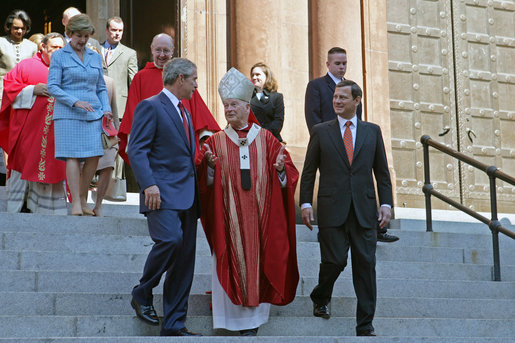
When McCarrick was appointed Archbishop of Washington in 2000, there were several categories of allegations against him known to church leaders, according to the report: Priest 1’s claims about McCarrick’s sexual conduct; anonymous letters accusing McCarrick of pedophelia; and knowledge that McCarrick shared beds with young men at the bishop’s residence and at a beach house on the New Jersey shore.
McCarrick, now 90, was defrocked by Pope Francis last year.
The current Archbishop of Washington, Wilton Gregory, released a statement Tuesday morning, indicating he had just received the McCarrick report, along with the general public, and was still reviewing it.
“My heart hurts for all who will be shocked, saddened, scandalized and angered by the revelations contained therein,” Gregory said in a statement. “Nonetheless, we know that if true redemptive healing is ever to commence — for those who have been harmed and for the Church Herself — this disclosure must be made.”
Becky Ianni, with the Survivors Network of those Abused by Priests, said that as a survivor herself, she was not satisfied with the report. Ianni said she was abused by a priest in Alexandria from the age of 8 to the age of 12, during the 1960s. She didn’t tell anyone for more than 40 years. “When I came forward, the church did not treat me very well and I fell into depression,” she said.
She said she worries how survivors of McCarrick’s abuse are feeling now, reading the Vatican’s report. “Are they feeling ignored or are they feeling like their concerns weren’t taken seriously?”
Ianni said the report’s ultimate impact depends on what church leaders do with the information.
“What are they going to do to the people that knew and did nothing? Are they going to punish them?” she asked. “If we don’t see a high official punished, then this report is meaningless.”
This story was updated to correct the year McCarrick was appointed Archbishop of Washington. He was appointed in November 2000, and formally installed in January 2001.