On a Wednesday evening in October, about 50 people crowded onto a Zoom call to sing.
As grainy faces popped up in the chat room, people began to cheerfully greet each other, their cameras panning across offices, bedrooms and living rooms — a far cry from the group’s usual rehearsal space underneath the grand, vaulted ceilings of the Washington National Cathedral.
“Someone has a glass of wine,” Steven Fox, Cathedral Choral Society’s music director, jokingly pointed out to laughter. “I normally don’t allow wine in rehearsals, but I think I’ll make an exception.”
The singers, who range in age from their early 20s to mid-80s, are members of the Cathedral Choral Society, the resident chorus of the National Cathedral and the oldest symphonic choral group in D.C. On their Zoom call, members were preparing for one of their most well-known performances — an annual holiday performance called Joy of Christmas — in a markedly different way.
When the group launched in a rendition of “Hark! The Herald Angels Sing,” every member remained muted, despite singing passionately into their computers. They could only hear pianist Joy Schreier playing her melody for the crowd.
As Fox had explained earlier, it would be difficult to actually sing as a group on Zoom without facing technological issues, like a lag in the sound.
“It’s great to imagine all of your voices,” Fox energetically told the group.
For the first time in its history, the 130-member chorus hasn’t be able to regularly practice, or even perform, in person all together. Like everything else in D.C., the chorus was forced to pause its activity in March during COVID-related stay-at-home orders, gutting the tight-knit group that not only loves singing, but also enjoys spending time with one another. It also came at a particularly hard time: The chorus still had two concerts left to perform in that season.
“We were ready and had done a lot of work. It was upsetting,” member Catie DeLiso said.
While the chorus continued to meet via Zoom for happy hours and vocal lessons throughout the spring and summer, it wasn’t until the fall that they began planning a public performance in earnest. Fox said they spent the summer trying to figure out how to make the 2020-2021 season, which will run from September to March, work.
“We realized, okay, there’s a new season coming up and we can’t do the one that we have planned in the cathedral, but we should do something else,” Fox, who joined the chorus in 2018, said. “For so many of us, it really is essential to stay connected with the arts.”
Their virtual season launched in September, with free pre-recorded performances streaming on YouTube and Facebook. Each month, the cathedral releases a new performance. In October, the group released a video featuring pianist Joy Schreier and a soprano from the chorus, Colleen Daly, performing Rachmaninoff’s “Dissonance.” In November, the chorus unveiled a video tribute to Beethoven, with solo voices and small ensemble groups singing in the cathedral.
Its Christmas show, the chorus’ marquee tradition, will premier in December. It will include small group ensembles along with home recordings from chorus members, featuring both classic and newer Christmas songs. According to Fox, the Christmas program last year drew more than 5,000 viewers over three performances.
In a way, the virtual chorus has been a respite for members.
“It was shocking and devastating for our singers not to be able to sing on a regular basis,” Fox said.
The chorus owes its COVID-friendly rehearsal plan, in part, to the insight of one famous local: Dr. Anthony Fauci.
With the National Cathedral limiting the number of people on its grounds to 20 at a time, and given that its chorus is largely comprised of people over 60 years old, chorus leaders had to think hard about how to make recording the program safe.
Fauci’s involvement came after the chorus’ executive director, Christopher Eanes, reached out to a chorus member, who happens to be a doctor, to ask for guidance. That doctor then gave Eanes Fauci’s personal email, Fox said. (Fauci helms the National Institute of Allergy and Infectious Diseases.) To their surprise, Fauci — whose friendly but stern wisdom about how to tackle COVID-19 has helped inform public policy and launch him into the public eye as a national hero — agreed to speak with Eanes over the phone.
According to Fox, Fauci’s advice for the chorus was similar to what he’s long been advising Americans to do: get tested, provide distance between singers, and encourage singers to quarantine as much as possible prior to meeting in person.
All singers were given the opportunity to take part in the small group recordings or decline.
DeLiso, who, in her 20s, is one of the younger members, agreed to a small group recording. DeLiso has been a part of the chorus since 2018 and says the group is her community. The thought of rejoining the chorus, albeit in a small group, made her emotional.
“It’s taken a toll that I’m not singing on a daily basis,” she said. It’s why she agreed to make the serious commitment to singing in person. That included signing a safety waiver, getting a COVID-19 test, and strictly quarantining between rehearsals.
But both DeLiso and Fox acknowledge that gathering in small groups presents a different challenge for the group: The sound quality is different singing in a small, spread out group as opposed to the rich tone that comes from an ensemble that’s physically closer to each other. Chorus members often feed off of each other, listening to vocal cues from the other singers near them. The further you get away from one another, the more delayed the sound is, DeLiso said.
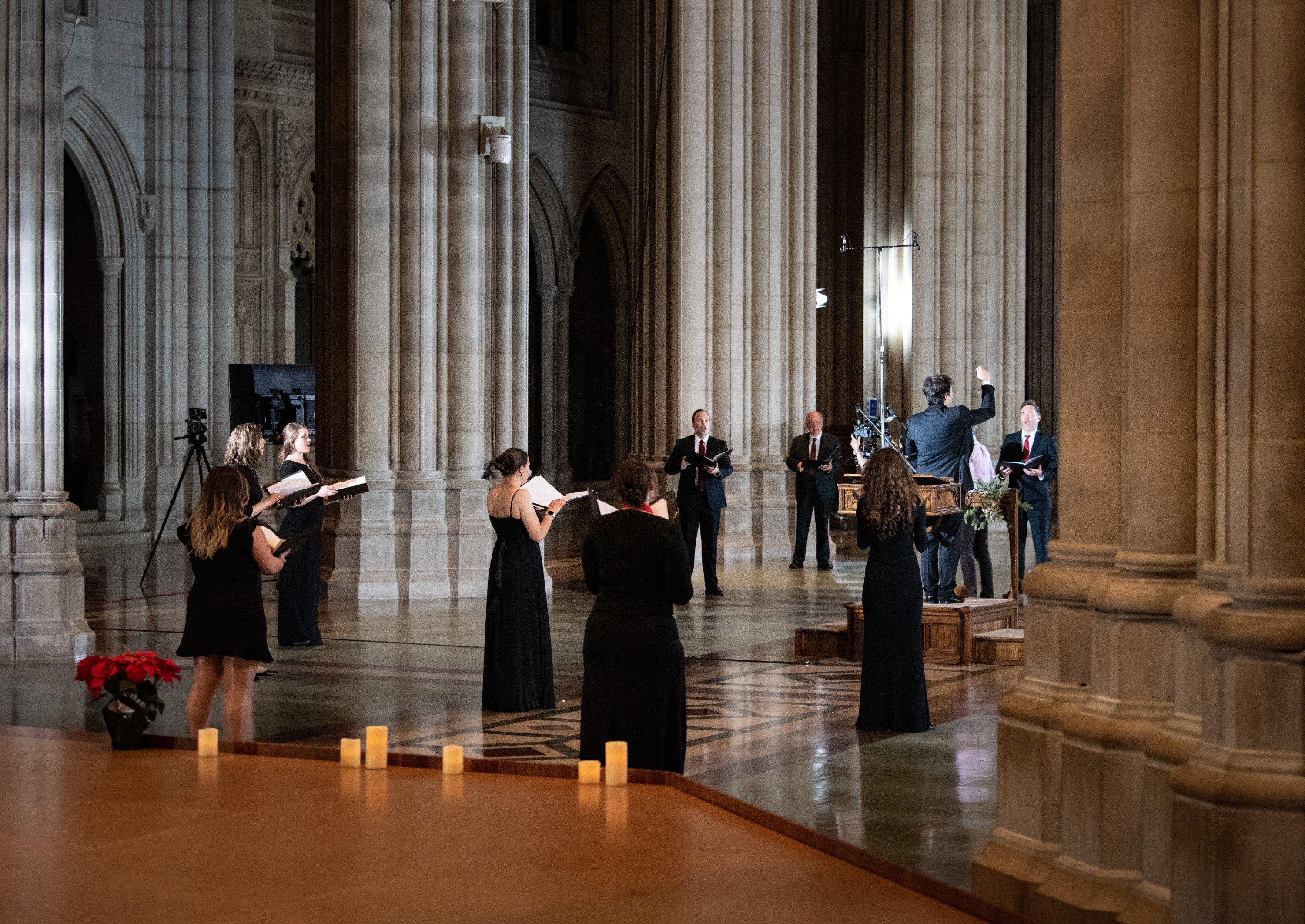
She said chorus members have to rely heavily on Fox’s direction to ensure everyone’s singing together. It also means the physical set-up of the singers had to change, to maximize sound quality as well as to adequately record members. During small group recordings for the Christmas performance, singers were positioned in a wide circle with Fox and microphones in the center, rather than facing forward into a would-be crowd.
This year’s program will include a mixture of recognizable Christmas songs and newer pieces, including an arrangement of “Angels We Have Heard on High” by National Cathedral artist-in-residence Stanley Thurston. In March, Thurston will lead the conclusion of the 2020-2021 season with a joint virtual concert alongside the Heritage Signature Chorale, a program comprised entirely of music by African American composers.
“We were able to spread out in the area where usually there’s an audience sitting so, you know, that got me really excited about the project—the idea of using the space in a different way, and capturing on film,” Fox said. He said the virtual Christmas performance will show a more intimate side of the cathedral itself. It’ll showcase “some of the different corners of this amazing building that our audience members usually don’t see when they come to a concert,” including a downstairs chapel, he said.
For members who aren’t comfortable recording in person, there are also opportunities to record from home. That includes Lesley Earl, a chorus member who has been recording herself singing from her office. That hasn’t been without challenges, too.
“There’s a big learning curve for how to produce a decent recording sound on the computer,” she said. It can be frustrating, especially when Earl thinks a recording has gone well only to hear that her computer has distorted the sound in some way. She’s even had to upgrade the microphone she uses to better record sound. But, despite the challenges, Earl is grateful for the community.
“To me, being part of this choir is yet another way to stay connected to our communities and stay connected to people,” she said.
Fox agrees, calling what the chorus has accomplished inspiring. “It’s a different way of singing, I think, in a lot of ways, and so this pandemic has really forced us in a way to think differently, and to make ensemble music in a very different way,” he said. “And, at the end of the day, I think that’s a challenge that’s going to make us a better chorus,” he added.
And he hopes what the chorus has had to overcome is reflected in the Christmas show when people finally get to watch it.
“We want them to be inspired, uplifted and moved, just like they are when they come to a concert at the cathedral,” he said.
This article has been updated to clarify Fox’s role in the Cathedral Choral Society.