Elliot C. Williams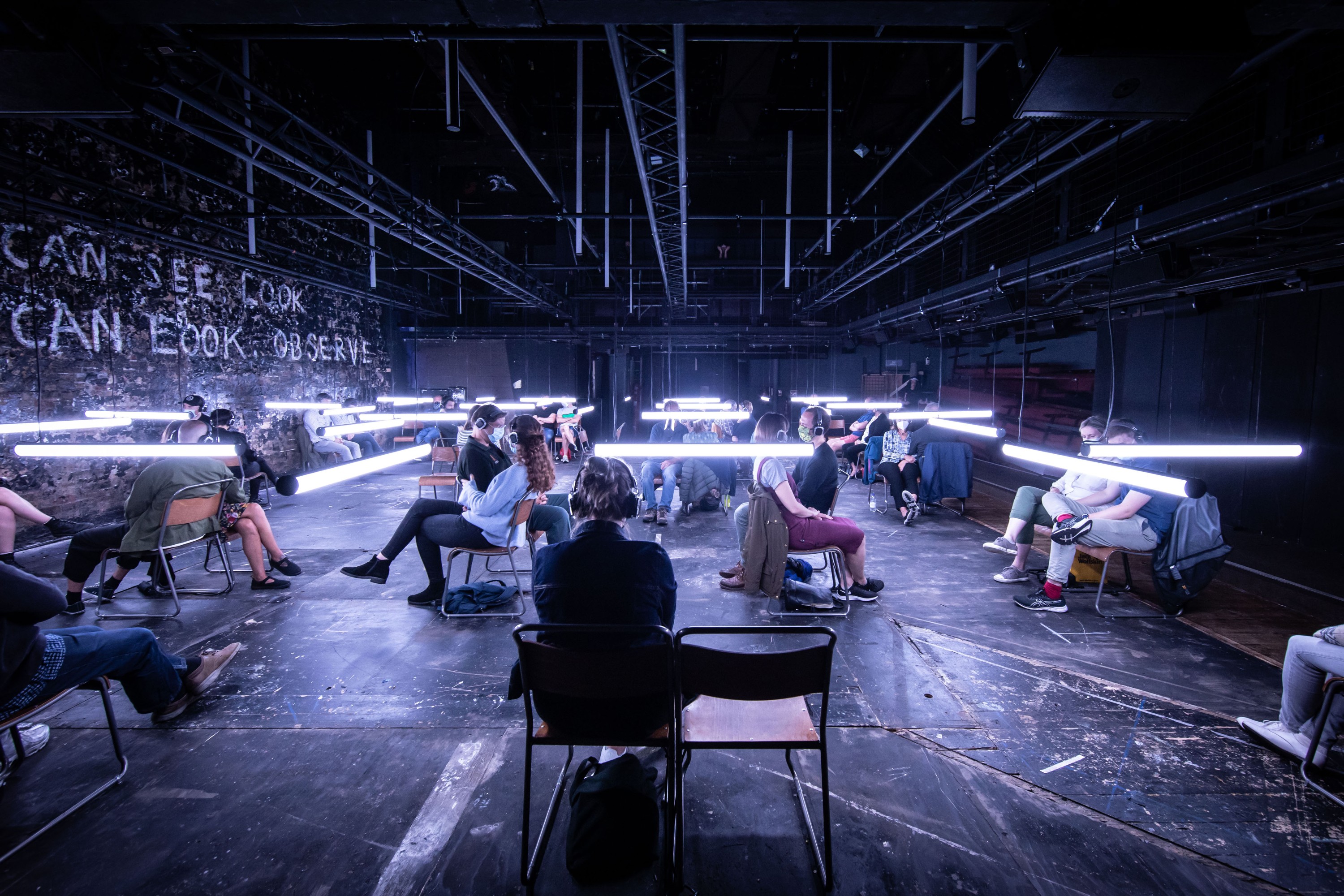
Why would someone want to sit in a dark room full of strangers right now? What would possess someone to attend a production about a pandemic during a pandemic?
These are questions Simon Godwin, artistic director at Shakespeare Theatre Company, has given a great deal of thought to while preparing Blindness, a dystopian sound and light installation set to open at Sidney Harman Hall next month. The answer, Godwin said in a November interview, is that this production from London’s Donmar Warehouse, which the New York Times called “brilliant,” is exactly what theater-craving audiences need right now.
“Theater thrives on togetherness,” Godwin said. “Here is a safe way of telling a story that we can experience together and come into a space, feel that life, that atmosphere, that energy, the joy, the mystery of what it actually means to be in a theater.”
Shakespeare Theatre announced in the fall that it would postpone its planned run of the show, following Mayor Muriel Bowser’s order to pause the entertainment pilot program — one of a handful of restrictions on nonessential businesses put in place amid rising COVID-19 case numbers in the region. But with a waiver from D.C.’s Homeland Security and Emergency Management Agency and the relaxing of restrictions on entertainment venues beginning May 1, Shakespeare announced new dates for Blindness.
To make this all work, the audience will sit socially distanced on a stage without actors at Sidney Harman Hall, alone or next to someone in their own party; masks are required the entire running time; and the seating capacity is 40, a fraction of the 761 people that typically fill the hall. Other safety measures include contactless ticket scanning, fresh air flow using MERV-13 air filters, and a trained safety compliance officer on site monitoring each performance.
Blindness is a re-imagining of Portuguese author José Saramago’s chilling 1995 novel about a pandemic of blindness that afflicts a doctor but mysteriously spares his wife. Adapted by playwright Simon Stephens, directed by Walter Meierjohann, and voiced by British actress Juliet Stevenson (the show’s sole performer), the production is “very topical,” Godwin says, but it’s more than just a 75-minute podcast or audiobook.
“It’s an immersive experience,” says Godwin. “So you are hearing it. You are feeling it. You are seeing it. You are inside it somehow.”
The production debuted to positive reviews in London, so STC — and two other theaters across North America, the Princess of Wales Theatre in Toronto and the Daryl Roth Theatre in New York — thought it might make for a great show to bring masked, socially distanced audiences back to the theater. (The show is awaiting scheduling at the Princess of Wales Theatre, while the Daryl Roth Theatre premiered its production in early April.)
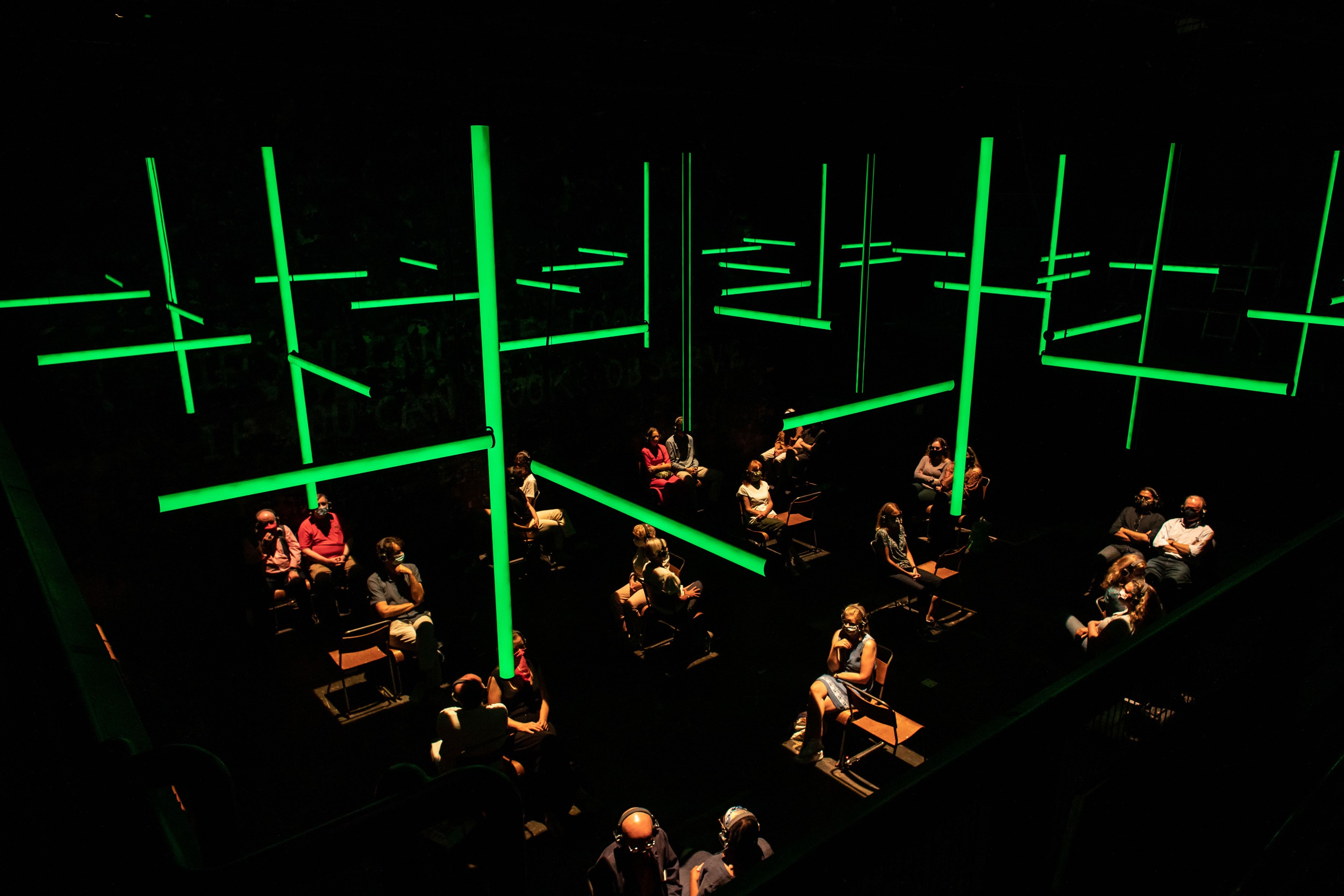
Under floating fluorescent lights, audiences tune in with headphones that are sanitized before use and listen to a dystopian story about how the public and the government responds to a plague. It has a thought-provoking, perhaps even hopeful message at the end. The concept might sound overwhelming for an audience already living through this experience — yet Godwin promises the show offers attendees an opportunity to live through a “complex” experience together and make it out on the other side.
“The timing of the music and the timing of the lights means that you really are invited to go into an emotive place,” he said. “It’s like climbing inside the radio and listening to this incredible story whilst other parts of your body and feelings are being touched by this light, by this music and by the darkness, too.”
Shakespeare is among the host of Washington-area theater companies that suspended public programming in mid-March and have been planning a way forward ever since. In late September, Mayor Muriel Bowser announced a pilot program that allowed six D.C. theaters to reopen for safe live performances: City Winery, GALA Hispanic Theatre, Pearl Street Warehouse, The Kennedy Center, The Hamilton, and Union Stage. The GALA and Kennedy Center were among the first to host in-person, indoor theater productions.
Godwin hopes test the waters with Blindness and gradually put on shows with live actors sometime later this year.
While the current safety measures may seem contradictory to the liberating quality of theater, Godwin says during times like this people have a craving to gather around art, even under such restrictive circumstances. Early on in the pandemic, he wrote an op-ed in the Washington Post and asked, “As theaters darken across the globe, where can we find the light?”
In the piece, Godwin explored the ways Shakespeare found opportunity in adversity during outbreaks of the plague, producing some of his most groundbreaking works. Under a similar darkness, he hopes Shakespeare Theatre Company can follow in the steps of its namesake.
Blindness has been extended from May 27 to July 03, with a run time of 70 minutes and no intermission. All seats are $49. Seats for Blindness are sold in pairs. For individual seats, please call the box office at (202) 547-1122.
This post has been updated throughout with information about the show’s postponement and new dates.