Matt Blitz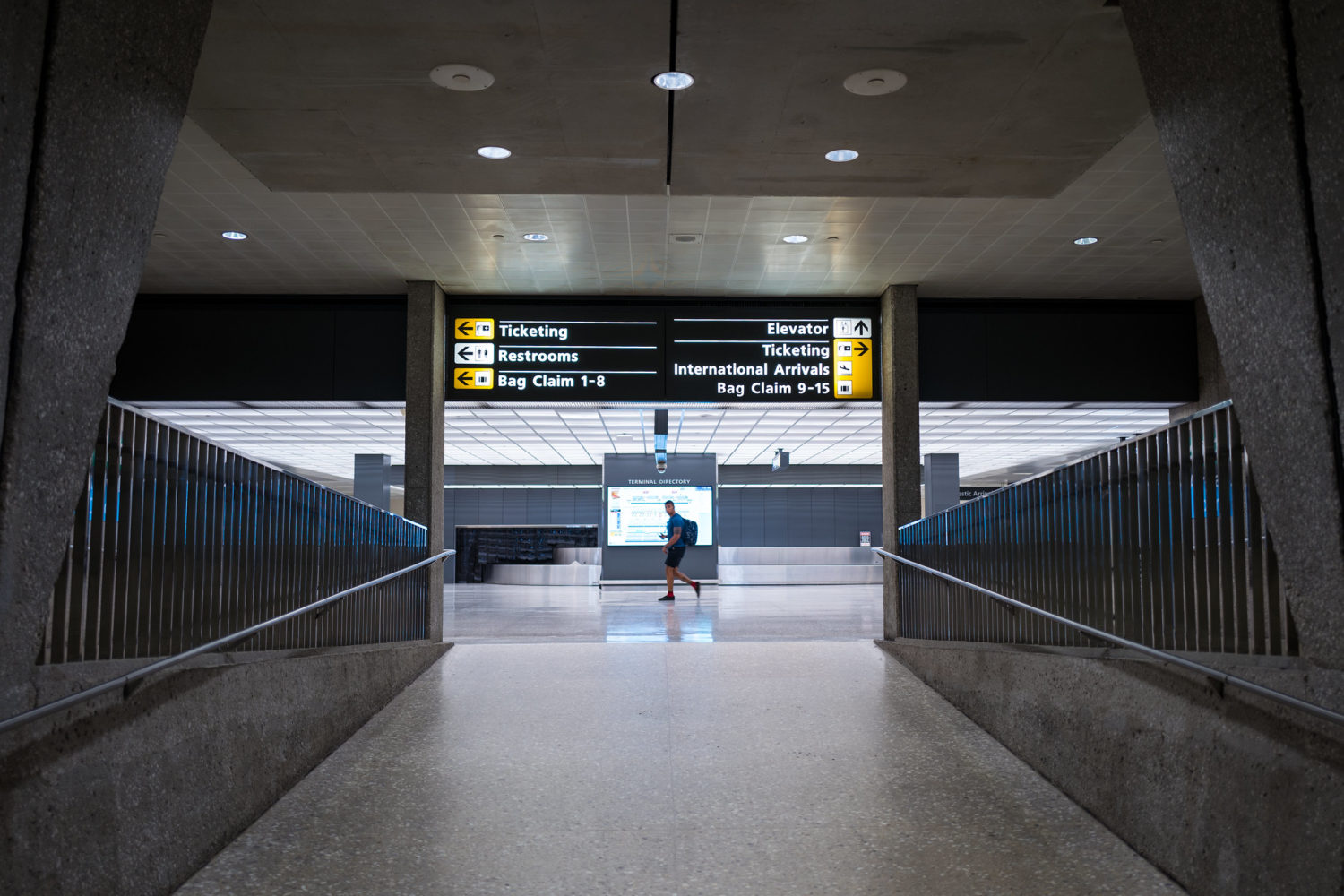
Despite officials and experts advising against it, some locals will still be traveling for Thanksgiving. And the region’s transportation agencies and companies are communicating a number of precautions and measures in hopes of keeping them healthy and safe from COVID-19 during what is typically the busiest travel period of the year.
At Reagan National Airport and Dulles International Airport (which are both run by the Metropolitan Washington Airports Authority), face coverings are required at all times and complementary masks are available at information counters. The airports also have “thousands of social distancing stickers” on the floor to remind folks about staying separated.
There are also more than 700 hand-sanitizing stations throughout both airports.
However, unlike a number of others across the country, regional airports currently do not have any testing sites.
Amtrak is partnering with the George Washington University Milken Institute School of Public Health on safety measures. Face masks are required at Union Station as well onboard throughout a train trip.
The train station also has social distancing stickers and the Amtrak website says cleanings are being done using EPA-registered disinfecting wipes. Boarding times are extended and fewer seats are being sold in order to reduce crowding. Additionally, on all Amtrak trains there are filtration systems that generate a full fresh air exchange every four to five minutes.
A majority of bus companies with local routes — Greyhound, Megabus, and Washington Deluxe — run out of a hub at Union Station. All are requiring face masks when boarding and walking around the bus, limiting the number of tickets sold, enhancing cleaning, and touting their air filtration systems. Greyhound, however, specifically notes that if you are unable (or unwilling) to wear a face covering, including due to a medical condition, they “regret that you will not be able to travel on Greyhound at this time.”
The bus company is also advertising that they are now “ozonate” each bus, which is a sanitation process more often used to prevent the spread of waterborne diseases. While studies are ongoing, some have determined the process to be “potentially useful” against the coronavirus.
As this has been a year like no other, it’s difficult to predict how many people will travel for the holiday. During a normal Thanksgiving week, a lot of people come and go in the D.C. region. Last year, it was estimated that nearly 1.35 million left town. About 100,000 locals flew and more than 105,000 train trips came through Union Station.
This year, the number will drop significantly. Air travel is expected to decline by nearly half nationwide compared to last year, according to AAA estimates. The number of people traveling by bus, train, and cruise is estimated to drop by more than 75% from last year’s level, due to the pandemic.
Earlier this month, D.C. Mayor Muriel Bowser instituted a travel advisory requiring those who are visiting D.C. or returning to the city from one of 42 high-risk states to get a test 72 hours before traveling. Private institutions, like universities, houses of worships, employers, and hotels, can require a negative test. Additionally, people who are visiting D.C. for more than three days (or live here) are required to get another test within three to five days of arrival.
Despite the strict words, Bowser admitted that enforcement will be tough and there won’t be any “checkpoints” where people are being asked for proof of their test results.
“Nobody’s going to be asking you at the airport or on bridges or on roads or at the train station to share your papers,” said Bowser.
If you are planning on traveling for the holiday, public health experts say there are ways to limit the risk.
Dr. Amira Roess, a professor of epidemiology at George Mason University, says transportation hubs need to help people maintain social distance. “The key, really, is to have enough space so that people, customers, commuters can physically distance,” she says. This means reconfiguring gathering spots and blocking off seating.
It’s also about enforcement, Roess says, both in terms of physical distancing and wearing face masks properly. “I would say don’t be shy about asking people to please make sure that they are six feet away from you and have their mask [on].”
In terms of the riskiness of transportation options, Roess reiterates what other medical experts have said: an airplane is likely a safer transportation option than a train or a bus.
For one, airplane trips are often for a shorter period of time. Two, airflow technology has greatly improved. “When you’re actually in the airplane, your risk of becoming infected is relatively low provided that the ventilation system, the airflow in the airplane, is moving in basically the standard way,” Roess says. “Airplanes have been engineered and reengineered so that the airflow and the cleaning of the air is really high quality.”
The greatest risk of exposure, says Roess, is actually when at a crowded airport or train station in close quarters with strangers and unable to physically distance. The risk only increases if some are taking off their masks to eat and drink in these enclosed spaces.
No matter what transportation option is chosen, Roess suggests that folks deciding to travel this holiday quarantine upon arriving at their destination or limit how much time they’re spending with other people, particularly around those who are elderly or have underlying conditions.
“Better safe than sorry,” says Roess.