 Daniella Cheslow
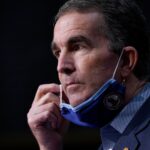
Every region of Virginia is seeing a sustained increase in COVID-19 infections, but Governor Ralph Northam did not impose any new restrictions Wednesday. Instead, he urged residents to take “personal responsibility” and advised Virginians to trust a forthcoming vaccine.
“What we all do affects other people,” the governor said. “Especially now, with these vaccines just around the corner, so that we can start to think about an end to this pandemic, it is foolish to take risks.”
Virginia recorded 20 new deaths Tuesday and 2,417 new cases, with an 8.3% positivity rate for testing. That is above the 5% threshold that epidemiologists say indicates more testing is needed to safely contain the virus. On Tuesday, 1,860 patients were hospitalized with COVID-19, higher than at any point since the pandemic began.
Northam said Virginia is “still doing well” compared to other states. However, even though Virginia’s rate of 27 cases per 100,000 people is among the nation’s lowest, the neighboring states of West Virginia, North Carolina, Kentucky, and Tennessee all have higher rates and contribute to spread in Virginia, he said.
The spread of COVID-19 has been accelerating in Virginia for weeks. On Nov. 13, Northam issued an executive order with new restrictions. They include limiting outdoor gatherings to 25 people and ending alcohol service by 10 p.m. On Wednesday, Northam declined to impose new limitations, saying “we are strengthening enforcement of existing measures,” and adding that he was monitoring whether Thanksgiving would lead to a surge in infections.
He also reiterated a common refrain, saying, “all options are on the table” for additional restrictions.
Some groups in Virginia have moved to shake off existing pandemic restrictions. Campbell County supervisors passed a resolution Tuesday declaring a “First Amendment sanctuary” and requesting that the sheriff’s office not assist state or federal agents trying to enforce Northam’s orders.
“I expect that law enforcement will be part of the solution here,” Northam said. “And I would remind everybody in Virginia that we are not the enemy. This should not be divisive, it shouldn’t pit one group of Virginians against another.”
There are signs the state’s hospitals are groaning under the rising case load. Ballad Health that serves southwest Virginia said Wednesday it would pause non-emergency elective procedures for at least 30 days.
Northam, a pediatrician, said hospitals are getting better at treating COVID patients and keeping them off ventilators, but they were still straining.
“The largest concern for our capacity right now is not so much bed space, not so much ICU space, not so much ventilator space, it’s the staff,” he said.
On a more positive note, Northam said the state stockpile of personal protective equipment (PPE) was adequate, and called on hospitals experiencing shortages to request help.
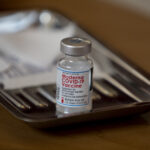
The increase in COVID cases comes as Virginia prepares to begin distributing vaccines. Northam estimated that, pending Food and Drug Administration approval, the first 70,000 doses of vaccine could be available in mid-December. He said ultra-cold storage facilities were available, and the state has partnered with CVS and Walgreens to help distribute vaccine.
The vaccines require two doses administered about three weeks apart. Northam said that when his turn came, he would have “no hesitation” in getting vaccinated.
“The vaccine news is extremely, extremely hopeful. It is the light at the end of this very long and dark tunnel,” he said. “If you want your kids back in school, our small businesses to reopen and thrive and to go to concerts and entertainment events, there’s only one way to get there: wear a mask and social distance now, and get a vaccine when the time comes.”
The first doses of vaccine will be reserved for healthcare workers and long-term care residents. State epidemiologist Lilian Peake estimated some 500,000 people are included in that group, adding that a committee would decide who should be first in line.
“We do have a process in place to determine, of the priority groups, the larger ones, how we divide them into smaller groups,” Peake said. “We should have a decision by the end of the week.”
Northam acknowledged skepticism toward the vaccine, in particular among African American communities who mistrust federal medical initiatives because of a history of unethical medical practices.
Northam said that he had enlisted faith leaders to help build trust for COVID testing, and he said Virginia’s Health Equity Commission would use similar outreach to make people comfortable with a vaccine, and to ensure that distribution “is equitable and that it is fair.”
He also urged Congress to pass a financial relief package before the holiday vacation, and he noted that the holidays during a pandemic and economic recession may be particularly stressful time. He said anyone experiencing anxiety, stress, trauma or grief can call or text a “warm line” operated by the Department of Behavioral Health and Developmental Disabilities at (877) 349-6428.