Margaret Barthel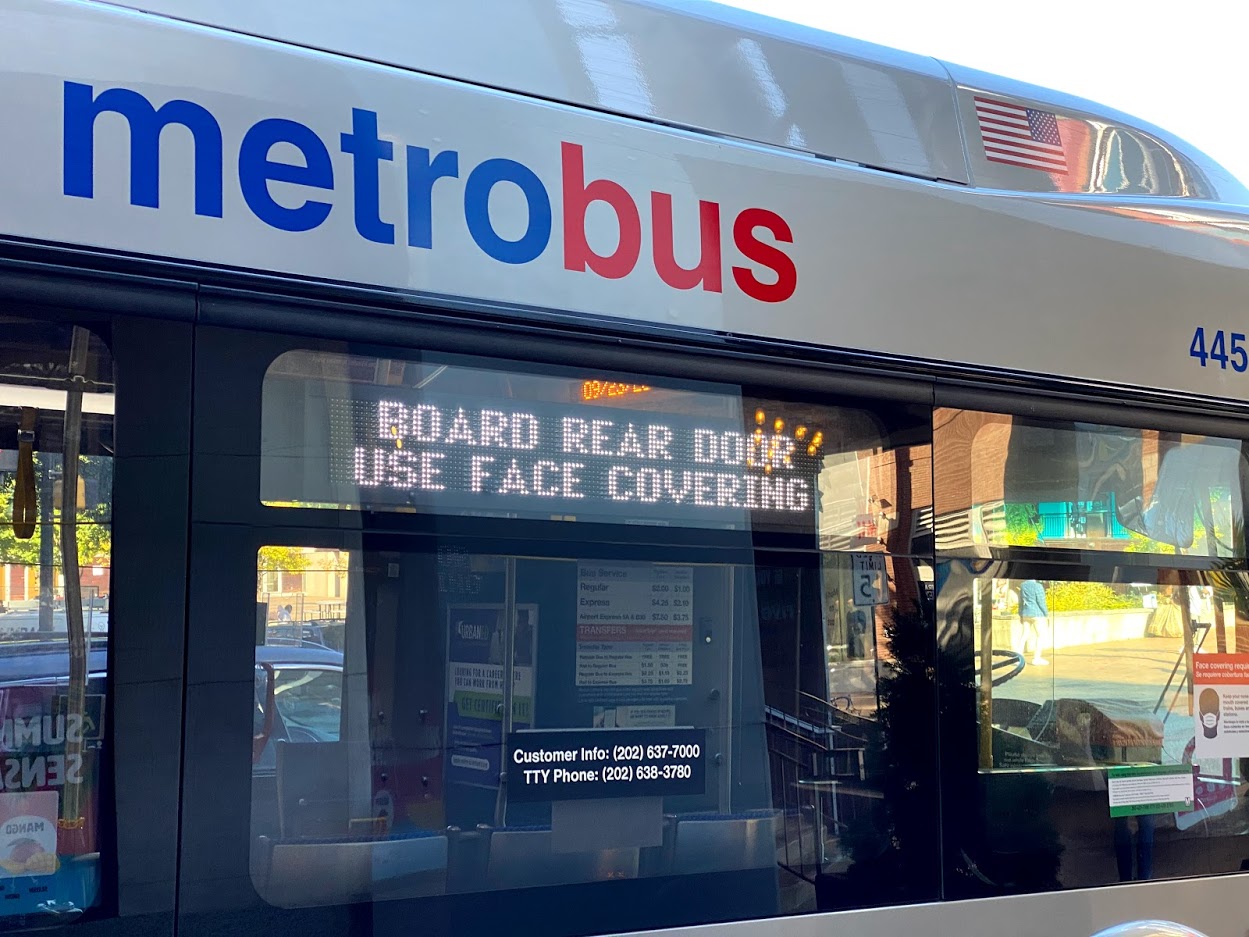
Metro is publishing information about crowding on buses in real time, on its website bus tracker tool and on third-party apps like Google Maps.
“Metro is doing our part to help Metro customers feel safe when traveling, and we’re proud to release this new tool to help customers make more informed travel decisions,” said Metro General Manager and CEO Paul J. Wiedefeld in a press release. “Social distancing is a top concern as we all navigate this public health crisis, and we hope customers find this information valuable when deciding when to ride.”
Now, riders tracking their bus will see icons showing whether a bus has “many seats available” (less than 25% occupied), “few seats available” (25-49% occupied), or is “full” (50% or greater occupied). Those labels are based on public health guidance for effective social distancing, per the Metro release.
Metrobuses are equipped with infrared sensors at front and rear doors, enabling automated counting of the number of people in the bus at any given time. That information will now be accessible to customers who want to take the bus but are concerned about keeping their distance from other riders.
Metro train cars don’t have the same sensor technology, but Metro is publishing information about typical passenger levels at any particular day, time, and rail line, based on trends from several prior weeks of data.
The rail car information will be represented in tracking apps as “many seats available” (less than 20% occupied), “few seats available” (20-32% occupied) or “full” (33% or more occupied).
Ridership on Metrobus and Metrorail has dropped precipitously during the pandemic. Recent data from the agency shows the rail system is seeing a nearly 90% decrease in ridership on weekdays. Bus ridership is down less, hovering near a 60% decrease on weekdays.
Access to real-time transit crowding information is new to D.C. region riders, but other cities have had systems in place for much of the pandemic. Data on crowding on buses in Boston and New York has been available to riders since April.