Ally Schweitzer
 Rachel Kurzius
D.C. Mayor Muriel Bowser described the insurrection by pro-Trump extremists at the U.S. Capitol on Wednesday as “textbook terrorism,” and urged an investigation into the U.S. Capitol Police response to the events.
“Obviously, it was a failure,” Bowser said during a press conference Thursday, referring to the federal police’s inability to protect the U.S. Capitol from rioters, some of whom were armed. “There’s going to have to be a real investigation into what happened.”
The mayor called on Congress to create a nonpartisan commission to “understand the security failures” at the Capitol building.
She laid the blame for the fatal insurrection on the “unhinged actions” and “baseless conspiracies that have been peddled by [President Trump] and by other elected officials.” Four people died at the Capitol grounds on Wednesday — one person was fatally shot by a U.S. Capitol Police officer, an incident currently under investigation by D.C. police, and three others died of what appear to be medical emergencies.
Bowser simultaneously defended the Metropolitan Police Department’s handling of the violence and reiterated the city’s willingness to continue assisting federal authorities. Capitol Police called MPD at 1 p.m., and D.C. police took the lead in clearing the building.
“We cannot decide for the Capitol… that we are going to be their police department. But we stand ready to assist them,” Bowser said.
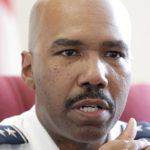
Acting D.C. Police Chief Robert Contee announced Thursday that police made 41 arrests on U.S. Capitol grounds the previous day, the bulk of 68 total arrests Wednesday evening into the early morning hours.
After a reporter asked about the seemingly low number of arrests, especially in comparison to the policing of racial justice protests during the summer, Contee responded that police first had to contain the chaos around the Capitol before officers could begin fanning out from the grounds to arrest violators of the city’s 6 p.m. curfew.
“Not many people in this room have been in the midst of a riot or an insurgence like that,” Contee said. “Once control was established… then, and only then, [were] we able to safely make arrests.”
On Jan. 7, U.S. Capitol Police reported 14 arrests from the prior day, most for unlawful entry.
While the D.C. National Guard’s deployment to the Capitol grounds was delayed on Wednesday, guardsmen were ultimately bussed there to assist. As of Thursday afternoon, 850 personnel were deployed to the scene, according to U.S. Secretary of the Army Ryan McCarthy. With the addition of guardsmen from across the country, there will be 6,200 personnel in the District by the weekend, he said.
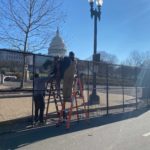
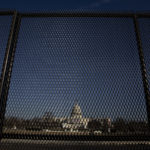
Guardsmen have erected a 7-foot, non-scalable fence surrounding the Capitol from Constitution Avenue to Independence Avenue and from First Avenue to near the pond in front of the Capitol. It will remain for at least 30 days, per McCarthy.
The mayor did not announce an extension of the 12-hour curfew she put into place Wednesday afternoon, but did not rule out the possibility of another one.
“D.C. residents should go about living their lives, and if there is a need… to ask them to stay away from certain areas, I will do that,” Bowser said. “I don’t have that request at this stage.”
On Wednesday the mayor enacted a 15-day public emergency, in effect until 3 p.m. on Jan. 21, that provides her office broad authority to respond to a crisis. The order enables the mayor to call for evacuations or sheltering in place; change business hours to enforce a curfew; shut off public utilities; destroy, remove, or prohibit access to property “found to be contaminated” by dangerous matter and regulate the distribution of food and fuel and other commodities, among other actions.
Bowser said the public emergency signals to residents, businesses, and visitors that “we may have to do something extraordinary,” like additional curfews, “to maintain public safety in the District.”
As the city gears up for the presidential inauguration on January 20, Bowser said that violent rallies “may not end on the 20th … that means a whole different level of policing.” She noted that the size of the D.C. police force is shrinking and that the D.C. Council has passed police reform legislation that addresses some policies related to policing demonstrations. (While the emergency legislation passed over the summer bars MPD from using chemical irritants to disperse peaceful protesters, that ban does not apply to violent riots like Wednesday’s insurrection.)
The mayor also voiced support for moving a D.C. statehood bill to president-elect Joe Biden’s desk within the first 100 days of the 117th Congress, and urged lawmakers to transfer command of the D.C. National Guard from the president to the mayor’s office.
After the insurrection began to take shape Wednesday afternoon, police recovered two pipe bombs near the headquarters of the Democratic and Republican national committees. Police also found a vehicle containing a long gun and Molotov cocktails on the Capitol grounds.
The FBI announced Thursday morning that it is “seeking to identify individuals instigating violence” in the city. MPD has already released a series of images of insurrectionists who breached the Capitol.
“We still have a significant amount of work ahead of us” to identify and hold accountable “all members of the violent mob,” Contee said, adding that MPD has distributed those images to local hotels and business improvement districts in case they recognize any of the people. MPD will also send the images to FBI field offices across the country, and is offering a $1,000 reward for information that leads to charges. He expects the Capitol Police to release additional images.
Elected officials across the country and the region criticized the response of U.S. Capitol Police to the insurgency. U.S. Rep. Don Beyer (D-Northern Virginia) tweeted Thursday that authorities demonstrated a “catastrophic failure to anticipate yesterday’s threat, defend the Capitol and communicate.” He, too, called for an investigation into the Capitol police response.
U.S. Rep Tim Ryan (D-Ohio), chairman of the congressional committee that oversees Capitol Police funding, described the police force’s response as an “epic fail” during an appearance on WAMU’s 1A Thursday.
Capitol Police Chief Steven Sund defended the actions of officers in a statement released on Thursday, after many hours of radio silence from the agency. “United States Capitol Police and our law enforcement partners responded valiantly when faced with thousands of individuals involved in violent riotous actions,” he said.
After the day’s violence, Congress reconvened in the evening to certify the election results. The U.S. House of Representatives has since adjourned until after the inauguration Jan. 20. The Senate is scheduled to adjourn Jan. 19.
But Bowser warned that pro-Trump agitators are unlikely to make an orderly exit.
“We have a lot to think about if this is going to be a new normal in America,” she said.