 Jenny Gathright
 Rachel Kurzius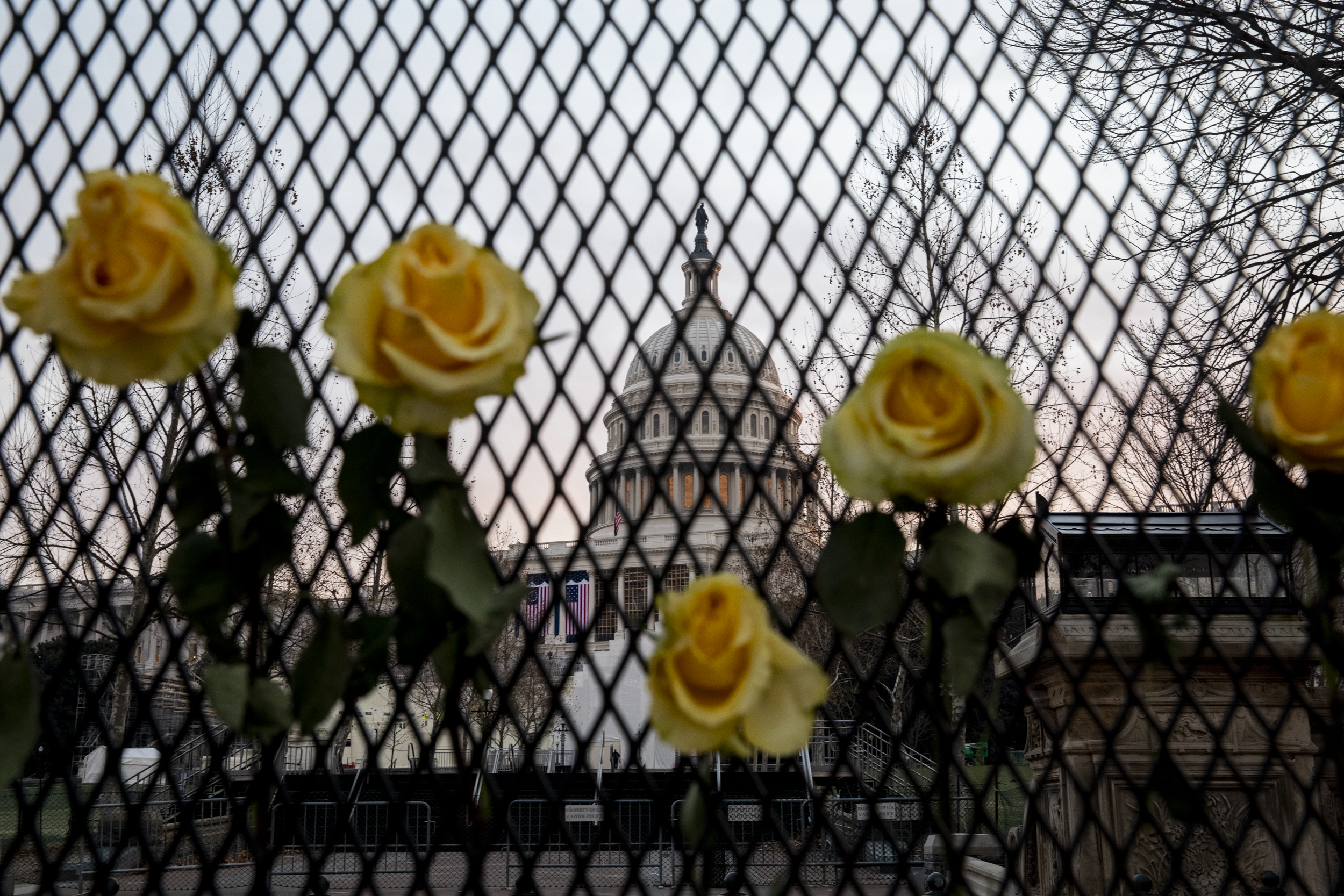
Chris Cooke has lived in D.C. since October. Since that time, Trump supporters and far-right groups have gathered for three large demonstrations in the city—each one ending in violence and leading to injuries or deaths.
Last Wednesday, things got even more personal for Cooke, when he spotted a group of people who appeared to be returning from the violent insurrection at the Capitol to an Airbnb near his home in Shaw (Airbnb has since decided to cancel D.C.-area reservations ahead of inauguration). Cooke took a photo: He wanted to gather images of people he thought may have been involved in violence. But once one of the Trump supporters saw him doing this, the man verbally threatened him.
“He threatened to jump over [the fence] and break my phone, and then afterward he would take care of me,” said Cooke. “So at that point, I just calmly got up, I stared him down, walked into my apartment, and then dialed 911.”
In the aftermath, Cooke said he felt traumatized. And he is not the only D.C. resident to feel shaken after last week’s violence and uncertain about the prospect of more in the coming days.
Some residents have rescheduled medical appointments or switched up their bike and run routes to steer clear of downtown D.C. or the Capitol complex. Others say they are avoiding speaking Spanish in public or buying items like baseball bats for personal protection. Some are making plans to leave the city for inauguration. And many have feelings of anger, sadness, and heightened anticipation for the near future.
Local officials are also on high alert.
Mayor Muriel Bowser issued a public emergency order through January 21, which gives her administration additional authority and the ability to corral resources. Bowser said the order signaled “we may have to do something extraordinary … to maintain public safety in the District.” Among the actions permitted under the order: calling for evacuations or sheltering in place, enforcing a curfew, shutting off public utilities, and more. (This is on top of the state of emergency and public health emergency that have been in effect in D.C. since March of last year.)
Bowser has also been calling on federal authorities to enact stricter security measures in the lead-up to the inauguration. Right-wing extremists have promised to return to the District and the FBI has issued warnings that armed protesters are planning to “storm” government buildings in all 50 states when President-elect Joe Biden takes office.
On Monday evening, President Donald Trump approved an emergency declaration in D.C. stretching from January 11-24, citing “emergency conditions” around the inauguration. It authorizes the feds to provide resources and coordinate any necessary response or disaster relief efforts.
Local officials have also told residents to expect an “inauguration perimeter” with security checkpoints to pop up in the coming days.
The National Guard presence in the District will reach at least 10,000 troops by January 16, with a possible total of 15,000.
“I think that we are going to see what is going to feel like a military presence…which is jarring for us in our community,” said Ward 6 Councilmember Charles Allen.
For Carol Ann, a federal worker who lives in Penn Quarter, the law enforcement and military presence she saw last Wednesday paled in comparison to what she witnessed during the racial justice protests in early June. (We’re not using her last name because she does not have permission to speak to the media.)
“Over the summer, military were stopping me” when walking back to her apartment, she says. “We were treated like criminals for doing nothing and [last Wednesday] criminals were given a free pass and now have to get tracked down across the country.”
From her apartment, she’s had a front-row seat to the pro-Trump demonstrations that have been held in D.C. since the election.
“Every time, it’s gotten worse. They’re walking down my street and all around my neighborhood. They’re angry, no masks,” she says. On Wednesday, she says she observed a group of men parked in a pick-up truck across the street as they put on tactical gear, bulletproof vests and camouflage.
“I’m scared — I’m wondering if I should move out of D.C. but I keep thinking it will get better after the inauguration,” says Carol Ann. “But now, who knows.”
In addition to causing fear, the insurrection at the Capitol had practical implications for residents: D.C. was under a 6 p.m. curfew, public COVID testing was canceled, and roads were closed off.
The charter school network KIPP DC paused meal distribution and COVID testing, and canceled classes last Thursday. (KIPP DC will also be closed for the Monday, Tuesday, and Wednesday around inauguration, but these closures were already planned prior to last week; Love said the school is closed on Martin Luther King Jr. day, and has been closing for inaugurations since former President Barack Obama’s first inauguration.)
Mekia Love, the Deputy Chief Academic Officer for KIPP DC, said school leadership decided to close because they wanted to make sure teachers had the space to take care of themselves before being asked to do the difficult work of processing a violent insurrection with their students.
Love said there are students at KIPP DC schools who have parents who work in Congress — and staff members who have spouses who work there, too—so the events were especially personal for many members of the school community. And on top of that, many D.C. students have visited the Capitol and other places downtown on field trips and notice how the physical landscape of the city has changed in response to protests for racial justice, the election, and most recently, gatherings of far-right mobs.
“They’ve seen those places that they see on TV. They’ve been to all of them,” said Love. “They just are really seeing everything play out in a way that is so close.”
For Capitol Hill residents, last week’s violence also hit particularly close to home.
Authorities discovered bombs outside the Republican National Committee and Democratic National Committee headquarters—and in response, authorities asked Capitol Hill residents who lived in the nearby blocks to evacuate their homes for several hours on Wednesday afternoon.
“We actually saw that photo of the suspect that the FBI released, and the picture that they captured of him—presumably from some security camera—is in the alleyway directly behind our home,” said one Capitol Hill resident, who declined to share his name because he was not authorized by his job to speak to the media. “Seeing that was pretty unnerving.”
The resident packed an overnight bag and stayed with friends outside the neighborhood that night. He said some family and friends have reached out to suggest that he refrain from staying in his home next week, when more extremist gatherings are scheduled around inauguration.
“I would definitely say that I was angered, and I would even say enraged,” he said. “I think there’s a tendency for there to be a conception on the right that D.C. is this city of nameless, faceless bureaucrats, that it doesn’t have its own vibrant urban culture…and that these types of disruptions don’t have an impact or an effect on individual residents.”
Some residents are also worried that a stepped up military and police presence in the city may only add to their unease.
“I am queer. I’m Brown,” said Cooke, who identifies as Latino. “And so, yeah, I do have misgivings and some mistrust about police in my community that comes with the experience of having the color of skin that I do…Of course, I’d rather have police officers than Trumpers, but at the end of the day, we’ve experienced violence from both of them.”
Allen, whose constituents include Capitol Hill residents, said he also has concerns about what a heavily fenced Capitol complex and National Mall might mean for the surrounding neighborhoods.
“For those of us that come up right next to that type of hardened fortress, what type of steps are being taken to make sure that our neighborhoods are safe, that the violence that we saw won’t be repeated in the neighborhood?” Allen asked.
Ahead of the Jan. 6 insurrection, the leader of the Proud Boys wrote on the social media site Parler that members of the extremist group would be “incognito and we will spread across downtown DC in smaller teams.” As of Monday night, Allen said he was focused on preparing for the possibility of this kind of decentralized violence in D.C. over the coming days: He said local officials are working with federal authorities to make sure they have adequate security for the Capitol complex and the National Mall so that D.C. police can focus on providing security for residential neighborhoods.
Dr. Martin Luther King Jr. Day falls in the middle of the state of emergency this year. But the mayor’s office has not granted a permit for the annual parade in Anacostia. The city’s celebrations of the holiday will largely happen virtually instead, both because the city’s coronavirus cases are surging, prompting Bowser to extend a temporary pause in activities like indoor dining, and due to safety concerns, per the mayor’s office.
Reverend George C. Gilbert Jr., of the Center for Racial Equity and Justice, as well as several local and national Baptist groups, says that “we are telling family, parishioners and followers not to go out during this time of turmoil.” On Inauguration Day, “we’re going to be watching and praying and hoping to see a better day.”
This story was updated to correct a misspelling of Chris Cooke’s name.