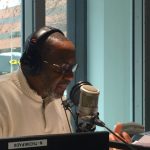
Elliot C. Williams
The Kojo Nnamdi Show’s 23-year-run on WAMU will end this spring, the station announced today. The last live show will air Thursday, April 1. Nnamdi will continue to host The Politics Hour on Fridays and he will host a series of live events for the station.
For decades — during his time at WAMU and before that, as a television host on Howard University’s station — Nnamdi has been a calm but unwavering voice for the D.C. area, helping listeners understand the complexities of living in the Washington region. He’s been praised for his interviewing ability, and has been named to multiple lists of the most influential people of D.C. over the years.
“There are people who, even after they leave this region, even after they leave this country, still listen to the show online because they get a sense of what’s going on here and what their hometown is like,” Nnamdi said in an interview. “I think that people having a sense of place and a sense of ownership of place is very important, and I think we’ve contributed towards having people in this region feel like ‘this is mine, this is ours.’”
Nnamdi, 76, has said he’s not retiring but is “reorganizing” and that the decision to move on from the show was his. He says he has discussed scaling back his hosting responsibilities with station management for years, but, still, the change is bittersweet.
“I’ll miss most the interaction with the people who work in that station, producing news and information every single day, and standing around in the hallways … talking about what it is that we’re doing and how best to do it,” he says.
Nnamdi’s noon time slot will be filled by The Takeaway from WNYC Studios, Monday through Thursday. The Politics Hour, which Nnamdi hosts with journalist and political analyst Tom Sherwood, will air Fridays. Nnamdi will also continue to host “Kojo In Your Community” events — soon to be rebranded as “Kojo In Our Community” — in which he hosts panel discussions outside of the station.
WAMU Chief Content Officer Monna Kashfi, who started at WAMU as a senior producer for The Kojo Nnamdi Show, says the station plans to create a new regionally focused show, but will take time to explore options that meet the changing needs of the community.
“Filling the void that Kojo is leaving is impossible under the best of circumstances,” Kashfi says. “But considering that we’re dealing with a tough financial reality at the station, created by the stress of the pandemic and a very different listening landscape, we wanted to take the time and be thoughtful and make sure we’re setting ourselves up for success for this new product.”
In the meantime, the show’s staff will be let go from the station, though one position will open for the Politics Hour producer, Kashfi says. Ingalisa Schrobsdorff, the show’s managing producer, says the team has long known about Nnamdi’s plans and had ample time to prepare for the transition.
WAMU has seen sweeping changes on air in recent months. Jenn White was announced as the new host of 1A in May, replacing Joshua Johnson, and Esther Ciammachilli took over the chair for longtime Morning Edition host Matt McCleskey.
Changes happened off the air as well. Over the summer, JJ Yore stepped down as general manager facing months of criticism from the public and staff over allegations of allowing a toxic work environment. At the end of the year, the station did not renew contracts for 13 staffers brought on to bolster WAMU and DCist’s coverage during the pandemic, a move prompted by pandemic-related budget constraints at American University (the university holds the license for WAMU, DCist’s parent company).
Schrobsdorff describes Nnamdi as a rare type of person in the media industry — someone who is as witty and steadfast behind the scenes as he is on air. It’s the reason politicians from both sides of the aisle were repeat guests, she says.
“We address people by their first names on the show,” Schrobsdorff says. “[Nnamdi] once explained it this way: Titles are just titles. Titles are not permanent. You are who you are underneath that.”
Nnamdi (referred to simply as “Kojo” by colleagues and avid listeners) didn’t always go by that name. Born Rex Orville Montague Paul in Guyana, his interest in politics was sparked by debates between visitors to his parent’s home, which was sandwiched between a winery and a rum shop, where he overheard even more political discussions.
In 1967, he moved to Montreal to attend McGill University and became interested in the Black Power Movement. He joined the Black Panthers in New York City, but says he “didn’t last very long, a few months maybe.”
He was drawn to Washington in 1969 by a Black education program at Federal City College, and took on a number of broadcast and non-journalism gigs — including a job at Drum and Spear bookstore, which was popular among Black activists at the time. He changed his name in 1971, after the Nigerian President Nnamdi Azikwe and “kojo,” meaning born on Monday in the African Christian tradition. “The name change was reflective of a change in me,” he told Washingtonian in 2013.
His life and career never stopped changing, either. Nnamdi served as a news editor and then news director at Howard University’s WHUR-FM starting in 1973, and from 1985 to 2011, he hosted the university’s public affairs television program Evening Exchange.
Interested in Nnamdi’s career, WAMU’s then-program director Steve Martin asked Nnamdi to guest host a week of the station’s program Public Interest, a two-hour show in which one hour was distributed nationally, and focused on national and international topics. It was in that chair that Nnamdi felt that same spark he had as a boy listening to political talk in Guyana. And he was reminded of something he had long forgotten: how much he enjoyed live radio.
“I would walk into that station, sit behind that microphone and just do it. It was like, ‘Oh, I’ve rediscovered heaven,’” Kojo says.
In 1998, Nnamdi replaced Derek McGinty as the full time host of Public Interest, and quickly gained a following among WAMU’s listeners. (Fans and a few pundits even floated the notion that he should run for mayor, which he says he never once considered.) In 2002, the program was renamed The Kojo Nnamdi Show and it took on an entirely local focus.
One of Nnamdi’s goals was to help bridge the gap between D.C.’s African American and white audiences, to help the city understand the region “across racial lines.” He was often amused when he’d enter a store and Black Washingtonians would recognize his face from his days as a television host, but white residents would recognize his voice from the radio. Locals are still trying to understand the complexities of race in Washington, he says.
“It’s going to take a long time before the kind of reconciliation that we’re talking about takes place, and that reconciliation is going to have to take place at several levels,” Nnamdi says. “Radio stations such as ours and a talk show such as mine can at the very least get people talking who would not normally be talking with one another.”
Nnamdi says he’s planning to spend his time after the show ends traveling (once it’s safe to do so) and he will continue working on a memoir about his life and career. He also plans to read and learn about the physical sciences and other subjects he didn’t focus on during his broadcast career.
Asked about his favorite interview, Nnamdi paused before recalling an interview he was conducting when a magnitude 5.8 earthquake rocked the East Coast in August 2011. A young, Black, HIV-positive woman was sitting across from him describing her experience as an outreach testing coordinator. Suddenly everything in the studio started shaking.
Nnamdi looked around for the exits and saw colleagues running, but he turned back to see the young woman staring him in the eyes.
“I was like, ‘This young sister has AIDS, and I’m thinking of cutting this interview off?’ No can do. I may have sounded calm, but I wasn’t.”
Of course, the following day’s episode focused on reactions to the earthquake from around the region. But in that moment, like countless listeners have done over the decades, the young woman turned to Nnamdi for guidance.
So he did what he’s always done. He stayed in his host chair and asked another question.
This post has been updated with additional statements from Nnamdi on his decision. WAMU’s executives were not allowed to review what was reported for this story before it was published. This follows the station’s policy on how to cover itself.