 Daniella Cheslow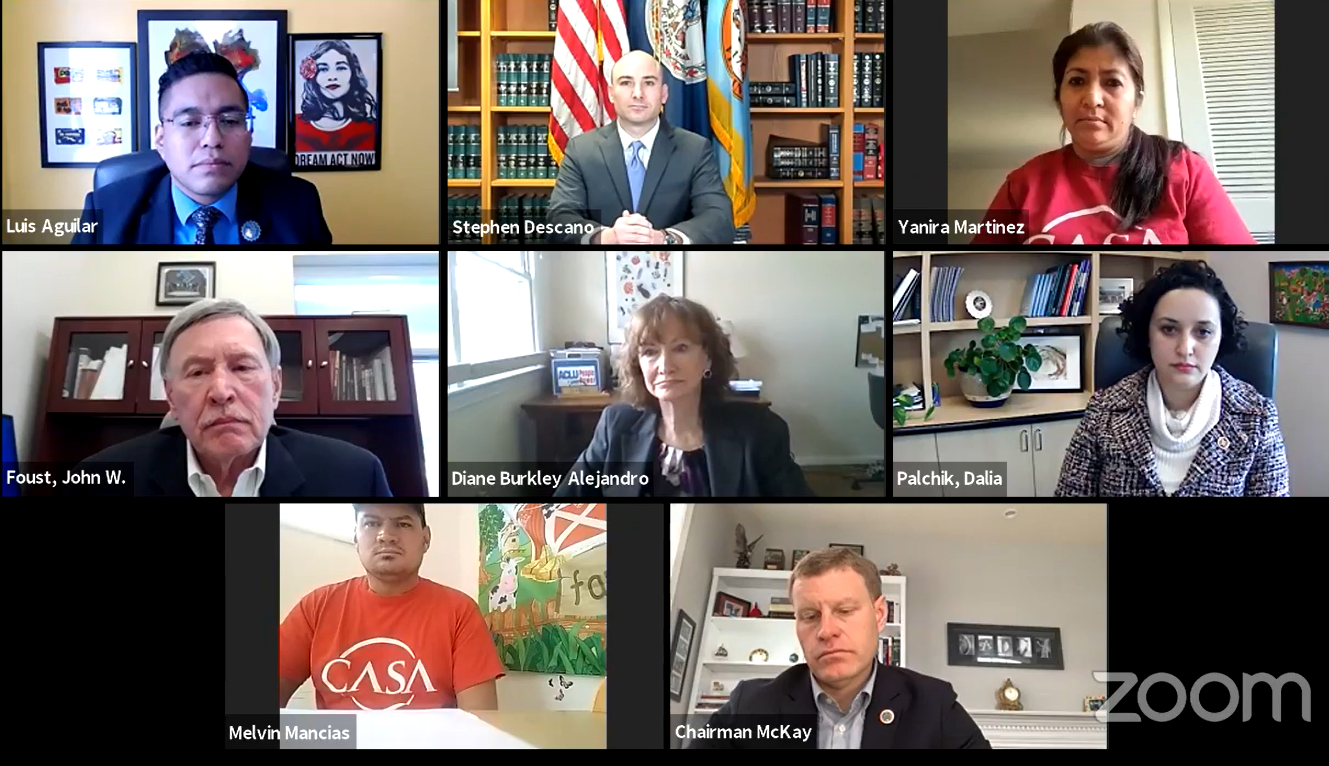
Fairfax County Board of Supervisors Chair Jeff McKay, a Democrat, celebrated a new policy Friday that will cut off all voluntary cooperation and information sharing between local government, including police, and federal immigration authorities.
“This new policy overarches all other county departments and says all county agencies will not communicate with ICE when people in our community are coming to us for services,” McKay said in a press conference simultaneously translated into Spanish. “We’re the first jurisdiction in Virginia to adopt a Trust Policy. I hope that we’re not the last.”
The county board voted 9-1 Tuesday to implement the Public Trust and Confidentiality Policy, with only Republican Supervisor Pat Herrity dissenting. It states that the county will comply with all federal and state regulations that require it to cooperate with U.S. Immigration and Customs Enforcement, but that it will otherwise restrict sharing personal information that could help enforce immigration law. This county-level policy works alongside a police order issued in May. Under that order, officers may not search any database “to satisfy any curiosity related to a person’s immigration status.”
Providence District Supervisor Dalia Palchik, the first Latina supervisor in Fairfax County and an immigrant from Argentina, said the issue was close to her heart.
“I have heard directly or seen directly in the community …about those families in need who need food, need rent assistance, need support for safety for themselves and their families, and are fearful to apply for help or to ask for assistance in fearing that their information will be shared with ICE,” she said.
Steve Descano, Commonwealth’s Attorney for Fairfax County, said he supported the policy. Speaking alongside McKay, he said he regularly hears of undocumented immigrants who do not come forward as witnesses or victims of crimes out of fear.
“It’s incumbent on us as elected leaders to address that fear and eradicate it,” he said. With this new policy, Descano addressed undocumented immigrants: “If you come to court, you will not be turned over to ICE, you will be treated fairly,” he said.
Republican Springfield District Supervisor Herrity did not respond to a request for an interview.
Mike Ginsberg, a state central committee representative for the Republican Party of Virginia and a resident of Fairfax County, said he believed county-level government should cooperate with federal authorities in enforcing all laws.
“It’s disappointing when one jurisdiction unilaterally decides not to cooperate with another in policies that benefit the community in Fairfax County at large,” he said.
Previously, Fairfax County ended some cooperation with ICE. However, Diane Burkley Alejandro, lead advocate of ACLU People Power Fairfax, said the new Fairfax policy codified some policies and represented a significant change.
“The police general orders permitted or required cooperation with ICE in some circumstances, and other agencies’ rules were silent on the subject,” she said. “Not only that, ICE is very skilled at end-running weak privacy laws such as those we have in Virginia.”
For members of the immigrant advocacy group CASA, the new policy lifted a burden of worry.
Yanira Martinez, an immigrant from El Salvador and an 11-year resident of Fairfax County, recalled her fear to report domestic violence two years ago because of her immigration status.
“I am very happy today, not only for me but for everybody, for my family, for the undocumented people,” she said. “I will not be afraid anymore in case I have to announce to the police anything that happened, because I am not going to be afraid that my information could be shared with anyone.”