Margaret Barthel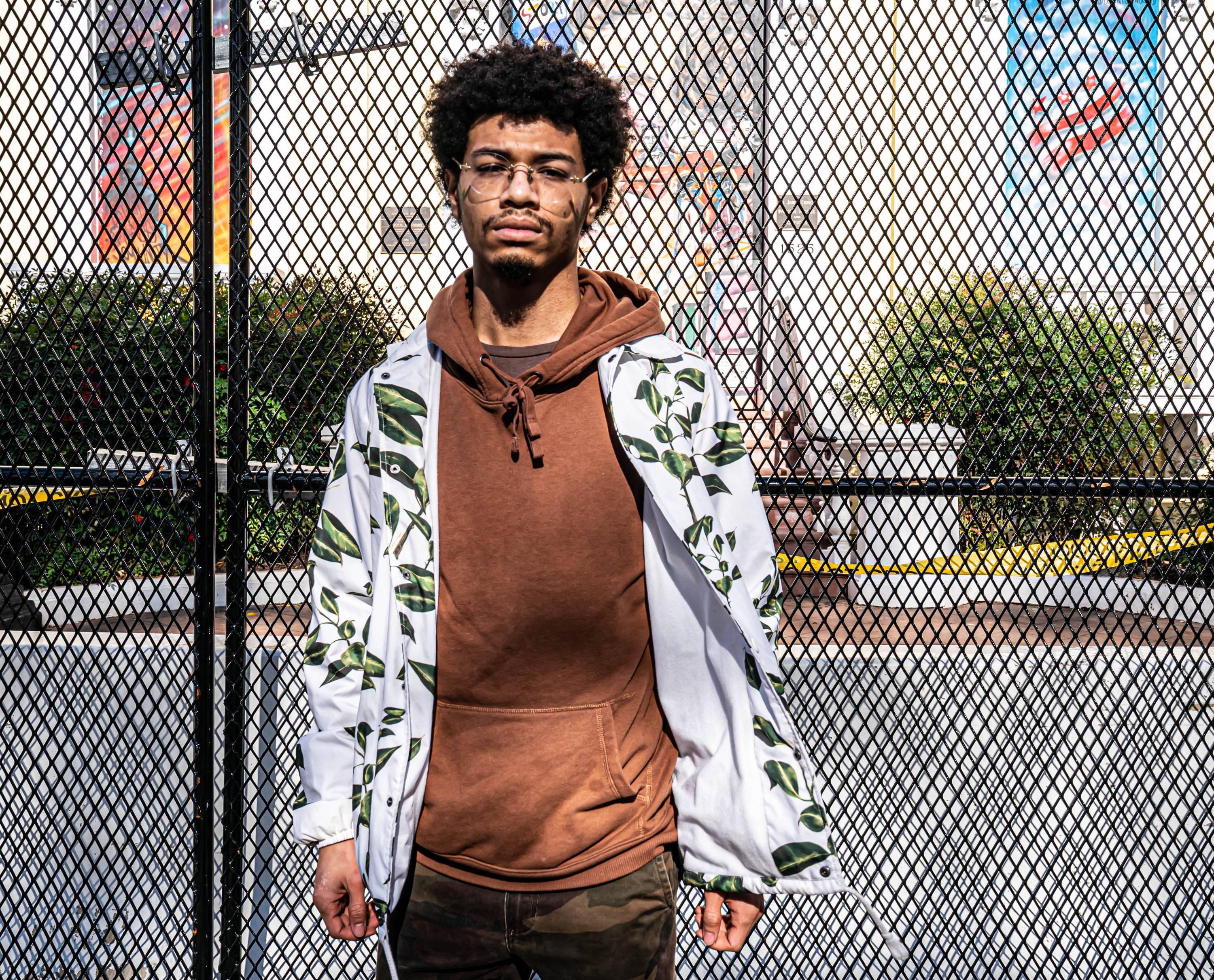
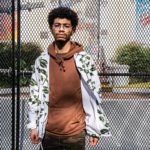
Local independent journalist and documentarian Kian Kelley-Chung was one of more than 40 people arrested by the Metropolitan Police Department at a racial justice protest in August. Officers seized his camera equipment, and he spent the night in a holding cell before being released without charges the following day. Kelley-Chung says he didn’t get his camera equipment or cell phone back from police custody for 10 weeks.
The experience took a financial and emotional toll on the 23-year-old Black journalist, who has been covering protests in D.C. over police brutality since the first week in June.
“I had never been arrested before. I had never been looked at in that way as a potential felon before,” Kelley-Chung says. “So that was all just a scary experience.”
Now, he’s suing the department, acting police chief Robert Contee III and the District for violations of the First and Fourth Amendment; his rights as a journalist under the Personal Privacy Protection Act, which protects journalists’ work product from warrantless searches; and for loss of income as a freelance journalist. Kelley-Chung is seeking compensatory and punitive damages, as well as an injunction to require the District to prevent police officers from interfering with journalists or the public recording protests.
“This case presents a disturbing example of the type of police misconduct directed at photographers that courts and the Justice Department repeatedly have condemned,” the lawsuit argues.
John Watson, a professor of media law and journalism ethics at American University, says this kind of lawsuit has become “quite common” as more people carry cell phones with cameras. (American University holds the license for WAMU, which owns DCist.)
“The courts began to recognize there was a First Amendment issue there, and the basic rights of the public to see how public employees were carrying out their public duties,” he says.
Watson says the case also raises questions about how the law defines journalists, and whether members of the press should receive special exceptions for their work.
A spokesperson for the Metropolitan Police Department said the department could not comment on pending litigation when asked about Kelley-Chung’s allegations, and further information on department policy regarding treatment of journalists.
The night of August 13
Kelley-Chung and his film partner, Andrew Jasiura, were out filming a group of protesters in Adams Morgan on Aug. 13. He was carrying two cameras and his cell phone, and his lawsuit claims both men were wearing t-shirts with the logo of their independent production company, RXNIN LIFE. The lawsuit claims they “were both known from earlier protests as members of the collective — i.e., the press — to MPD officers on the scene on August 13, 2020.”
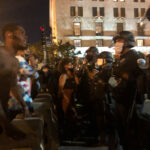
According to the lawsuit, Kelley-Chung rushed over to film a developing altercation between an MPD officer and a protester, who was pushed to the ground by the officer. Shortly after, the group of protesters was surrounded by police (a crowd control tactic known as kettling) who arrested more than 40 people. Just one was later prosecuted by the U.S. Attorney for D.C.
Kelley-Chung says he clearly explained to officers that he was a journalist filming the protests, but he was arrested and charged with felony rioting. (An independent journalist was similarly arrested and charged while covering the 2017 presidential inauguration protests.) His film partner Jasiura, who is white, was not taken into custody. Kelley-Chung believes that fact points towards racial bias in MPD’s response to the situation, a belief he says is reinforced by the police shooting of Deon Kay and the police chase that ended in Karon Hylton’s death.
“It’s really hard to look at that situation and think that racism does not have anything to do with it, when they prove that they [MPD] continue to kill Black men,” he says.
Watson agrees that the contrast between how MPD officers treated Jasiura and Kelley-Chung is especially relevant considering the context in which it occurred — a racial justice protest. He says he tells his students of color that they may face particular discrimination from authorities as working journalists.
“You will have to really emphasize that you are a journalist and have all the credentials that you think they will accept clearly visible and available,” Watson tells his students. “It’s like practicing journalism while Black. You really have to be careful because you’re not necessarily going to be treated the same as your colleagues.”
Kelley-Chung was released from police custody the following day with no charges pressed (many protesters in the D.C. racial justice movement have also been arrested overnight and “no papered” the next day). He says he spent the night in a holding cell with a maskless person and no ability to clean his hands until his repeated requests for hand sanitizer were granted.
According to the lawsuit, it took 10 weeks for Kelley-Chung, a lawyer for the National Press Photographers Association, and eventually Kelley-Chung’s own legal team to recover his cameras and cell phone. At one point, an MPD commander said the department had requested a warrant to search Kelley-Chung’s belongings from the U.S. Attorney’s Office. In October, the U.S. Attorney’s Office asked Kelley-Chung to “voluntarily turn over data” in his equipment as part of an ongoing investigation into the events of Aug. 13 and 14. Kelley-Chung refused. He received his cameras and phone back on Oct. 20.
In addition to alleging violations of Kelley-Chung’s constitutional rights to free speech and against unreasonable search and seizure of his belongings, the complaint also details violations of MPD internal policies. The lawsuit cites the department’s Video Recording General Order, which recognizes the broad First Amendment rights of people making recordings of working police officers conducting official business in public, and the department’s Media General Order, which requires officers to allow “maximum access to the scene, without disrupting Department operations” for journalists in protests and other news-gathering situations.
The lawsuit argues that neither policy was followed in Kelley-Chung’s arrest, and further accuses the District of Columbia of “displaying deliberate indifference to its citizens’ constitutional rights” in allowing MPD officers to violate the department’s own policies.
An arrest’s lasting impact
Kelley-Chung says the financial impact of the seizure of his recording equipment was significant. His complaint says he spent “several thousand dollars” to replace his cameras. He replaced his cell phone twice out of fear of surveillance. And because he didn’t recover the footage until 10 weeks after the fact, he lost out on the chance to license it to other media organizations interested in covering the Aug. 13 protest.
The emotional impacts of his arrest — and months of bearing witness to police violence at protests — endure, too.
“It’s had a massive negative impact on my mental health, whether that’s been random anxiety attacks that I’ve never really experienced before, my body just feeling a completely different way that I’ve never experienced before because of the violence that I’ve witnessed over the past couple of months,” he says.
It wasn’t a hard decision to bring the complaint, according to Kelley-Chung, who says he’s been thinking about it since the night he was arrested. He says his experience that night feels in line with the story he’s focused on as a journalist for the better part of a year — the protest movement against police brutality and for racial justice.
“We know that it’s so difficult for Black people, for people who are constantly victims of violence, of abuse and oppression, whether it’s the police or the government at large — it’s so rare that justice is ever served,” he says. “So just knowing that there’s even an opportunity to seek it out is just part of the reason largely why I wanted to open up a case.”
Kelley-Chung is one of a handful of independent journalists who have been some of the most faithful chroniclers of the new generation of local racial justice activists, who threw themselves into mutual aid and protest work in the wake of the police killings of George Floyd and Breonna Taylor.
Kelley-Chung believes journalists can bring a sense of accountability to police conduct in protest situations, as well as a sense of humanity to the people protesting.
“There are so many times throughout the summer where I witnessed either extreme, extreme levels of violence that I’ve never seen before, that I think were incredibly important to capture and hold the police and government accountable,” he says. “But there are also instances in which I’ve seen the community really come together and grow in a completely inspiring and spontaneous way that I think is also incredibly important to capture.”
That’s especially important for independent and freelance journalists, who have covered the protests and the communities that created them with more depth than many mainstream media outlets, Kelley-Chung says.
Mainstream media are “never there, or when they are there, they’re not reporting things accurately or they’re not showing any type of effort to get the true story, to talk to the people, to create relationships with the people who are actually out here doing things,” Kelley-Chung says.
Now, Kelley-Chung and Jasiura are preparing a trailer for their film, which means watching back months of footage.
“That has been a lot,” he says. “As you can imagine, it’s traumatic oftentimes to have to go back and watch a lot of these things.”
But Kelley-Chung isn’t deterred. The whole experience of covering the D.C. racial justice protests — including his own arrest — has only made him want “to work harder to make sure that my work means something, and that it has the ability to create the changes in the world that we need in order to create a better and safer society,” he says.