Elliot C. Williams
The homes along the 3300 block of Q Street NW in Georgetown are known for their history, their prices, and their bones. Human bones, that is.
Since the late 1800s, Q Street residents have stumbled upon skeletons and tombstones on their properties, sometimes deciding what to do with the remains themselves — like the man who, in 1920, uncovered nine bodies in the walls of his basement and reburied them in a nearby dirt road. Or the couple that, in the late 1950s, found a skull near their home’s foundation, put it in a white bag, and buried it in their yard.
As residents keep renovating their homes, they keep finding skeletons. Since 2005, construction workers have gone about their business digging in the earth to make space for utility rooms and pools, only to find something out of an Indiana Jones movie. Homicide detectives and investigators from the D.C. Office of the Chief Medical Examiner show up, determine it’s not a crime scene, and then call the D.C. Historic Preservation Office and Smithsonian’s anthropology department. Archeologists navigate plumbing and sift through layers of dirt and rat poison in narrow crawl spaces. They find jaws, joints, teeth, and limbs, sometimes four burials at a time, some with coffin nails and buttons from clothing.
The D.C. government is still trying to estimate the exact count, but the HPO is currently storing remains belonging to at least 28 individuals buried at Q Street in a Smithsonian lab, waiting for COVID-19 restrictions to lift so they can be fully studied. Burials have been found at 3311, 3317, 3319, 3333, and 3329 Q Street, per the HPO. Only one body has been formally analyzed and six have had preliminary analyses — all appear to be of African descent, and most seem to have been between the ages of 30 and 60.
“There are plenty others there,” says David Hunt, a forensic anthropologist and archeologist at the Smithsonian’s National Museum of Natural History, who’s often been called in to analyze bones for the D.C. government. “How many more are there, and how many are underneath and in the backyards of those houses on Q Street? It’s anybody’s guess.”
Researchers involved in trying to trace Q Street remains — a rotating cast of local archeologists and volunteers — have yet to find historic records that explicitly name the alleged burial ground or reveal clues as to who exactly might be buried there. One of the leading current theories is that the street was once the site of a Black cemetery that held both free and enslaved people.
These burials have presented residents and researchers with an important question, as the nation reels from intense scenes of racial justice protests, slur-shouting Capitol rioters, and a presidential administration that tried to rewrite Black American history: What’s the best way to study, respect, and honor Black bodies that are recovered from the earth beneath modern cities, victims of injustices that happened long ago?
It’s a story that’s been told across America — it’s a story of America: forgotten Black gravesites rediscovered under Florida parking lots; 600 unmarked graves found near Clemson University’s football stadium in South Carolina; hundreds found in the former “colored section” of a North Carolina graveyard; the remains of 419 African Americans found in Lower Manhattan; the president of University of Richmond confirming that the campus was likely built over a graveyard for enslaved people.
In the D.C. region, at least five Black burial grounds have been moved or bulldozed to make way for commercial development. There’s the Mount Pleasant Plains Cemetery, once the largest African American burial ground in the city, now a park in Adams Morgan. There’s the Columbian Harmony Cemetery, the city’s busiest Black cemetery for about four decades, which eventually became the Rhode Island Avenue Metro Station. The historic site of the Moses Cemetery in Bethesda was paved over to make room for a parking lot and has been in developers’ crosshairs for years. A Virginia pastor brought attention to a forgotten cemetery for the enslaved on a former plantation in Loudoun County, in part, by burying her son at the site last summer.
At Q Street, residents say they want to know more about the people buried beneath their homes. But they’ve largely been left in the dark about the progress of any excavations and research.
Some of the bodies have sat for years without analysis or a final decision on where they belong. The remains of a teenage girl found in 2005, for example, stayed under the supervision of the medical examiner’s office until 2017, when they were archived for research and curation at the National Museum of Health and Medicine, a quirky museum full of body parts in Silver Spring.
D.C. real estate agent Diana Minshall came home one day in 2012 to police officers swarming the house next door. Her neighbors, she soon learned, had unknowingly disinterred a human body while digging a pool in the backyard of their Q Street townhouse.
“They didn’t even remove the whole body. They only removed half of it and left the other half in my yard,” says Minshall, who lives at 3327 Q Street NW in Georgetown.
Ruth Trocolli, the city’s official archeologist with the HPO (which was in charge of the removal) says that it would have been unsafe to dig up the full burial since it spanned two lots with decades worth of landscaping and construction to consider.
Minshall has questions, though: Who was buried there, who are their descendants, and will the city do anything to reinter or otherwise memorialize the body?
She also has plans. “I’d also love to build a pool one day,” she says. “What’s the protocol if you know that you’ve already got half a body in your yard?”
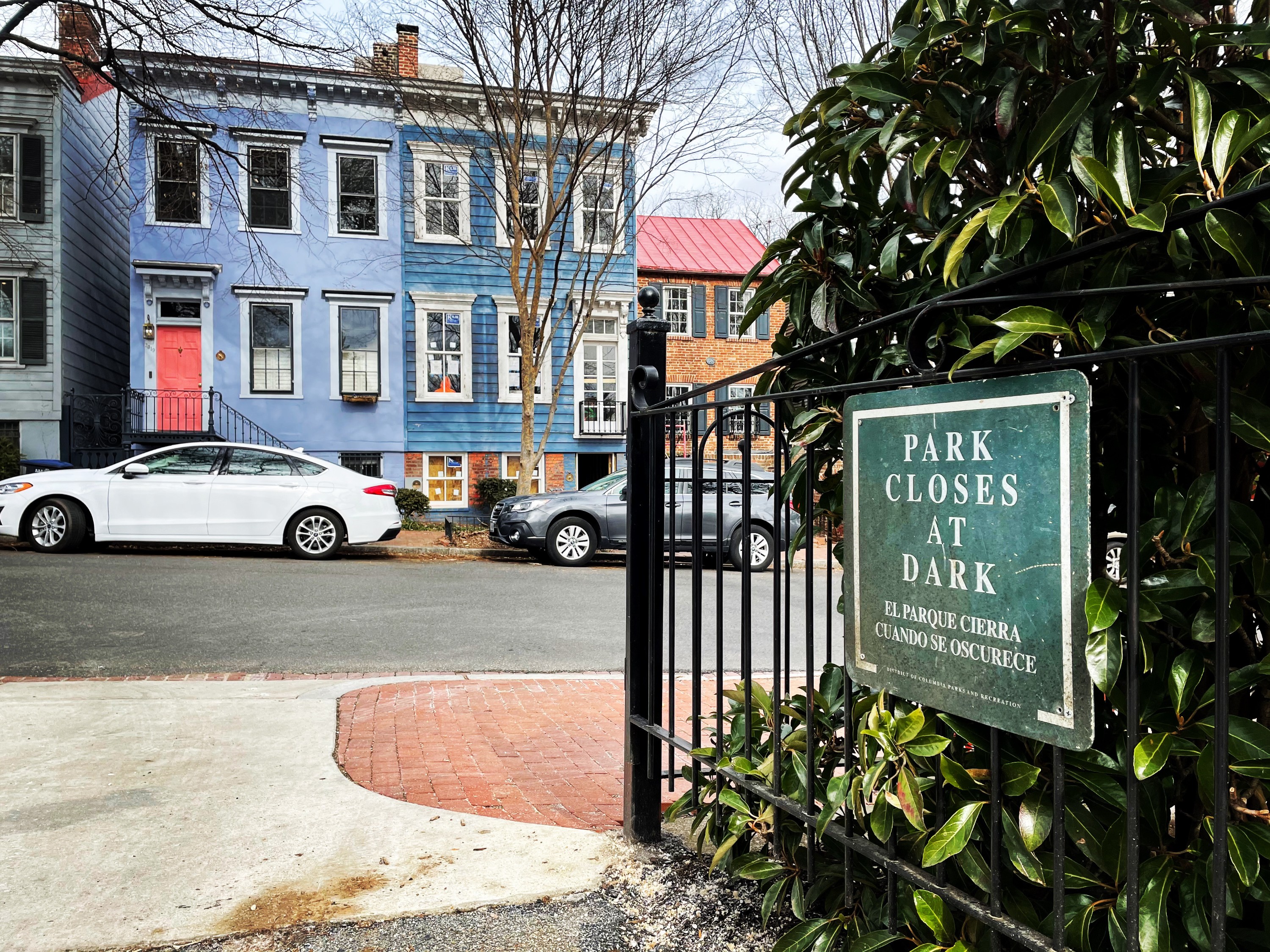
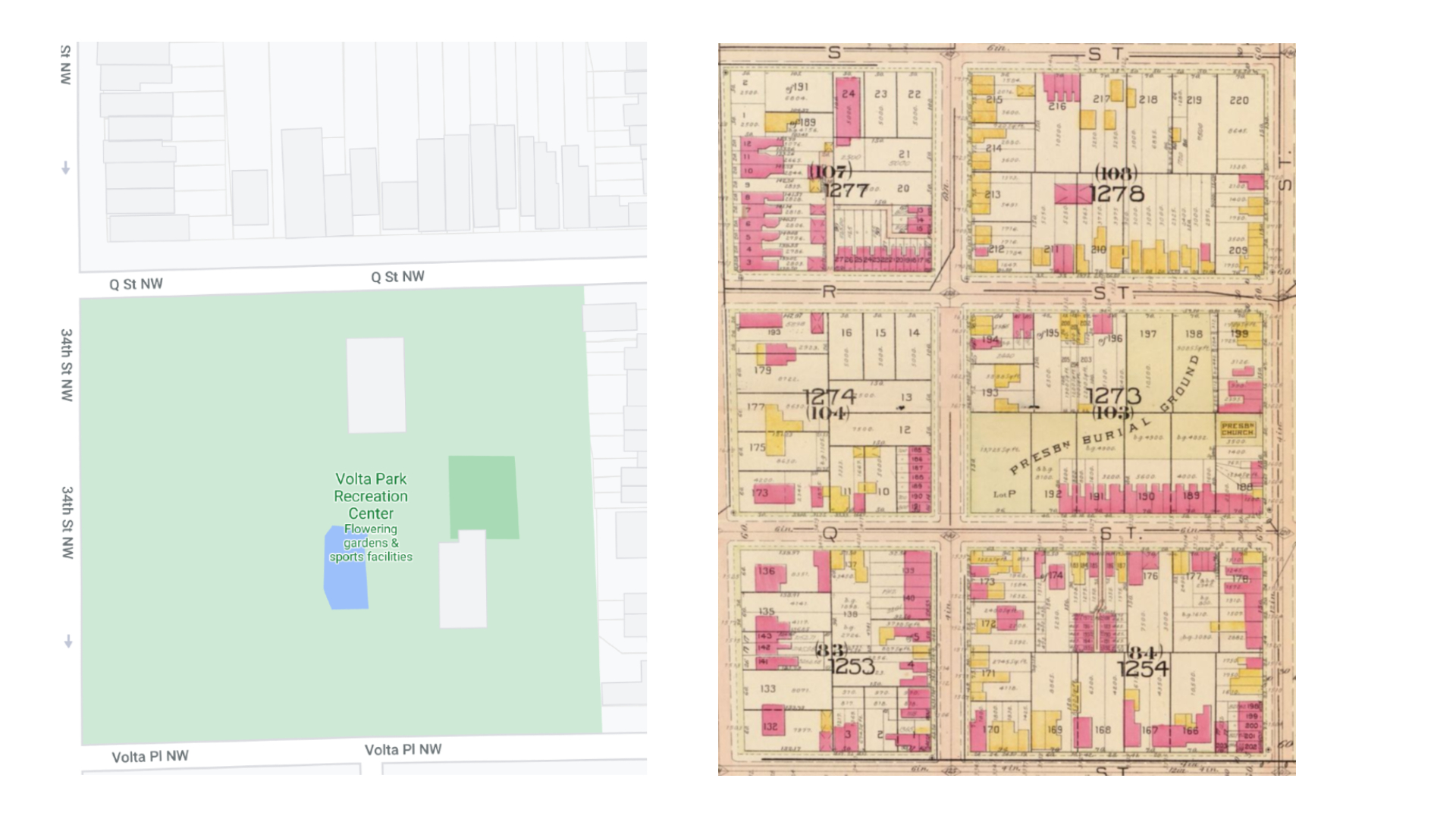
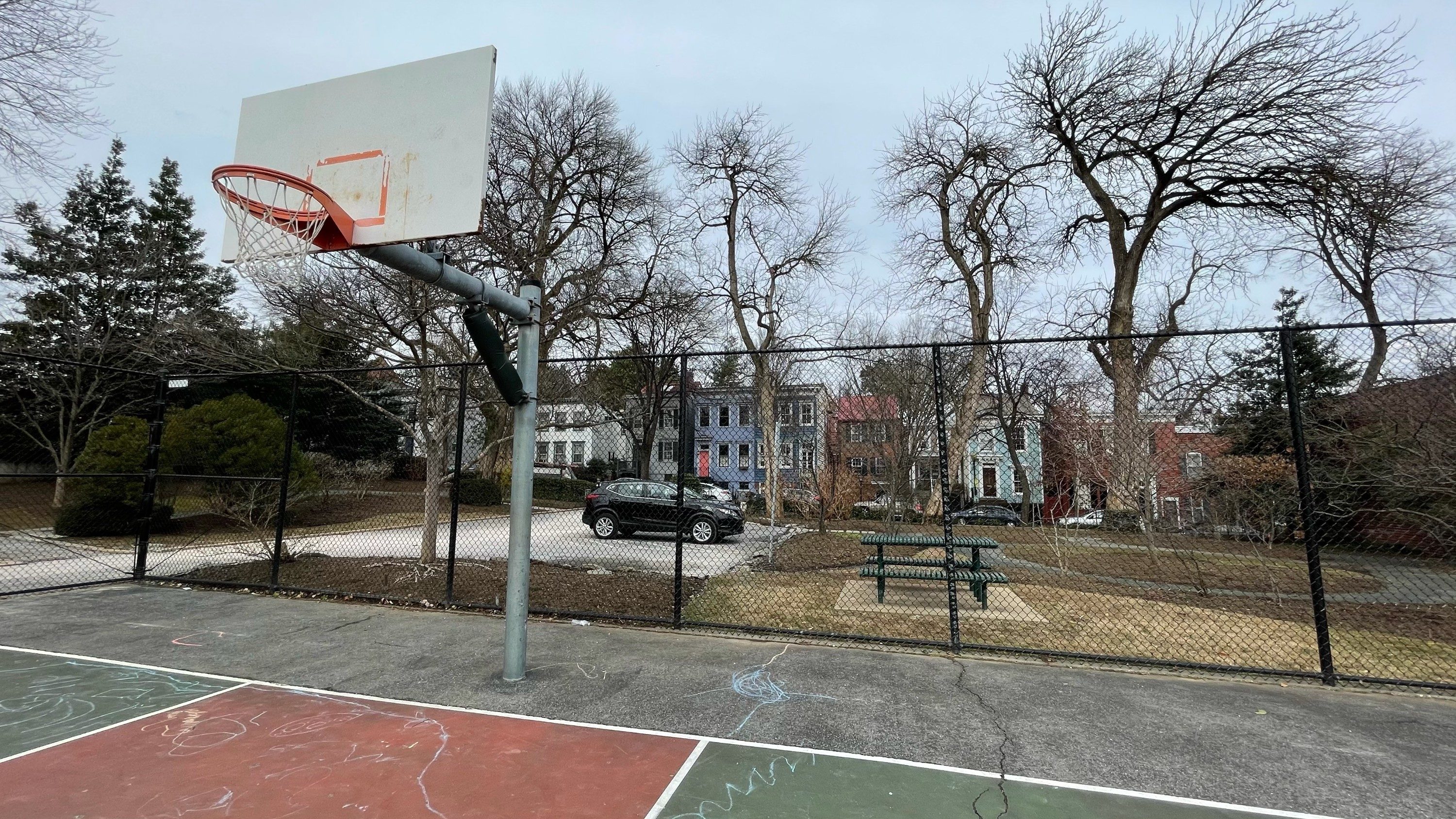
Many theories exist over why so many bodies are buried on the 3300 block of Q Street. One suggests that the site was once a cemetery for Black Georgetown residents, both free and enslaved. It’s possible that the burial ground was segregated from the nearby cemetery for white members of a Presbyterian Church that’s no longer there, or carved out of a double lot left vacant by the Church of England following the Revolutionary War. By 1900, the Old Presbyterian Burial Ground was mostly abandoned and children played along the tombstones as if the site were a playground. (It’s now the site of Volta Park, a slice of recreational heaven with a pool, a jungle gym, and tennis courts.)
Georgia Ravitz, who’s lived at 3319 Q Street since 1998, says that according to land records, the first owner of her home was noted with a “C,” for “colored.” Historian C.R. Gibbs speculated in a 2005 Washington Post article that the bodies might have been buried under the owners’ homes in accordance with some West African traditions, though no such burials had been previously found in D.C.
Ravitz says the bodies could be evidence that the Underground Railroad ran through Georgetown, given its proximity to nearby slave trading hubs and the Potomac River, and all that is known (and unknown) about the Underground Railroad in the Washington region. “If we’re talking about such a significant number [of remains] here, is it possible that people were being hidden somewhere for safety?” she asks.
“We need to know more about the individuals,” says Ruth Trocolli, who’s been the D.C. government’s official archeologist since 2007. “If we want to rebury them somewhere, we need to know who they are … and figure out the appropriate way to rebury them, memorialize them, or tell their story.”
With each discovery, local media and some residents get worked into a frenzy about the possibility that the remains could belong to one famous Georgetown resident: Yarrow Mamout, an African Muslim and former enslaved man-turned entrepreneur, who owned a house just around the block from Q Street at 3324 Dent Place NW. Mamout was buried “in the corner of his garden,” according to an obituary written by the famous American painter Charles Willson Peale, who painted a portrait of Mamout. It’s a passage that has led many people to search for his remains in the nearby land.
With the homeowner’s permission, the D.C. Office of Planning launched the Yarrow Mamout Archeology Project in 2015 on Mamout’s former property. (So far, none of the remains found in the area are old enough to belong to him.)
James Johnston, a D.C. lawyer and writer, is the author of a book about Mamout and has been poring over records, photos, and reports on the burials for years, dedicated to the mission of solidifying Q Street as hallowed ground.
“I’m now pretty convinced it was a Black cemetery, and that’s big news from a racial justice standpoint,” he says. “If it turns out some of these bodies are white, then my whole theory goes out the window.”
Making matters more complicated, burial records are scattered and hard to find since Georgetown was part of Maryland before being incorporated into the District.
“Q Street is unusual in so many ways,” Trocolli says. “It’s a many-stranded rope that’s going to take a lot of people to research and come up with guidelines. How are we going to address these? What do we do about the ones that are already gone?”
Even though the pandemic has put a hold on the excavations and research, there’s hope more information will be available soon.
Delande Justinvil, a biocultural anthropologist and PhD candidate at American University, is making Q Street the subject of his dissertation. (Disclosure: AU holds the license for DCist’s parent company, WAMU.)
Justinvil says he wouldn’t be surprised if his research confirms a combination of multiple theories — that this was a gravesite for both free and enslaved Black residents, as well as a place where the city dumped victims of the cholera pandemic of 1832. Similar to the COVID-19 pandemic, the first ones to die of cholera were the marginalized: those without reliable access to food, healthcare, and secure working conditions. Canal workers who died during the pandemic were buried in Georgetown “without regard to the location,” according to an Evening Star clipping from 1902.
“I think this site — whether or not it’s an African American cemetery, a cholera cemetery, or both — I think it’s only the starting point for this network of thinking of the Black geography of Georgetown,” Justinvil says.
Local historians have already created the Georgetown African American Historical Landmark Project, a tour of historic locations around Georgetown. 30 years ago, a trio of scholars published Black Georgetown Remembered, a well-researched book about two centuries of Black history in the vibrant neighborhood.
But locally and nationally, interest in African American historical sites has spiked in the wake of George Floyd’s killing.
In the midst of the racial unrest of 2020, Congress introduced the African-American Burial Grounds Network Act and the African-American Burial Grounds Study Act, twin legislation that would set up a nationwide network of African American burial grounds. The bills would direct the National Park Service to study and preserve these sites before they are lost to time, decay, or development. (The study act was passed by the Senate in December but is still up for consideration in the House.)
Once passed, Justinvil hopes Georgetown’s historic gravesites can be included in that network.
Justinvil and the HPO agreed that he will have three years to complete the research, with the potential for an extension. He says he has no plans of slowing down, once pandemic restrictions are lifted.
The researchers are even studying the diaries of local residents who were quarantined during the cholera pandemic — treading what is likely to be more familiar territory than Justinvil originally anticipated.
“It may have taken a long time for this project to come up and for everyone to get on board, but, oh my goodness,” says Trocolli, “its time has come.”