Martin Austermuhle
In pre-pandemic times, Steven Weinstein was like hundreds of thousands of other Washington-area commuters. Every weekday, he went from his home in Centreville, Virginia, to his office at 16th and L streets in downtown D.C. He left the office a few times during the day for a cup of coffee or lunch.
All that ended last March, when the COVID-19 pandemic shuttered most offices and left Weinstein to work from home. His company offered workers the chance to come back in the summer; not many did. By the end of the year, he says, the company decided not to renew its lease.
“I think the plan is to have everyone start coming back in around June or July, but lease a smaller office and then have people come into work, you know, twice a week, something like that,” says Weinstein, 25.
In other cases, office workers are already hearing that their employers are deciding to abandon their offices altogether, turning telework from a temporary solution to a permanent fixture.
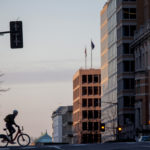
There’s little question the pandemic has scrambled Washington working culture in a significant way. Legions of office workers are toiling from home, leaving Metro and the city’s many office buildings eerily empty. Now D.C. officials, building owners and businesses are now starting to confront a startling new question: what if many of those workers never come back?
It’s almost an existential question, given how many workers flooded into D.C. every day before the pandemic hit. According to an analysis from the U.S. Census, D.C.’s daily population swelled by 87% because of commuters, more than any other city in the country — and double the list’s second-place finisher (Boston). More than 250,000 commuters came in from Montgomery and Prince George’s counties alone; Fairfax County contributed another 100,000 per day.
Many of those commuters worked at non-profit organizations, advocacy groups, law firms, and other businesses that occupied office space throughout the city; those buildings — notably the newer ones — are a valuable source of property tax revenue for D.C. coffers. Commuters’ daily spending on lunch and lattes ($127 a week, on average) sustained many businesses, all of which collected sales taxes that were also remitted to the city.
“They’re critical for the economic infrastructure of downtown D.C. and the city as a whole,” says Neil Albert, a former D.C. deputy mayor and current president of the Downtown D.C. Business Improvement District, which swelled by almost 200,000 people on a daily basis pre-COVID. “The office workers drive the transportation ecosystem, they drive the retail and restaurant ecosystem.”
According to D.C. Chief Financial Officer Jeffrey DeWitt, prior to the pandemic some 7% of workers with a job in the city worked from home. After the pandemic passes, DeWitt estimates that number might jump to 20%. A survey of employers conducted last fall by the Metropolitan Washington Council of Governments found that 57% of respondents said they would consider keeping their current levels of telework — or at least expand the use of telework they had before the pandemic struck.
A survey of regional employers conducted by the Greater Washington Partnership in November and December similarly found that while many businesses and organizations expect full-time telework to decrease significantly after the pandemic, they expect part-time telework — working from home one or two days a week — to jump. About 8% of employees teleworked part-time before the pandemic. The survey estimates that number will hold at 56% after it passes. And employers reported that the likelihood of increased telework is higher for offices in D.C. than in Maryland or Virginia.
If any of these scenarios come to pass, it could well complicate D.C.’s post-pandemic recovery, says DeWitt. “There will be less day-to-day activities that generate sales tax to the District, and those [office] buildings will be generating less net operating revenue,” he says. That will translate into lower assessments and property tax revenue.
On the sales tax side, D.C. has seen a 45% decline since March 2020. Tax revenue from commercial buildings makes up two-thirds of all property tax revenue in the city, and DeWitt says he was seeing consistent 3-5% growth from commercial buildings every year. By next year, though, he expects a decrease. Some parts of the city could see double-digit drops in property value and revenue.
“There’s no question that how you value property is going to be impacted in the near term,” he says.
The D.C. Policy Center, which is run by Yesim Taylor, a former staffer in the CFO’s office, summarized the risk to D.C. as follows in its 2020 State of Business Report: “If worker location ceases to be important, then, when recovery begins, business location will also matter less in attracting a talented workforce.”
In short, as workers have gotten used to being at home, many of their employers may decide it’s best to just keep them there.
‘It will take time to rebound’
But it’s not all doom and gloom for D.C. — at least not yet.
DeWitt says there are variables that could spare the city from the worst. First, not all business and organizations are bailing on their existing office space, largely because many longer-term leases may not expire for a few years. The survey from the Greater Washington Partnership similarly found that while 13% of employers were looking to shrink their square footage, 75% currently have no plans to do so.
“We’re all struggling with how much teleworking is going to exist by these businesses. Are they going to ask for smaller spaces? Are they going to ask for more space because they’re worried about the next variant of the COVID coming up? So do they want bigger spaces or lesser spaces? All these things are being discussed across the country as to what does the future of space look like,” DeWitt says.
Eric Jones, a vice-president for government affairs at the Apartment and Office Building Association of Metropolitan Washington, says the property owners he speaks to on a daily basis know a rocky future awaits them. But if the vaccine rollout picks up and more kids return to school in the fall, many office workers may look forward to getting out of their houses again.
“I think you’re going to see a lot of folks coming back because a lot of folks have been cooped up in the house for the last year,” he says.
Albert says the reason D.C. became a destination for employers to begin with won’t change, and could still remain a selling point in the future.
“I think post-COVID people are still going to want to take public transportation to and from their work, to their entertainment; the proximity to the seat of power,” he says. “So there are a number of characteristics about D.C. that make it a desirable place to be. It will take time, however, to rebound.”
‘More people should be living downtown’
Even if that rebound takes a while, some experts say a reckoning was already coming for downtowns across the U.S., and the pandemic has merely sped that process along — and could spur a much-needed transformation.
“A lot of office space was functionally obsolete and something was going to have to happen with it, even if increased telework and the pandemic hadn’t happened. So we were going to have to figure out this problem no matter what,” says Tracy Hadden Loh, a scholar at the Brookings Institution who focuses on commercial real estate trends.
On the bright side, Loh says office work continues to grow. “There’s no reason to think the knowledge economy is going to stop growing. The new jobs that we’re creating in our economy are disproportionately office space jobs,” she says.
But on the other hand, employers are looking for smaller and more flexible office space. And the old office buildings that were already getting hard to rent out could be repurposed for other uses. “In D.C. and a variety of other markets, one kind of conversion that we’re seeing is old office buildings being turned into residential,” she says.
That trend was on the rise before COVID hit. Still, not every office building can easily become a residential building; a 2019 report from a D.C. task force said such conversions — especially to affordable housing — would be tricky in the downtown core. Loh says it’s clear that some projects will need government assistance in the form of loans or tax breaks to make them worth doing. And even those that succeed will produce less property tax revenue than a traditional office building. But she says it’s still worth doing.
“The future is for downtown to become a neighborhood,” she says. “It will be it will still be a neighborhood that is far more dominated by commercial uses. But absolutely, yes, more people should be living downtown. It will be good for the city.”
Albert agrees. “There’s an ability to create a more vibrant downtown, a more vibrant city, if there are people living and working there 24-7,” he says.
In the short-term, the reality is still bleak: Without hundreds of thousands of office workers coursing into D.C. on a daily basis, many commercial property owners and businesses will feel the pain. Buildings will become worth less; deed taxes have already decreased 20% over the last year, partially because of a lower number of sales of large office buildings. Hotel stays and restaurant sales have dropped massively since last year, and some in the industry assume that upwards of 20% of bars and restaurants may not survive the pandemic. And all of that means a slower recovery for D.C. after the pandemic passes; the city’s revenue stream isn’t expected to stabilize until 2024 or 2025.
Still, DeWitt remains bullish about D.C.’s future, largely because of what has happened in the past.
“After the Black Plague was the Renaissance, and people came back to the cities,” he says. “And then after the 1918 pandemic, the Roaring ’20s started. There’s this sort of human history that cities always recover. Not immediately, but sometimes better.”